Last updated: May 2026
The end of the $800 de minimis threshold fundamentally changed cross-border Ecommerce in 2025. Every shipment entering the US now requires full documentation, and every unit triggers duty. Many brands quickly shifted their tariff strategy, but one part of the import system remained exactly the same.
Valuation rules did not change.
This number shapes your total duty bill, margin, cash flow, and forecasting accuracy. When customs valuation is correct, your landed costs stay predictable. When it is wrong, brands face unnecessary duty charges, shipment delays, and potential audits.
This guide breaks down how customs valuation works today and how Ecommerce brands can stay accurate as they scale.
What is the rule that governs customs value?
The primary method is transaction value, but CBP applies six methods in a strict hierarchy. If transaction value cannot be used, for example when the buyer and seller are related and pricing is not at arm's length, or when no qualifying sale for export exists, CBP moves down the list in order. The full sequence under 19 CFR Part 152, Subpart E is:
- Transaction value of the imported merchandise
- Transaction value of identical merchandise
- Transaction value of similar merchandise
- Deductive value (resale price in the US, working backward)
- Computed value (production cost plus profit and general expenses)
- Fallback method (a reasonable adjustment of the above)
For most DTC brands buying directly from a factory in China or Vietnam, method one applies cleanly. You pay the factory, you import the goods, you are the importer of record. That price is your declared value.
What customs includes and excludes
Most valuation questions fall into a few clear buckets.
Customs value includes:
- The factory invoice price
- Packing materials and cartons included before export
- Design work, artwork, molds, or other materials supplied to the factory free or at reduced cost
- Royalties or license fees tied to production
- Selling commissions paid by the buyer
Customs value excludes:
- International freight (if separately stated)
- Insurance (if separately stated)
- Duties and taxes
- US inland freight
- Fulfillment labor done in North America
- Marketing inserts or materials added after import
To keep duty low and correct, invoices should clearly separate freight and insurance. If they are blended into the unit cost, customs may include them.
Two simple, universal examples
These apply broadly across lightweight products sourced from Asia, whether you sell accessories, home goods, beauty, electronics accessories, or multi-component consumer goods.
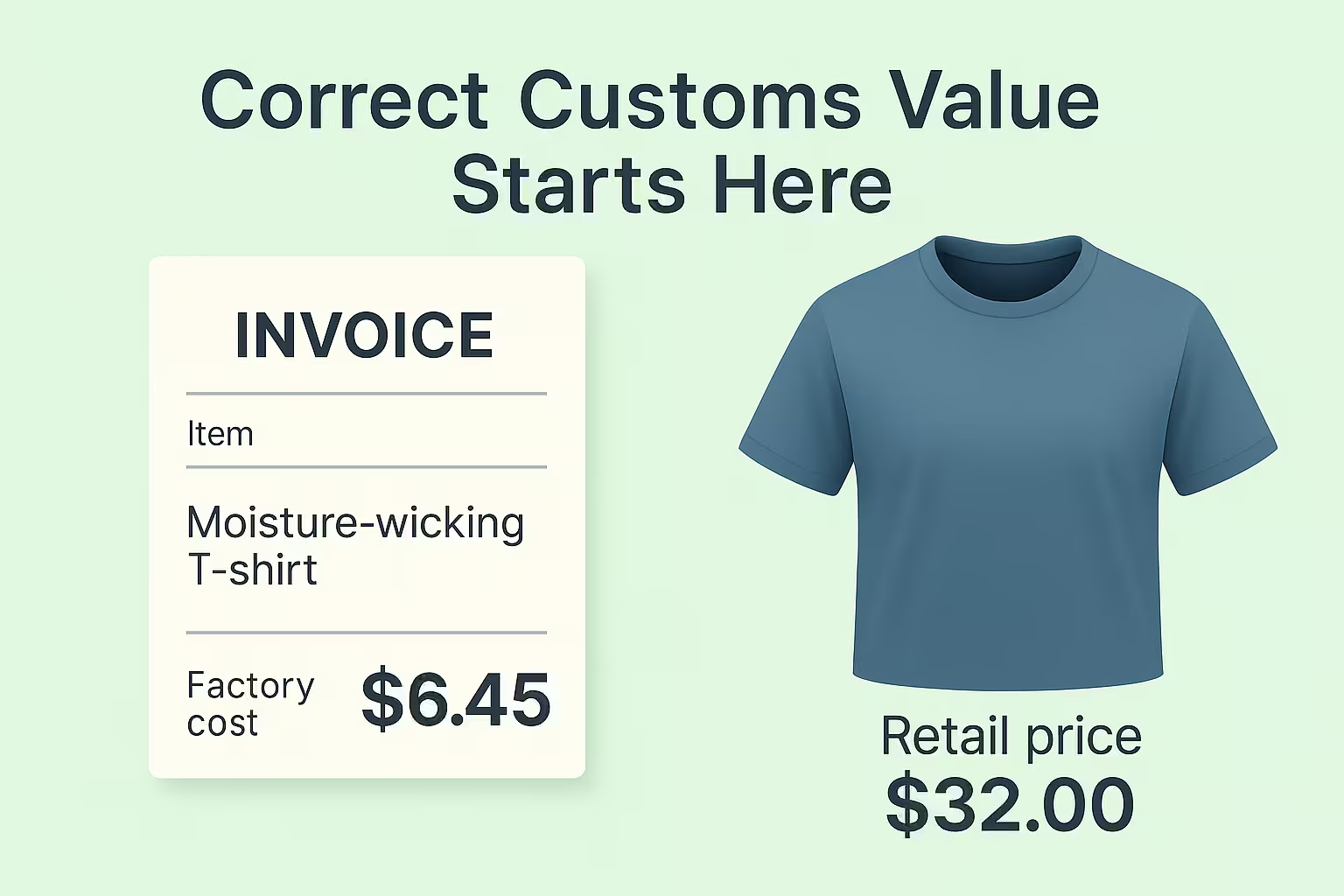
Example 1: A standard consumer product
- Factory cost: $6.20
- Retail price: $32.00
- Packaging included in the factory invoice: $0.25
Declared customs value: $6.45
Duty is calculated only on this amount, not the retail price.
Example 2: A multi-component product assembled in Asia
- Factory invoice: $4.80
- Design file or artwork supplied by your team for free, valued at $200 allocated across 2,000 units
- Assist per unit: $0.10
Declared customs value: $4.90
Assist value must be reasonably allocated across the units produced.
These examples reflect how most lightweight consumer products are valued under US law.
The most expensive mistake: declaring retail price
Some brands declare the customer-facing price or the Shopify order value, which significantly increases duty.
Example:
Retail declared: $29.99 Duty at 8%: $2.40 Factory declared: $3.90 Duty at 8%: $0.31
That is a 674% overpayment.
Customs expects your declared value to match your factory cost and documentation. Retail price has no role in valuation and creates financial risk.
With the ability to look up retail prices online in seconds, Customs can easily identify values that seem abnormally low or suspiciously high. Companies caught undervaluing goods may face penalties under the False Claims Act, which can include treble damages (up to three times the duties owed) plus civil penalties per violation that are adjusted annually for inflation. As of 2024, per-violation penalties range from roughly $13,946 to $27,894. Beyond financial penalties, violations may trigger audits, shipment delays, and reputational damage.
There is a clear line between mitigating duties and evading them. Optimizing country of origin, valuation within the rules, and duty timing is mitigation. Understating your FOB supplier price or obscuring true costs is evasion and creates legal risk.
How to know your customs valuation is correct
Check for these points before every shipment:
- The declared value matches your factory invoice.
- Payment records align with the invoice.
- Freight and insurance are separated.
- Any assists are included when required.
- Multi-component or bundled products are described clearly.
- Product descriptions match the HTS code.
- Documents show the sale was for export to the US.
These simple checks prevent nearly all valuation issues.
When customs challenges your declared value
Customs may increase your declared value if:
- The declared price is significantly lower than industry norms
- Invoices do not match payment records
- Product descriptions are vague
- Assists are not disclosed
- Bundled products are not itemized
- The buyer and seller are related without proof of arm's length pricing
If this happens, customs may assign a higher value or request additional documentation. This can lead to delays, penalties, or shipment holds.
How does country of origin affect customs valuation and duty costs?
Country of origin significantly influences your total duty exposure.
Example:
FOB supplier price: $7.00
China origin (apparel example):
- Base HTS duty: 16%
- Section 301 tariff: 25%
- IEEPA reciprocal tariff: additional layer that varies by executive order
- Total effective duty for many China-origin apparel SKUs now exceeds 50% to 70% once all layers stack. Exact rate depends on the HTS classification and which executive orders are active at time of entry.
Vietnam origin:
Vietnam-origin goods face their standard MFN duty rate plus any active reciprocal tariff set by the most recent executive order. Rates have moved repeatedly through 2025 and depend on the HTS code, the ongoing USTR review, and whether the goods are deemed transshipped. Check the current rate against your HTS code in the USITC HTS database before reordering.
Same product, same cost, different duty outcome.
This is why many brands are exploring alternative sourcing regions and rethinking how to build a tariff-resilient Ecommerce supply chain. For a deeper breakdown, see our analysis on China Plus One strategy.
Where does First Sale fit into customs valuation?
The First Sale rule lets you base dutiable value on an earlier sale in a multi-tier supply chain, typically the price the factory charges a trading company or middleman, rather than the higher price the middleman charges you. The rule comes from Nissho Iwai American Corp. v. United States (1992), which built on the earlier E.C. McAfee decision.
To qualify, you need:
- Two documented bona fide sales (factory to middleman, middleman to you)
- Arm's length pricing at each stage
- Clear evidence the goods were destined for export to the US at the time of the first sale
- Full documentation of both transactions
Typical savings run 10% to 20% of dutiable value. The overhead — legal review, supplier cooperation, audit-ready records — generally only pencils out if you're buying $1M+ annually from a single factory through a middleman structure.
For DTC brands buying direct from the factory, First Sale is not available. There is only one sale. Standard transaction value is the right method, and it's already the lower of the two prices in the chain. For a deeper breakdown, read how Ecommerce brands can use First Sale to defer tariffs.
Valuation and forecasting go hand in hand
Correct valuation affects:
- SKU-level landed cost
- Gross margin
- Reorder timing
- Inventory turnover
- Pricing decisions
- Contribution margin
- Forecasting accuracy
- Overall working capital
Even small errors distort financial models and reduce clarity for operators.
Duty timing: the shift most brands underestimated
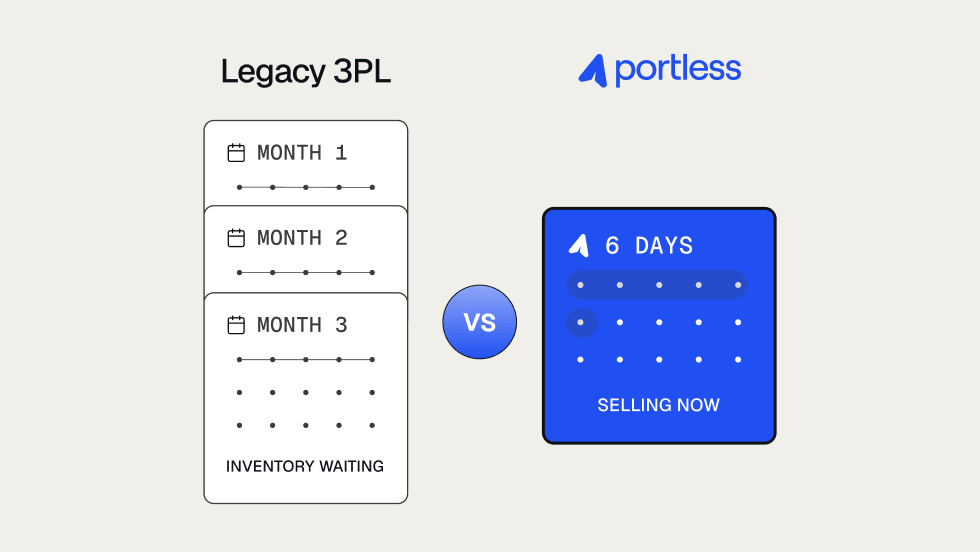
After the end of the $800 de minimis threshold, brands began paying duty on every shipment. This changed the cash flow equation more than the duty rate itself. This is the structural cost of the legacy model: bulk ocean freight into a domestic 3PL warehouse, with duty assessed at the point of import before any unit has sold.
Legacy importing:
- Duty paid on bulk imports
- Paid months before the product sells
- Duty paid on unsold units
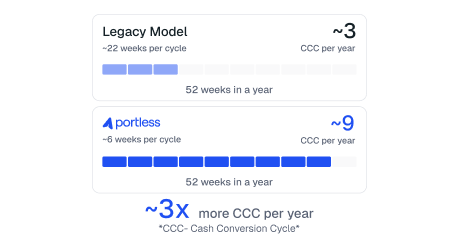
- Cash conversion cycle often 120 to 180 days
Per order importing:
- Duty paid only after a customer buys
- No duty on unsold units
- Cash conversion cycle compresses to a matter of days. Foreign Resource, a streetwear brand on Portless, moved from a 21-day production-to-shipping window to two days and now operates with a near-negative cash conversion cycle. Read the full Foreign Resource case study.
- Eliminates warehouse carrying risk
Case study: &Collar went from 5% to 100% in-stock during peak season
&Collar, a DTC menswear brand doing $10M+ annually, was at 5% in-stock on their hero SKU heading into Father's Day 2023, their second-biggest sales event. The inventory was still being produced in China, and legacy ocean freight wouldn't make it in time. Air freighting 50,000 units would have gutted their margins.
They onboarded to Portless in 30 days, rerouted 40,000 units through direct fulfillment, and went from 5% to 100% in-stock. Duty was paid per order as customers bought, not upfront on the full container. They closed the season with 35% year-over-year revenue growth instead of the projected 30% to 40% decline.
"Portless legitimately saved our year that year. If we ended 40% down YoY on Father's Day, that would've ruined the rest of our year." — Mark Brown, Founder at &Collar
Read the full &Collar case study.
Duty timing is now one of the most important variables in unit economics. For a deeper breakdown of timing vs rates, see Duty Timing vs Duty Rates.
What operators should review regularly
Weekly:
- Invoice accuracy
- Payment alignment with invoices
- Product descriptions match HTS codes
- Freight separation on all invoices
Monthly:
- Landed cost by SKU
- Duty exposure by country of origin
- Changes in factory pricing
- Documentation consistency across shipments
These small reviews keep duty predictable as your volume grows.
Where to monitor US tariff and customs policy changes
Trade policy moves on a rolling basis, not an annual one. Build a monitoring habit around four primary sources:
Signals that something is coming: USTR opens a comment period, CBP issues a clarification CSMS, or the White House publishes a fact sheet on trade. Changes are rarely a surprise to operators who watch these channels weekly.
The bottom line
❌ You do not need to overpay duty.
❌ You do not need to guess how valuation works.
✅ Transaction value is simple when documented correctly.
✅ Accurate valuation protects your margins.
✅ Correct timing protects your cash flow.
✅ A clean import model protects your operations from delays and risk.
Run the numbers with the direct fulfillment ROI calculator or learn more about direct fulfillment.
Align duty with actual sales
Accurate customs valuation protects your margin, but it only solves half the problem. If you want to eliminate duty on unsold units, compress your cash conversion cycle, and modernize cross-border operations, this is the exact fulfillment model Portless runs. The fastest way to see what that looks like for your SKUs is to speak with our team.
FAQ
Do I pay duty on shipping?
No, if freight and insurance are separated on the invoice. International freight is excluded from dutiable value when separately stated.
Can I declare retail price?
No. You must declare the transaction value of the sale for export, which is typically your FOB China supplier price if you are the importer of record. The customer's checkout price is not used for customs valuation.
What if the invoice is in RMB?
Use the certified Federal Reserve exchange rate for the export date and document which rate you used.
How do I find my product's HTS code?
Use the Harmonized Tariff Schedule search tool. For complex items, consider working with a licensed customs broker.
What if I made a mistake?
Minor issues can often be corrected through a post entry adjustment. Repeated issues may trigger closer inspection or audit. US Customs expects importers to exercise "reasonable care".
What is customs valuation?
Customs valuation is the procedure US Customs and Border Protection uses to determine the value of imported goods for calculating duty. The primary method under 19 U.S.C. § 1401a is transaction value: the price actually paid or payable to the seller for the goods when sold for export to the US, plus specific additions.
What is transaction value in customs?
Transaction value is the price paid or payable by the buyer to the seller for goods sold for export to the United States, plus packing costs, assists, royalties, and selling commissions. It is the preferred valuation method under US law and the WTO Customs Valuation Agreement.
How is customs value calculated for Ecommerce shipments?
Customs value equals the factory invoice price plus any required additions (packing, assists, royalties, selling commissions), minus separately stated freight, insurance, and US inland transport. Retail price, Shopify checkout value, and customer-paid totals are not used.
What are the six methods of customs valuation?
CBP applies valuation methods in this order: (1) transaction value of the imported merchandise, (2) transaction value of identical merchandise, (3) transaction value of similar merchandise, (4) deductive value, (5) computed value, and (6) the fallback method. Most DTC brands use method one.







.jpg)