Last updated: May 2026
Revenue is up. Order volume is up. You have more data than ever. Yet your fulfillment setup feels more fragile, not less.
That is not founder anxiety. It is how decisions about inventory, timing, and partners interact once you move past scrappy early stage into a few million in annual revenue across your Ecommerce supply chain.
This post explains why that risk shows up, which choices are actually hard to undo, and what to consider before you talk to any logistics partner.
Why fulfillment risk increases as you scale
On paper, scale should make you feel safer. More cash in the bank, better negotiated rates, and more predictable volume.
In reality, risk often feels higher.
Once your annual revenue hits the million dollar range, you sit in an awkward middle. Mistakes hurt your bottom line. You still lack deep buffers. And you start making structural decisions that do not quietly unwind.
The environment is not getting calmer either. With trade rules and tariffs shifting, the 2025 RSM US Supply Chain Special Report found that most mid-market supply chain leaders now prioritize technology, compliance, and outsourced services to stay aligned with new requirements, not just cost.
At a global level, the 2025 OECD Supply Chain Resilience Review shows how tightly connected modern supply chains have become. Many key industries rely on a small number of trade corridors, and true resilience requires agile, adaptable supply chains rather than simple reshoring.
When one bad logistics or inventory decision could wipe out a quarter of progress, that is a rational read of the system you operate in.
Light vs heavy fulfillment decisions: what's easy to undo
Not every fulfillment decision sits at the same level. Light decisions are things like tooling and minor terms. You switch an analytics tool, adjust an SLA, or renegotiate a surcharge. You pay some switching costs, but your business shape does not change.
Heavy decisions involve working capital and physical stock. Where you hold inventory, how much you commit to each region, and what lead times you build into planning.
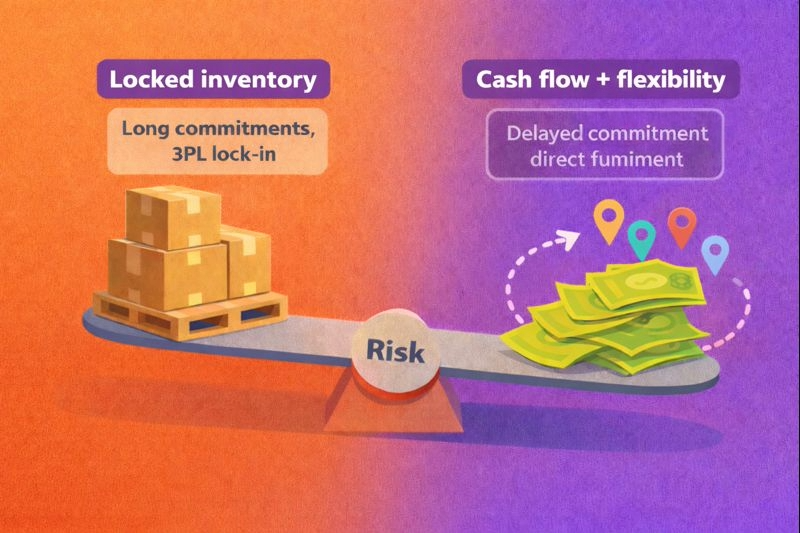
These put real weight on your balance sheet. Once you treat these as capital allocation decisions, not just ops preferences, you start to see why they feel so risky as you grow.
McKinsey's 2025 article on optimizing working capital explains that focusing on working capital early can unlock meaningful liquidity. A lot of that improvement comes from how cash flows through purchasing, production, and inventory.
If you sign a new analytics tool and regret it, you cancel. If you move four months of stock into a region assuming demand will be there and you are wrong, you tie up cash in the wrong place. To fix that, you discount, move product at extra cost, or sit on dead stock while other parts of the business starve for cash. That's how you turn 2025 inventory into 2026 cash flow, or fail to.
Some fulfillment calls are capital allocation decisions that lock you in for six to 18 months: the length of a typical container production cycle plus the time it takes to sell through committed regional inventory.
Why fulfillment mistakes hurt growing brands more than enterprise retailers
The damage from a bad inventory bet scales inversely with company size. A growing brand absorbs the full cost of a wrong call. An enterprise retailer spreads it across hundreds of SKUs, channels, and markdown budgets.
Here's what that looks like in numbers. Inventory carrying costs typically run 20% to 30% of total inventory value per year (source: APICS / industry benchmark cited by Shopify). For a brand holding $500,000 in stock, that's $100,000 to $150,000 per year in storage, handling, insurance, and capital cost, before a single unit ships. When that inventory is mispositioned, you pay carrying costs and write-down costs simultaneously.
Now layer in tariffs. According to McKinsey's Supply Chain Pulse Survey 2025, 82% of supply chain leaders said tariffs affected their operations in 2025, with many reporting 20% to 40% of activity exposed. Those are the numbers enterprise companies absorb. For a $5M brand, that same shift can mean the difference between funding Q4 paid acquisition and pulling back ad spend entirely.
Scale doesn't remove fulfillment risk. It changes who absorbs it and how survivable each error is. The operators who scale through volatile periods aren't the ones who forecast better — they're the ones who built supply chains with enough slack to recover when forecasts miss.
Fulfillment strategy by growth stage: 500 vs 2,000+ orders
Stage 1: 300-500 orders a month into a new region
You manufacture in Asia and want to grow France. You have early traction but lumpy demand. You can hold inventory near the factory and ship cross-border, or move stock into a local French 3PL. The second option looks attractive but is risky if demand comes in slower. You tied cash up in a node that might not turn.
This is where Portless de-risks international expansion. You keep inventory upstream in our Shenzhen hub, ship cross-border as orders come in, and validate French demand without committing capital to local warehousing. In this stage, bias toward reversibility while you validate demand.
Stage 2: 2,000-3,000 stable orders a month
Back to France. Now you have run campaigns, tested channels, and seen consistent demand across several cycles. Those early 300-500 monthly orders have grown into 2,000+ with predictable patterns. Rethinking your 3PL location and moving inventory into a French 3PL starts to look rational. You still carry risk, but you are making a heavy decision with signal, amplifying something you have already proven through the upstream model. Heavy decisions make more sense once you have proven, repeatable demand.
Two fulfillment models: how they handle demand uncertainty
Forecasts miss. New products over-perform or flop. Retail partners change timelines. What you control is how your network behaves when you are wrong.
Forward-deployed vs. centralized inventory: the decision framework
::table
Factor;Forward-deployed;Strategically centralized (upstream)
Capital commitment per region;High. Months of stock committed before demand is proven;Low. Units commit to a region only when an order arrives
Reversibility if demand misses;Low. Markdowns, freight back, or dead stock;High. Redirect to a different market without re-warehousing
Duty timing;Paid in bulk at import, before any sale;Paid per parcel, matched to order revenue
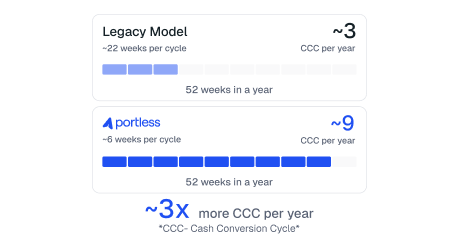
Cash conversion cycle;60 to 90 days;Five to 12 days in many corridors
Best fit;Proven, repeatable demand (2,000+ stable monthly orders);Validating new markets or volatile SKUs
:table
The mistake most brands make: treating the centralized model as the safer option by default. A domestic warehouse in your target market is still a heavy commitment — you've already paid duties, freight, and storage on inventory that hasn't sold. The version that actually reduces risk is upstream centralization, holding inventory at a factory-adjacent hub and shipping individual orders as they come in. That's the operating logic behind just-in-time fulfillment.
This is the model Shein and Temu built their global reach on, and the same structural choice DTC brands now use through direct fulfillment to ship to 85+ countries without standing up local warehouses.
Forward deployed inventory
You place stock closer to expected demand. When you are right, customers see faster delivery. When you are wrong, inventory sits and you pay storage in a node that does not move.
Centralized inventory
You hold stock in one or a few locations.
Legacy centralized inventory often sits in your target market. This feels efficient when demand aligns with your plan. But when demand shifts, you ship further and struggle to respond quickly.
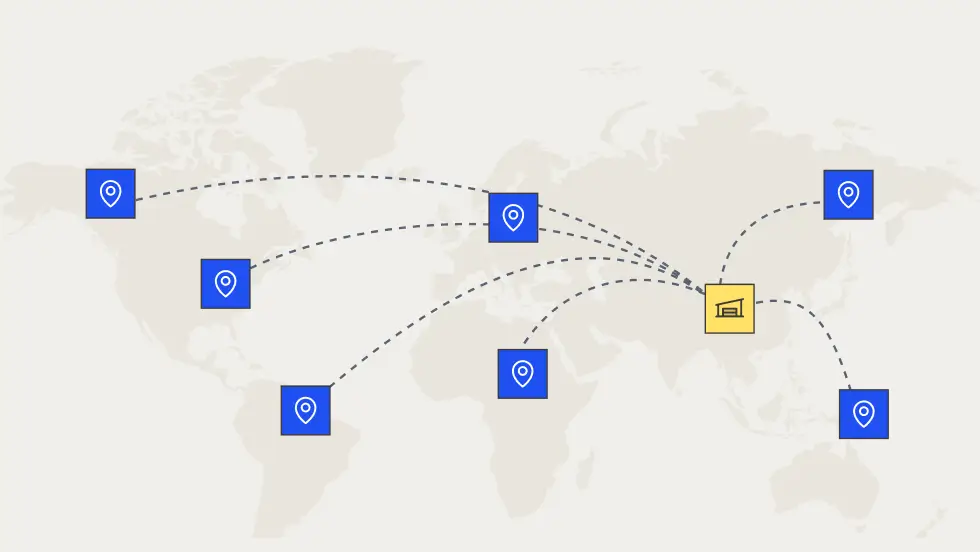
The alternative is strategic centralization. Keep inventory upstream in a factory-adjacent hub, closer to supply than to demand. This changes your decisions. You are no longer committing today to how much sits in North American or European warehouses for three months. You keep stock near the source, then let actual orders determine where units go.
That is exactly how Portless operates. Our Shenzhen fulfillment center is hours from many factories in China. Inventory lands there first. Orders flow in from Shopify and other channels. Packages hand off to more than 20 last-mile carriers. Most brands see five to eight days delivery to North America and Europe.
Learn more: Inside Portless Operations.
The benefit is responsiveness. You hold inventory centrally but with better information about where demand actually is, not where you forecasted it would be months ago.
Craft Club case study: removing the growth ceiling
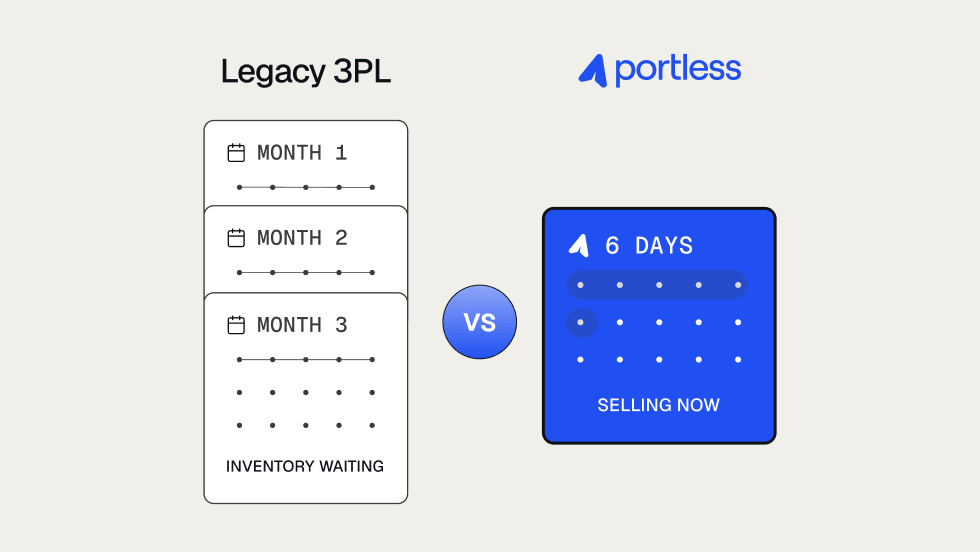
Craft Club used Portless to keep inventory upstream, turning product demand into campaigns instead of container commitments. The company had demand, but their legacy model turned inventory into a growth ceiling. Long lead times meant frequent stockouts or wrong stock in the wrong place.
After moving to Portless, here's how their founder Nikos Maniaty described three changes:
- 3x growth tied to faster replenishment
- 3x drop in cash conversion cycle because inventory spent less time in transit
- Ability to scale new markets by "just creating a campaign and turning it on," since one upstream pool serves multiple regions
When inventory could move from production into global shipping in days, the team stopped planning around container cycles and started planning around campaigns.
How to design your fulfillment model for reversibility
Reversibility isn't a single decision. It's a set of operating principles that keep your options open as you grow. Use this checklist before you commit capital to any heavy fulfillment decision:
- Hold inventory upstream until you have at least three to six months of stable demand data per region
- Commit duty and freight per order, not per container, while you validate
- Keep your cash conversion cycle under 30 days so a missed forecast doesn't drain a quarter of operating capital
- Test new markets with smaller production runs and cross-border fulfillment before committing to a local 3PL
- Model landed cost per SKU at current duty rates plus a +10% and +25% scenario before signing any warehousing contract
Want to see what reversibility looks like against your actual numbers? Run them through the Portless direct fulfillment ROI calculator or check the fulfillment model ROI breakdown, then validate duty exposure with the landed cost calculator.
Building reversibility into your supply chain
The brands that survive volatile cycles aren't forecasting better. They're keeping heavy decisions reversible until demand proves itself, holding inventory upstream, and committing duties and freight per order rather than per container. If your current model is locking up cash six to 18 months ahead of revenue, it's worth talking to our team about what direct fulfillment would change for your specific cost structure.
FAQ
What is the biggest fulfillment risk for growing Ecommerce brands?
Making heavy inventory decisions before you have repeatable demand data. These tie up working capital and are hard to reverse without markdowns or extra freight costs.
What is a delayed commitment fulfillment model?
A model that keeps inventory upstream near production and commits units to final regions only when orders arrive, so you pay duties and freight on units that already sold, instead of on large, speculative batches.
When should I use forward deployed inventory?
Use it when you have proven, repeatable demand (2,000+ stable monthly orders). Use centralized inventory when demand is uncertain.
How can I reduce my cash conversion cycle?
Keep inventory closer to production, use favorable payment terms with factories, and ship orders as they arrive rather than prepaying for large container shipments.







.jpg)
%20(1).jpg)
%20(1)%20(1).avif)