Last updated: May 2026
Since 2020, reshoring headlines have surged, but for most brands, moving production home increases costs and strains cash flow instead of fixing supply chain risk.
Reshoring, nearshoring, and offshoring represent three distinct approaches to manufacturing location strategy that directly affect how efficiently capital moves through your supply chain.
This guide explains what each strategy means, when they make sense, and how agile, factory-direct fulfillment can help protect cash flow no matter where you manufacture.
What is offshoring?
Offshoring means relocating production to distant countries to take advantage of cost efficiency and established supply ecosystems.
Unlike outsourcing, which shifts work to third-party providers, offshoring keeps operations within your company but in a different country.
Since the 1970s, many brands have offshored to Asia for its manufacturing expertise, supplier networks, and quality systems.
When people ask "what does reshoring mean," it is often in contrast to this model of moving production closer to home.
What is nearshoring?
Nearshoring refers to moving production to neighboring or regional countries to reduce transit times and align time zones.
The nearshoring definition emphasizes geographic proximity, such as US companies manufacturing in Mexico instead of China.
It offers moderate cost savings while improving oversight and communication.
What is reshoring and when does it make sense?
Reshoring means bringing manufacturing back to your home country. Also called "onshoring," it provides maximum control but often at significantly higher cost.
For many consumer goods, reshoring increases unit costs by several times while reducing supply-chain flexibility.
Offshoring vs nearshoring vs reshoring: cost, control, and transit compared
::table
Factor;Offshoring;Nearshoring;Reshoring
Cost impact;Lowest;Moderate;Highest
Control level;Limited;Moderate;High
Transit time;3–6 weeks;1–2 weeks;1–3 days
:table
Key benefits of each supply chain strategy
What are the benefits of offshoring?
- Established ecosystems: deep vendor networks and skilled labor built over decades
- Capital efficiency: scale production without large upfront investment, preserving cash for growth
- Predictable quality: mature QA systems and supplier reliability
- Strategic flexibility: ability to switch factories or ramp production as demand changes
What are the benefits of nearshoring?
- Reduced shipping time: shorter routes mean faster replenishment cycles, typically one to two weeks instead of three to six
- Regional alignment: shared time zones and cultural similarities simplify collaboration
- Balanced costs: logistics and carrying costs decline even though labor is higher
- Improved communication: overlapping business hours reduce friction and delay
What are the benefits of reshoring?
- Regulated industries: best suited for sectors with strict oversight such as pharmaceuticals or defense
- IP protection: closer control reduces risk of intellectual property exposure
- Marketing appeal: domestic manufacturing supports "Made in USA" positioning
- Government incentives: tax credits or grants can offset part of the expense
Risks and challenges to consider
What are the real risks of offshoring in 2025?
Offshoring risk concentrates in three places: tariff exposure, transit-locked capital, and coordination lag.
Tariff exposure. US tariffs on Chinese imports have escalated sharply. As of 2025, the US imposes a 20% IEEPA fentanyl tariff plus an additional 10% reciprocal tariff on most Chinese-origin goods, layered on top of pre-existing Section 301 tariffs, per the US Trade Representative. Brands paying duties at bulk import absorb every rate change on inventory already in transit. If you want to build a tariff-resilient Ecommerce supply chain, the fulfillment model matters more than the sourcing country.
Transit-locked capital. Ocean freight from China to the US west coast averages 30 to 45 days door-to-port, before customs and domestic trucking. Under the legacy bulk model, that capital sits idle for the full cycle plus warehousing time, commonly 60 to 90 days before revenue arrives.
Coordination lag. A 12-hour time-zone gap between North America and China turns a one-question clarification into a one-day delay. Multi-step decisions stretch across a week if your team works only in business hours.
The structural fix isn't moving the factory — it's moving the fulfillment model. Direct fulfillment applies duties per parcel as orders ship, not in bulk before they sell. Same factory, different cash-flow shape.
What are the risks of nearshoring?
Limited manufacturing capacity creates challenges when demand surges. Smaller manufacturing bases can't absorb massive volume shifts without bottlenecks.
Higher relative cost: production costs in Mexico typically run 20% to 35% higher than in China for comparable goods, per Reshoring Initiative data, closing the gap on shipping savings but rarely overtaking them on total landed cost.
Infrastructure gaps: less developed port, transport, and supply chain ecosystems can create unexpected bottlenecks. This requires more careful logistics planning.
What are the risks of reshoring?
Domestic production dramatically increases unit costs through higher labor, compliance, and facility expenses. Reshoring to the US can raise unit costs by three to five times for labor-intensive consumer goods, driven by hourly manufacturing wages that average $28+ in the US versus $4 to $6 in coastal China, per US Bureau of Labor Statistics and Statista wage data.
Labor shortages: finding skilled manufacturing workers presents significant challenges in many Western countries. This creates hiring difficulties and wage pressure.
High upfront investment: facility setup and equipment costs require substantial capital that could otherwise fund growth. This creates cash flow pressure, particularly for smaller brands.
Understanding what nearshoring and reshoring mean compared to legacy offshoring clarifies which model best supports your business goals.
::table
Factor;Offshoring;Nearshoring;Reshoring
Distance from home;Far (different continent);Close (same region);Zero (same country)
Labor costs;Lowest;Moderate;Highest
Shipping time;3–6 weeks;1–2 weeks;1–3 days
Communication;Challenging;Easier;Direct
Control level;Limited;Moderate;High
Initial investment;Low;Medium;High
Cash flow impact;Inventory-heavy;Moderate;Cash-light (but capital-intensive)
:table
Offshoring remains dominant for most consumer goods because it balances scale and efficiency. Nearshoring provides regional responsiveness but cannot close Asia's cost gap.
Reshoring makes sense only for specialized, regulated, or government-subsidized sectors. For most brands, the smarter move is to keep manufacturing where it is efficient while designing a supply chain that is agile and cash-efficient.
How to choose the right strategy: a cash-flow-first checklist
Pick the strategy that matches your volume, product profile, and capital position, not the one that sounds most defensible in a board deck. The three variables below decide whether cash flow works for or against you.
Key decision factors: how to choose the right strategy
- Cash flow and capital: legacy offshoring ties up 60–90 days of inventory. Agile or factory-direct models release that cash sooner, often outweighing labor savings. Evaluate how long you can afford to have capital tied before inventory sells — see why DTC brands fail to the cash flow trap.
- Product characteristics: high-value or customized products benefit from proximity, while durable, stable-demand items usually stay offshore.
- Market requirements: fast-moving categories like fashion or consumer electronics rely on responsiveness more than location.
- Total cost vs. working capital: look beyond wages. Include freight, duties, storage, and the financing cost of holding inventory.
- Risk tolerance: weigh your exposure to geopolitical shocks and logistics delays against the cost of moving production.
How to choose between nearshoring, reshoring, and offshoring
The right strategy depends less on geography and more on three operator-level questions:
1. What's your monthly order volume?
- Under 1,000 orders per month: offshoring with direct fulfillment beats every other option. You don't have the volume to justify domestic warehousing overhead or the capital to fund a reshore.
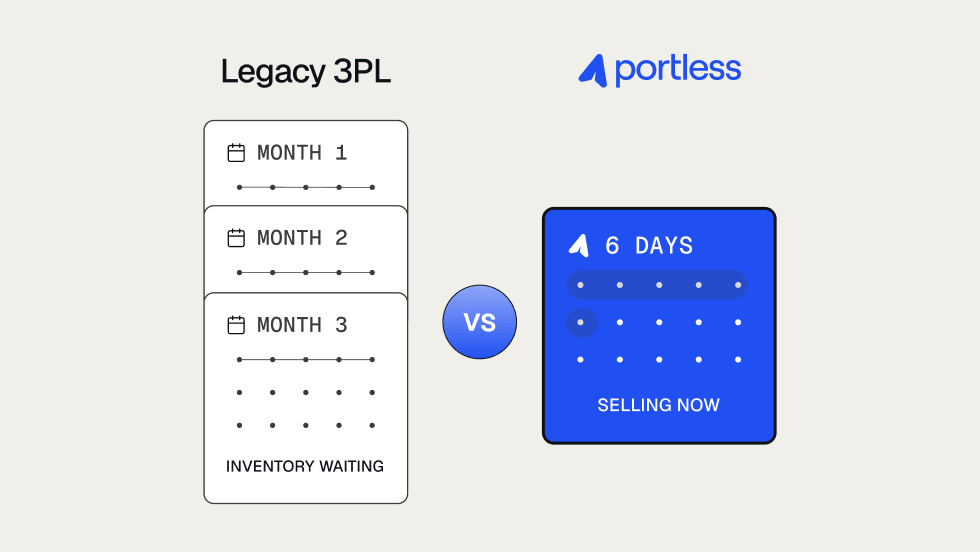
- 1,000 to 15,000 orders per month: offshoring remains the cost base, but how you fulfill matters more than where you make. Direct fulfillment compresses the cash conversion cycle from 60 to 90 days down to five to eight days.
- 15,000+ orders per month into a single market: a hybrid model starts to make sense, with direct fulfillment for international and new markets, and regional inventory for proven, high-velocity SKUs.
2. What's your product profile?
- Lightweight (under 3.5 lbs), non-regulated, stable-demand goods fit offshoring with direct fulfillment cleanly.
- Heavy, oversized, or hazmat goods may need regional warehousing.
- Regulated categories (medical, defense, certain food and beverage) push toward reshoring regardless of cost.
3. How much working capital can you afford to lock up?
If 60 to 90 days of inventory ties up more than 25% of your cash, the cost of capital outweighs the labor savings of offshoring. Shorten the cycle before you change the geography. See how Ecommerce fulfillment risk for growing brands compounds when inventory and cash sit in the same place.
The real advantage: liquidity and flexibility
Most brands frame the sourcing decision as a cost equation: what does a unit cost to produce in country A versus country B? That equation ignores the larger number: how long your cash sits between production and revenue.
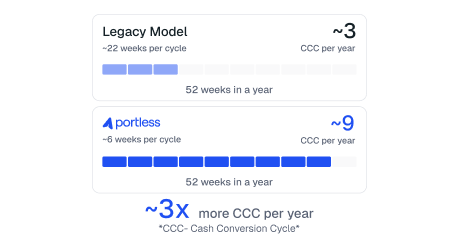
Under the legacy offshore model, capital is deployed at PO, sits through 30 to 45 days of ocean transit, clears customs (duty paid upfront), then waits 30 to 60 more days in a domestic warehouse before selling. Total cycle: 60 to 120 days of working capital tied up before a single unit converts to revenue.
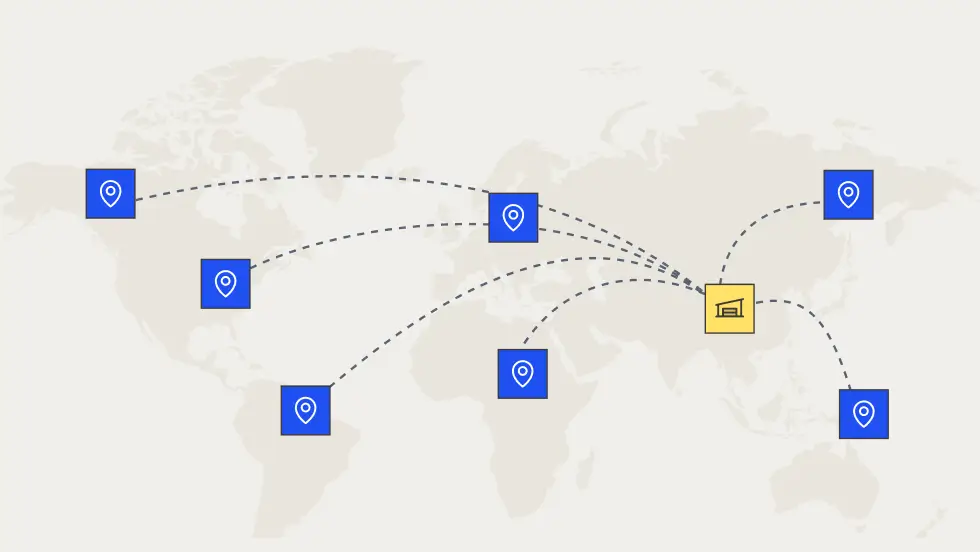
Direct fulfillment compresses that to days. Goods are inspected and stored at a factory-adjacent fulfillment center, then ship individually to customers as orders come in. Duties apply per parcel at the point of sale, matched to revenue. Inventory exposure drops. Cash recycles into the next production run or paid acquisition.
Flexibility compounds the liquidity gain. When inventory ships per order instead of per container, you can change SKUs, test variants, or kill underperformers without writing off a warehouse full of stock. That responsiveness matters — decision latency drains DTC margins in ways that don't show up on a unit-cost spreadsheet.
The implication: for most DTC brands, the question isn't reshore or stay offshore. It's whether your fulfillment model lets your offshore production work for you, or against you.
Keep production where it works, fix the cash cycle
For most DTC brands, reshoring trades a manageable cost problem for an unmanageable one. The higher-leverage move is to keep manufacturing where it's efficient and rebuild the fulfillment model so cash recycles in days, not months. If you want to see what that shift would look like against your specific volume, product profile, and cash position, talk to our team.
FAQ
What is the difference between reshoring and nearshoring?
Reshoring brings production back to your home country, while nearshoring moves it to a nearby region. Reshoring offers maximum control but highest costs; nearshoring balances proximity and cost.
How much does reshoring increase manufacturing costs compared to offshoring?
Reshoring to the US can raise unit costs by three to five times for labor-intensive consumer goods, driven by hourly manufacturing wages that average $28+ in the US versus $4 to $6 in coastal China, per US Bureau of Labor Statistics and Statista wage data, partially offset by lower shipping and carrying costs.
How do these sourcing strategies impact inventory and cash flow?
Offshoring requires 60–90 days of inventory investment, nearshoring about 30–45, and reshoring 7–14. Shorter cycles improve liquidity but raise production cost.
Does direct-from-manufacturer fulfillment provide benefits similar to nearshoring?
Yes. Direct fulfillment from Portless's factory-adjacent center in Shenzhen makes inventory sellable five to eight days after production, with duties paid per parcel under a DDP model rather than in bulk at import. This collapses the cash conversion cycle from 60 to 120 days down to a matter of days, without changing your manufacturing geography. See which fulfillment model maximizes profit margins for the full breakdown.
What is the main difference between offshoring and nearshoring?
The main difference is distance. Offshoring moves production to a distant country, usually a different continent, for the lowest cost. Nearshoring keeps production in a neighboring or regional country to shorten transit times and align time zones, accepting moderate cost savings instead.
Is nearshoring or reshoring better for compliance-heavy industries?
Reshoring or nearshoring is generally safer for compliance-heavy industries. Domestic or regional production gives you direct oversight, faster audits, and tighter control over IP and regulatory documentation. Offshoring works in these sectors only with strong governance, in-country QA teams, and clear contractual controls.
Why isn't reshoring happening at scale despite the headlines?
Reshoring isn't happening at scale because the cost gap is too wide for most consumer goods. US labor, compliance, and facility costs raise unit costs significantly compared to Asia. There's also a domestic skilled-labor shortage. For most DTC brands, fixing cash flow through direct fulfillment delivers more value than relocating production.








.jpg)
.jpg)
%20(1).jpg)