“We generated $70K in package protection revenue in a single quarter by adding a simple $4 protection option at checkout — plus an additional $12K from cashbacks. Customers get peace of mind, and we're making a profit on every protected order with zero effort."
“We generated $70K in package protection revenue in a single quarter by adding a simple $4 protection option at checkout — plus an additional $12K from cashbacks. Customers get peace of mind, and we're making a profit on every protected order with zero effort."
Your Ecommerce supply chain is the end-to-end system that moves a product from raw materials to your customer's door. But how you've structured it determines whether a tariff change costs you a few margin points or blows up your cash flow entirely.
That's the problem this guide solves: not what a supply chain is, but how to build one that doesn't fall apart when trade policy shifts.
In a recent survey of 100+ Ecommerce brands, our team at Portless found that 92% of merchants have already raised prices in response to tariffs — and the brands still absorbing the hit are the ones whose supply chains gave them no other choice.
Free reportTariffs have reshaped Ecommerce. Here's the data.Find out how 100+ Ecommerce operators are responding on pricing, inventory, and international expansion — and where you stand.Get the free report
In this article, we’ll cover:
What is an Ecommerce supply chain?
What is Ecommerce supply chain management?
The six stages of SCM and where tariff exposure enters
Why the legacy model amplifies every tariff shock
The hidden drag: how bulk freight locks your capital
Five strategies to build a tariff-resilient supply chain
How direct fulfillment changes the supply chain math
Limitations to know
What is an Ecommerce supply chain?
An Ecommerce supply chain is the sequence of processes covering sourcing, manufacturing, inbounding freight, warehousing products, order fulfillment, and returns that moves a physical product from a factory to an end customer.
That definition sounds like a logistics puzzle, but it's really just capital allocation. Every stage in your supply chain is a place where money either moves or sits still. Goods on a container ship aren't generating revenue. Inventory in a domestic warehouse isn't generating revenue without sales and marketing behind it. Duties paid upfront at import on goods you haven't sold yet means cash deployed with no immediate return. The shape of your supply chain is the shape of your cash flow, and if you've built it around bulk ocean freight and domestic warehousing, you've built it around a long, front-loaded cycle that leaves very little buffer when external costs spike.
Ecommerce supply chain management (SCM) is the active coordination of every stage in your supply chain, from which suppliers you source from to which carriers deliver your orders, to reduce cost, shorten lead times, and protect your margins when conditions outside your control change.
The difference between managing a supply chain and just running one matters. Running it means executing the process you've set up. Managing it means continuously evaluating whether that process is still the right one — whether your sourcing geography concentrates too much tariff exposure in a single country, if your freight model is locking more capital than your margins can absorb, or if your warehousing setup gives you any flexibility when duty rates shift without warning.
Good SCM is how you stay solvent through the bad quarters and have enough runway to fund the good ones.
The six stages of SCM and where tariff exposure enters
Every Ecommerce supply chain runs through the same six stages. At each one, there's a decision that either concentrates or distributes your exposure to trade disruption.
1. Sourcing and manufacturing
This is where your product is made. If you're sourcing from Asia, your goods are classified under Harmonized System (HS) codes at import into the US, and that classification determines your duty rate. You can look up your product's classification on the US International Trade Commission's HTS search tool. Worth noting: these are US import rates. Every country sets its own tariff schedule, so if you're selling into the EU, Australia, or Canada, the numbers will be different.
If all your production sits in one country with one factory, one policy announcement reprices your entire cost base with no buffer.
What most brands miss is that the manufacturing location isn't actually where the exposure lives. It's in how you move goods after the factory. Importing a bulk container means paying duties on the entire shipment before a single unit sells. Fulfilling individual orders direct from your manufacturing market means duties apply per order, matched against the revenue from that order. Same factory, same country. But structurally different tariff impact on your cash flow.
2. Freight and inbound logistics
This is where tariff exposure becomes a cash flow event. Under the legacy bulk ocean freight model, you manufacture a large production run, ship by sea at typically 45 to 60+ days in transit, clear customs through US Customs and Border Protection (CBP) on arrival, and move goods to a domestic warehouse. Duties are paid at the point of entry, before a single unit sells.
You're paying a tax on inventory you haven't moved yet. If rates rise between when you placed the order and when the container lands, your pricing assumptions are wrong and you find out too late to act on it. This happened repeatedly throughout 2025 as tariff rates were in high flux.
3. Warehousing and inventory
Once goods land in a domestic warehouse, carrying costs start accumulating. Inventory carrying costs typically run 20% to 30% of total inventory value per year, meaning a brand holding $500,000 in stock spends up to $150,000 annually in storage, handling, and insurance before a single unit ships.
When tariffs rise, the instinctive response is to front-load inventory and order more to beat the rate increase. That move can make sense tactically, but it accelerates the carrying cost problem and commits capital months before you know whether demand holds. If it softens, or rates shift again, you're sitting on expensive inventory with margins narrower than you planned for.
4. Order management
Order management is the coordination layer between your storefront, your inventory, and your fulfillment operation. It carries less direct tariff exposure than the stages above, but it's where the downstream effects show up first. Delayed restocking leads to out-of-stock SKUs. Longer inventory lead times erode conversion. Manual workarounds burn team time that should be going toward growth. When your supply chain is under pressure, your order management layer is usually the first place it becomes visible.
5. Fulfillment and last-mile delivery
For brands running a domestic warehouse to domestic carrier model, the fulfillment stage itself doesn't carry direct tariff exposure. What it does is amplify the inventory problem. If you've front-loaded stock and demand softens, you're paying carrying costs and fulfillment overheads simultaneously on slow-moving goods with no easy exit.
For brands shipping internationally, the DDP (Delivered Duty Paid) versus DDU (Delivered Duty Unpaid) decision at fulfillment matters more than most brands realize. DDU is cheaper to set up. It's also how you end up with customers abandoning parcels at customs, leaving negative reviews about unexpected charges, and never buying from you again. DDP means duties are handled upfront — the customer gets what they ordered, no surprises at the door.
6. Returns and reverse logistics
Returns are the stage most brands underinvest in relative to their actual cost. For international shipments, duty paid on outbound goods is rarely fully recoverable on a return. If your margins are already compressed by carrying costs and tariff exposure earlier in the chain, return handling erodes what's left.
Plan your returns model before you scale internationally. Treating it as a problem you'll solve later is how brands end up absorbing return costs they never budgeted for.
Why the legacy model amplifies every tariff shock
The legacy DTC supply chain looks like this: manufacture in bulk, ship by ocean, warehouse domestically, fulfill from that warehouse. It was designed for a predictable world with stable rates, stable lead times, and stable costs. It wasn't designed for what's been happening since 2025.
Every decision in the legacy model is front-loaded. You commit to a production volume before the goods exist. You commit to a freight route before rates change. You pay duties before you know if the inventory sells. By the time you have pricing clarity, your capital is already deployed with very limited options for responding.
In a stable trade environment, that concentration is manageable. The math works out. But when tariff rates shift sharply and repeatedly, a front-loaded model means you absorb the full impact of each change with almost no flexibility to respond. The three specific failure modes this creates:
Failure mode
What happens
Why it hurts
Duty paid on unsold inventory
Tariffs assessed at bulk import, before revenue
Cash leaves before sales arrive, and if demand softens you're liquidating stock at a loss on goods you've already paid duties on
Front-loading response to rate hikes
Brands overbuy to beat increases
Carrying costs spike on inventory that may not move
Repricing lag
Landed cost rises while goods are in transit or in warehouse
Margins compress on stock already committed
The brands that absorbed the 2025 tariff waves hardest weren't necessarily in the wrong product category. Many were in the wrong supply chain structure — one that left them with no room to maneuver.
Nik Sharma, CEO of Sharma Brands and widely known as the “DTC Guy,” talked about how tariffs have affected the brands he works with in a conversation with our CEO, Izzy, on an episode of The Modern Supply Chain podcast:
The hidden drag: how bulk freight locks your capital
The tariff problem sits on top of a structural cash flow problem that was already making legacy supply chains expensive, and it's worth separating these because solving the cash flow problem also makes you more resilient to tariff shocks. They're connected.
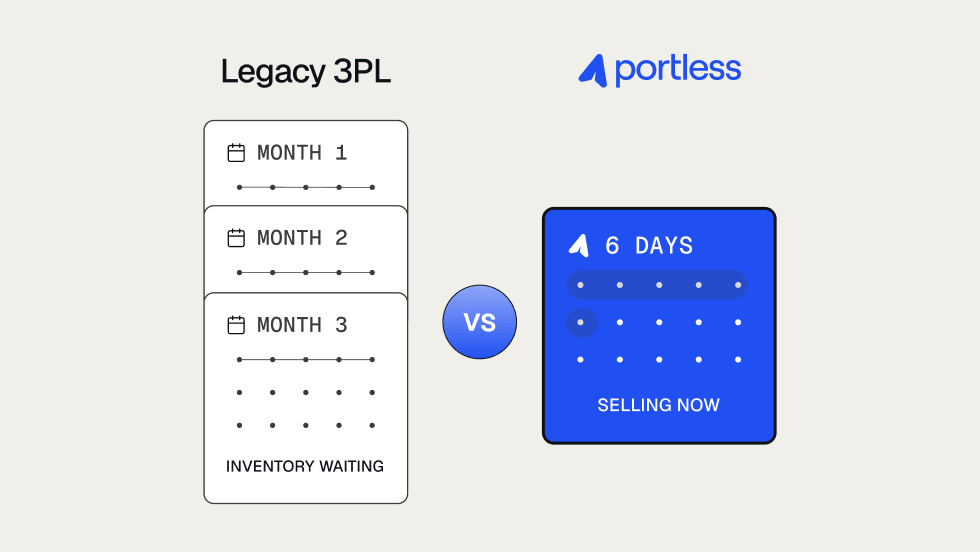
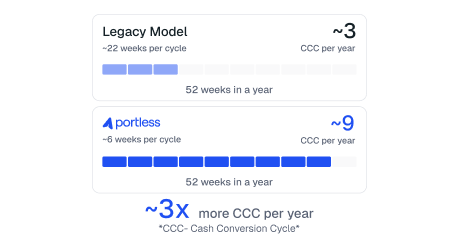
Under bulk ocean freight, your capital cycle runs like this: pay for production, wait 6 to 8 weeks for goods to arrive, pay duties at import, warehouse goods, sell gradually over the following weeks or months, then collect revenue. Cash out. Long wait. Cash in. For a DTC brand doing meaningful volume, that cycle commonly runs 60 to 90 days.
During that window, that capital is doing nothing for you. It isn't going into paid acquisition. It isn't funding your next product launch. It isn't building a buffer that lets you absorb a tariff increase without immediately raising prices or cutting spend elsewhere.
Brands that shorten their cash conversion cycle free up capital that compounds. That capital goes into marketing, which drives revenue, which funds more inventory, which the supply chain can now move faster. The loop accelerates. Brands that don't restructure are funding the same cycle at a progressively higher cost, every quarter, with less and less slack to absorb external shocks when they come.
Five strategies to build a tariff-resilient Ecommerce supply chain
Building resilience into your supply chain comes down to a set of structural choices that collectively reduce how much any single policy change costs you. Here's what those look like in practice.
1. Diversify your sourcing geography
Single-country sourcing means a single point of failure. If all your production is in China, every US-China tariff movement lands across your entire cost base. Splitting production across Vietnam, Cambodia, India, or other manufacturing markets means any one rate change affects a portion of your supply rather than all of it.
This takes time. Supplier development and quality processes in new markets take months, sometimes longer. But the brands that started this work in late 2024 are in a meaningfully better position today than the ones just beginning it now.
2. Shorten your manufacturing-to-ship timeline
The longer the gap between production and delivery, the more time conditions have to change between when you set your cost assumptions and when goods actually land. Brands using air freight or fulfilling direct from manufacturing markets compress that window from 30 to 45 days down to two to five days.
Faster transit costs more per unit. But for many DTC brands, the cost of speed is lower than the cost of holding inventory for an extra four to six weeks, particularly when tariff uncertainty makes that inventory difficult to price confidently.
3. Shift from inventory-heavy to on-demand fulfillment
The legacy model requires you to hold inventory before demand exists. Shifting your inventory strategy to a direct fulfillment model — meaning shipping individual confirmed orders from a fulfillment center near the manufacturer directly to the end customer — means you're fulfilling against real orders rather than forecasted ones.
This doesn't eliminate inventory risk entirely. You still need to manage production timing. But it dramatically reduces the volume of finished goods you need to carry at any given time, which shrinks carrying costs and reduces the capital sitting idle in the system waiting to be converted.
4. Know your landed cost before you set your prices
Landed cost is the full cost of getting a unit from factory to customer: product cost, freight, insurance, duties, and last-mile charges. Most brands either underestimate it or treat it as a fixed number. Neither holds up when tariff rates shift.
Model your landed cost per SKU at your actual shipping volumes and current duty rates, then run it again at +10% and +25% tariff scenarios so you know your margin floor before conditions force you to find out the hard way. The Portless landed cost calculator is a free tool built specifically for this calculation.
5. Separate your international and domestic fulfillment
Fulfilling international orders from your domestic warehouse feels simpler. It's not cheaper. You're paying to import goods into a country and then paying to ship them back out again, which means you're covering freight twice for orders that never needed to touch domestic soil.
Domestic warehouse to international carrier also typically means longer transit times and the risk of duty surprises landing on your customers at delivery.
The reality is that domestic fulfillment only makes sense when express shipping speed is critical, and for most brands and most orders, it isn't. Keeping inventory in a single pool closer to the manufacturer gives you more flexibility to ship into more countries without duplicating logistics costs in each market.
Separating international fulfillment from domestic operations lets you optimize each independently. It also opens the option of fulfilling international orders direct from your manufacturing market, closer to the origin, no re-import, no domestic warehouse touchpoint for goods that never needed to enter the country in the first place.
How direct fulfillment changes the supply chain math
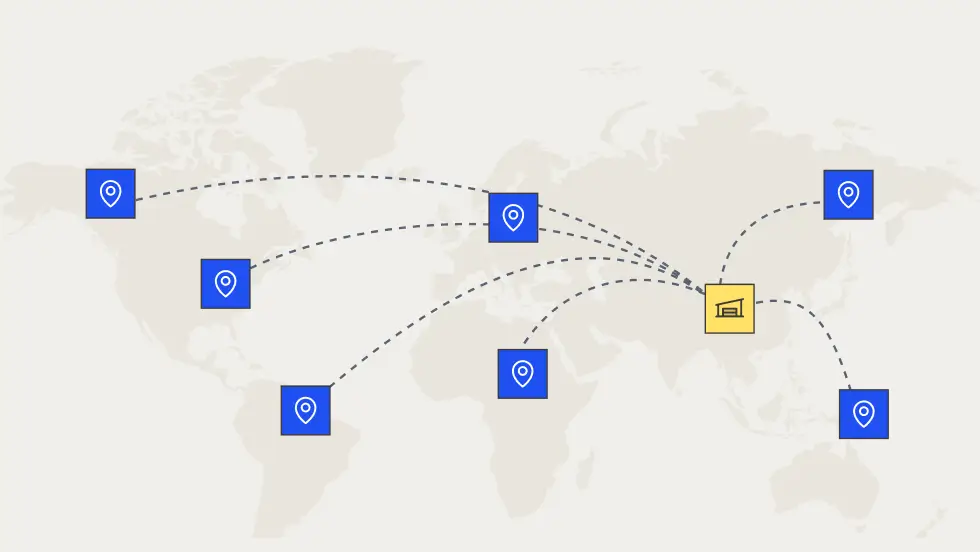
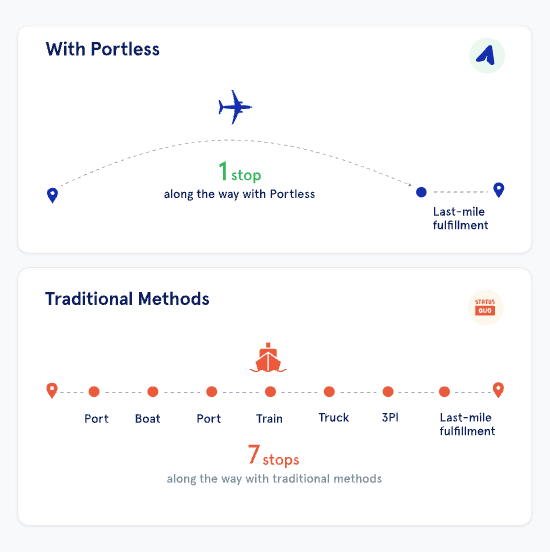
Direct fulfillment is a model where individual customer orders ship from a fulfillment center close to the manufacturer (in the country of production) directly to the end customer, with no domestic warehousing in between. Portless operates this model from a central fulfillment center in Shenzhen, shipping to 85+ countries with domestic last-mile carriers handling delivery in each market.
For brands manufacturing in Asia, this changes the supply chain math in three specific ways.
Legacy model
Direct fulfillment
Cash conversion cycle
60 to 90 days — duties and warehousing precede revenue
Days — fulfill confirmed orders, collect revenue fast
Duty timing
Paid in bulk at import, before goods sell
Applied per parcel at fulfillment, matched to order revenue
Inventory exposure
Months of finished goods held in domestic warehouse
Lower carry volume — fulfill against demand, not forecasts
Two brands that have lived this shift in practice:
Foreign Resource: from 21-day lag to a near-negative cash conversion cycle
Matias Belete built Foreign Resource, a premium streetwear brand designed for global travelers, with a clear product vision and a supply chain that was quietly undermining it.
The setup was standard: manufacture in China, ship by ocean freight, sell from inventory. With sea freight, Foreign Resource could only turn inventory six times per year. Every time Matias needed to move fast on a time-sensitive collection or hit a launch deadline, he had to air freight inventory at a cost that wrecked his unit economics. "Those costs stack up," he said, "and then your unit economics get cooked." He was spending entire quarters managing logistics instead of building the brand he'd started.
He switched to Portless for direct fulfillment from China. The manufacturing-to-shipping timeline dropped from 21-plus days to two days. The cash conversion cycle shifted to near-negative — revenue arrives before the next production run needs paying. Matias's time shifted back to product development and marketing, the two activities that actually drive brand growth.
“Now instead of having to pay all these tariffs, taxes, duties and shipping fees upfront I can pay them as sales are made. So I recoup all that cash." — Matias Belete, Founder at Foreign Resource
&Collar: from 5% in-stock to a record-breaking peak season in 30 days
&Collar is a DTC menswear brand that grew past $10M in annual revenue fast enough to outrun its own supply chain. Heading into Father's Day 2023, their second-biggest sales event of the year, they were at 5% in-stock on their hero SKU. The inventory was still being produced in China. Legacy ocean freight wouldn't get it there in time.
Their options under the legacy model were grim. Run out of stock entirely, or air freight 50,000 units at a cost that would gut their margins. "How do we get things from China to our Utah warehouse like yesterday?" said co-founder Mark Brown. "We didn't want to air freight 50,000 units due to costs."
They found Portless, onboarded in 30 days, and rerouted 40,000 units via direct fulfillment. They went from 5% in-stock to 100%. They posted a 35% year-over-year revenue increase during that peak season.
“Portless legitimately saved our year that year. If we ended 40% down YoY on Father's Day, that would’ve ruined the rest of our year… we would have no cash for July, August is hamstrung, then you’re recovering in September, and you don’t have enough to spend to fill the Black Friday funnel.” — Mark Brown, Founder at &Collar
The takeaway isn't that direct fulfillment is a crisis tool. It's that a supply chain built entirely on ocean freight and domestic warehousing has no slack in it. When something goes wrong, every option available is expensive. A more flexible model means more levers.
Limitations to know
Direct fulfillment works well for a specific profile of brand and product. It doesn't work for everyone, and you should know where the edges are before evaluating it.
Sourcing concentration. Fulfilling direct from your manufacturing market shortens your cash cycle and removes domestic warehousing from the equation, but it doesn't diversify your manufacturing geography. If reducing country-of-origin exposure is your primary goal, that requires a separate sourcing strategy running in parallel.
Product fit. The economics of air-based direct fulfillment work within certain weight and value bands. Oversized, heavy, or highly regulated products may not fit the model. It's worth getting a landed cost comparison on your specific SKUs before assuming it pencils out.
The brands absorbing tariff shocks are built differently
If you're treating your supply chain as a cost to manage, you're solving the wrong problem. How you've structured it determines when duties hit your P&L, how long capital sits idle between factory and customer, and how much you have left over to invest in growth. The brands still scaling through trade disruption didn't get lucky. They made different structural choices earlier.
If you want to see what those choices look like for your specific numbers, talk to our team and we'll model it out.
FAQ
What is Ecommerce supply chain management?
Ecommerce supply chain management is the coordination of every process that moves a product from manufacturer to customer: sourcing, freight, warehousing, fulfillment, and returns. The goal is to reduce cost, protect margins, and keep capital moving through the business efficiently.
How do tariffs affect the Ecommerce supply chain?
Tariffs increase the landed cost of goods imported from affected countries. Under a bulk ocean freight model, those duties are paid upfront at import before goods sell, creating an immediate cash flow hit and compressing margins on inventory already in transit or sitting in warehouse.
What's the difference between a 3PL and direct fulfillment?
A third-party logistics provider (3PL) warehouses your inventory domestically and fulfills orders from that warehouse. Direct fulfillment ships individual confirmed orders from a fulfillment center near the manufacturer, typically in the country of production, directly to the end customer, bypassing the domestic warehousing layer entirely.
What is a cash conversion cycle and why does it matter for DTC brands?
The cash conversion cycle (CCC) is the number of days between when you spend money on inventory and when you collect revenue from selling it. A shorter CCC means capital cycles back into the business faster, giving you more to reinvest in growth. Brands with long CCCs are structurally constrained because their capital is always tied up somewhere between factory and customer, leaving little room to absorb external shocks or fund the next phase of growth.
How do I calculate landed cost for my products?
Landed cost includes product cost, freight, insurance, duties and taxes, and any last-mile or brokerage fees. Calculate it SKU by SKU at your actual shipping volumes and current duty rates, then model it across at least two tariff increase scenarios. Our landed cost calculator is a free tool built for exactly this.
Can I use direct fulfillment for international orders only?
Yes. Portless supports brands that want direct fulfillment for international orders while keeping an existing domestic setup for US fulfillment. It's a common entry point that adds a new channel without requiring a full supply chain rebuild.
/
Frequently asked questions
Heading
Lorem ipsum dolor sit amet, consectetur adipiscing elit. Suspendisse varius enim in eros elementum tristique. Duis cursus, mi quis viverra ornare, eros dolor interdum nulla, ut commodo diam libero vitae erat. Aenean faucibus nibh et justo cursus id rutrum lorem imperdiet. Nunc ut sem vitae risus tristique posuere.
Get operator-level supply chain insights
Thank you! Your submission has been received!
Oops! Something went wrong while submitting the form.







.jpg)
.jpg)
.jpg)