“We generated $70K in package protection revenue in a single quarter by adding a simple $4 protection option at checkout — plus an additional $12K from cashbacks. Customers get peace of mind, and we're making a profit on every protected order with zero effort."
“We generated $70K in package protection revenue in a single quarter by adding a simple $4 protection option at checkout — plus an additional $12K from cashbacks. Customers get peace of mind, and we're making a profit on every protected order with zero effort."
When comparing air freight vs sea freight, the per-kilogram cost difference is a jump scare. Sea freight runs 12–16x cheaper. On paper.
Most businesses stop their math there. They look at the freight invoice, pick the cheaper option, and move on. But the freight invoice isn't the full picture. When you factor in warehousing, upfront duties, inventory carrying costs, and the risk of stockouts, the "expensive" option often results in a lower total cost to serve and healthier cash flow. You can run your own numbers with this landed cost calculator.
A 2022 IHL Group study found that global inventory distortion (the combined cost of overstocks and out-of-stocks) reached $1.9 trillion. That's what happens when brands optimize for the freight rate instead of the full equation. It’s not only about which freight rate is the lowest, but which model improves total cost to serve (CTS) and keeps cash moving.
This article breaks down what each model actually costs, where ocean freight hides its fees, and when air freight (especially via direct fulfillment) comes out ahead.
In this article, we’ll cover:
A side-by-side comparison of air vs sea freight
When sea freight makes sense
The hidden costs of ocean freight most businesses miss
Bulk air freight vs direct fulfillment
How the direct fulfillment model works
The tipping point: when does air actually win on total cost?
Four scenarios where air freight wins
Real brands that made the switch
Long-term considerations for your freight strategy
A side-by-side comparison of air vs sea freight
Before getting into the details, here's the high-level view. The key metric to keep in mind throughout isn't freight cost. It's total cost to serve (CTS), which includes everything from duties and storage to the opportunity cost of capital sitting in unsold inventory.
Air freight vs ocean freight comparison
Factor
Air freight
Sea freight
Cost basis
Charged by dimensional weight
Charged by cubic meter (CBM) or container (LCL/FCL)
Speed
Days
Weeks
Reliability
More consistent schedules
More variable due to port congestion and rollovers
Inventory required
Lower safety stock needed
Higher safety stock required
Warehousing
Minimal with direct fulfillment
Typically requires a domestic DC or 3PL buffer
Common surprise costs
Fuel surcharges, dimensional adjustments, and weight
Port fees, demurrage, detention
Often appears cheaper based on
Total cost to serve
Freight invoice rate
One of the key differences between the two models is how and when you pay landed costs. With ocean freight, you typically bring in bulk orders at once. That means paying duties and tariffs up front on the entire shipment. So if you import 15,000 units, you pay duty on 15,000 units immediately, even if you sell them slowly over months.
With air freight under a direct fulfillment model, you ship smaller batches or even individual sold orders. You’ll still pay the same duty rate, but it's spread across smaller lots over time. This also means you won’t be paying landed costs on anything you don’t actually sell.
When sea freight is the right call
Not every product should go by air. There are clear cases where sea freight is the only practical option.
Heavy or bulky goods
Air freight is priced on chargeable weight, which accounts for both actual weight and dimensional weight. If you're shipping furniture, e-bikes, or fitness equipment, the cost per unit by air becomes prohibitive fast. For these categories, ocean freight is the only viable route.
Regulated or hazardous goods
Airlines have strict restrictions on batteries, liquids, and other controlled items. If your product falls into one of these categories, sea freight is often your only option.
Stable, high-volume evergreen SKUs
If you've got a product with years of predictable demand and you're confident in your forecasting, bulk ocean shipping can work well. The risk profile is lower when you know exactly how much you'll sell.
For everything else, especially lightweight, high-margin, or fast-moving products, the case for ocean freight gets weaker once you dig into total cost.
The hidden costs of ocean freight
At first glance, ocean freight looks cheap. Most businesses don't look past the rate card and then discover six months later that their unit economics don't add up. Here's what the freight invoice doesn't show you.
Tariffs: the lump-sum problem
When you import a container, you pay duties on the full shipment upfront. That's a significant cash outlay before you've sold a single unit.
If you bring in 20,000 units to make the most of your ocean shipment and the tariff is $2 per item, that means you immediately have a $40,000 bill. This doesn’t account for whether or not you sell those units, leaving you with a high upfront cost and no guarantee of sales.
Under a direct fulfillment model, you move inventory in smaller lots. For example, 1,000 units at $2 per item will only require a $2,000 tariff payment. While there’s no way to avoid tariffs, you’ll be able to reduce your risk by spacing out the cost in line with sales.
This also allows you to test new markets without as much upfront risk.
Inventory carrying cost: the silent killer
Inventory carrying cost is what it costs you to hold stock over time. This is usually around 20% of total inventory value per year and includes:
Insurance to cover your goods while they’re in transit and storage
Shrinkage and damage for lost, stolen, or damaged goods
Obsolescence risk for products that go out of trend or need discounting
Cost of capital or the money tied up in inventory that you can’t spend on marketing
So for example, if you’re carrying $500,000 in inventory for 45 extra days because of ocean lead times, that’s roughly $12,500 in carrying cost. Trim that to 10 days with air freight, and it drops to around $2,700. That’s nearly $10,000 in savings before you’ve even touched the freight invoice.
Warehousing and handling add up fast
Ocean freight almost always requires domestic warehousing to hold your bulk inventory before it ships to customers. Those costs include:
Storage by pallet or bin per month
Inbound receiving fees
Put-away and replenishment
Pick and pack charges
Larger shipment volumes mean you’ll need more storage space, more handling, and increased operational complexity. These costs can compound over time.
Deadstock and the risk of stockouts
Ocean freight forces you to forecast demand months in advance. That can be difficult even in stable markets, but it becomes far harder if you’re expanding into a new country or testing a new product.
Get it wrong in one direction and you're sitting on deadstock you still need to insure, store, and eventually mark down or write off. Get it wrong in the other direction and you're out of stock. Research from supply chain academics Corsten and Gruen found that stockouts cause an average 4% loss in total sales. And that's before accounting for lost rankings, customer churn, and the hit to paid ad efficiency when your best SKUs aren't available.
When brands do face stockouts, one response is to place emergency air shipments. These last-minute panic moves often come with premium rates and limited negotiating power. This means that what started as “cheaper” ocean freight can suddenly become much more expensive than anticipated.
Opportunity cost: cash tied up is cash not working
Every dollar sitting in a container or a warehouse is a dollar you can't use to run ads, reorder bestsellers, or expand into a new market. The longer your cash conversion cycle, the harder it is to grow.
Air freight under a direct fulfillment model dramatically shortens this cycle. In some setups, you're shipping sold orders, which means you collect revenue before (or immediately when) the parcel ships. You can see how this math plays out for your own business using Portless's direct fulfillment ROI calculator.
Understanding air freight pricing and why it’s not as expensive as it looks
Air freight is priced on chargeable weight. The higher of actual weight and dimensional weight (volume ÷ a volumetric factor). For lightweight products with compact packaging, this works in your favor. For bulky items, it can make air unworkable.
The perception that air freight is always expensive comes from comparing bulk air rates to bulk ocean rates. That's the wrong comparison for most ecommerce brands. The more relevant comparison is:
Bulk air freight: Ship a large batch by air to a domestic warehouse, then fulfill from there. Same inventory risks as ocean freight, just faster and more expensive per kg.
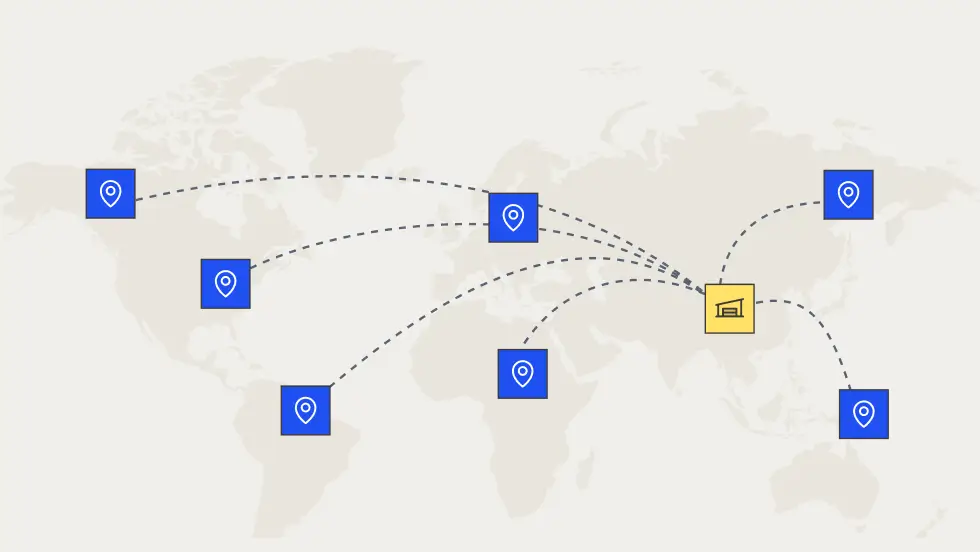
Direct fulfillment: Keep inventory at an origin warehouse (like in China), ship individual sold orders via air cargo directly to the customer. This is the model used by Temu, Shein, and Quince. It’s what Portless offers.
The direct fulfillment model changes the economics entirely. You're not paying air freight rates on bulk. You're injecting individual parcels into existing air cargo at rates that are often far more competitive than a standalone bulk air quote.
The case for direct fulfillment
Direct fulfillment means your inventory stays at a fulfillment center close to the factory (typically in China) and only ships when a customer places an order. There's no domestic warehouse, no bulk import, and no upfront duty bill on unsold stock.
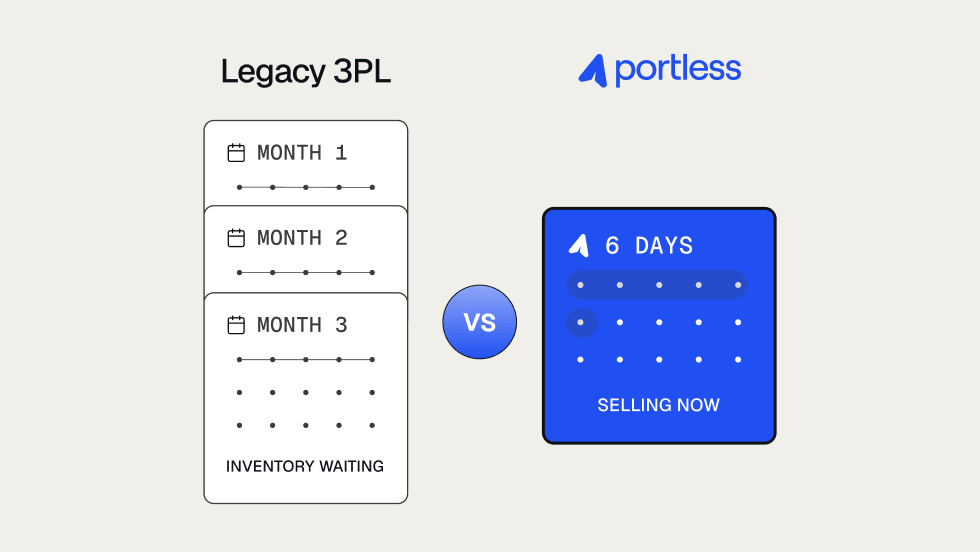
At Portless, most factories can inbound to our Shenzhen fulfillment center in a single day. Your inventory is available for sale almost immediately after production, not weeks later after clearing customs and trucking to a 3PL.
Warehousing: near-zero cost
Portless warehousing costs $2 per bin per month or $15 per pallet per month. Compare that to a US 3PL charging $25–$45 per pallet per month plus receiving, put-away, and pick/pack fees on top. The storage cost difference alone often closes most of the gap between air and ocean total cost.
Cash flow velocity: sell first, ship after
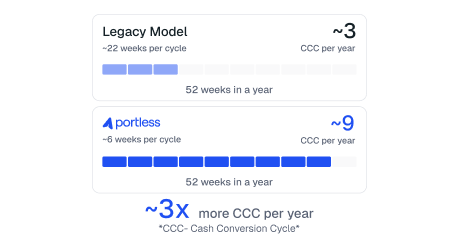
Cash conversion cycle (CCC) is simply the time between when you spend money on inventory and when you get money back from selling it. The shorter it is, the healthier your cash position.
With ocean freight, your CCC includes manufacturing time, 30–45 days of ocean transit, customs clearance, and time sitting in a domestic warehouse before it sells. That can easily push your cycle past 90–120 days.
With direct fulfillment, that same cycle can shrink to days or weeks.
De minimis and regulatory context
In August 2025, the US removed the de minimis exemption for parcels from China and Hong Kong. This is worth understanding: de minimis was never a loophole. It was a standard US Customs regulation. Portless operates on a DDP (Delivered Duty Paid) model, meaning duties are pre-calculated and arranged before the parcel ships. This keeps customs clearance fast and the customer experience clean.
By July 2026, the EU will also remove its €150 customs duty exemption. Portless supports fulfillment to 85+ countries, and our team can walk you through how duty handling works for the markets you're targeting.
How direct fulfillment via air freight actually works
Here's the Portless process end-to-end:
1. Your finished goods are sent to a warehouse in Asia
Once your factory in China finishes production on your items, your inventory gets sent to our Shenzhen-based fulfillment center. For most factories, this delivery only takes a day.
2. We receive and store your inventory
We receive, scan, and store your inventory at our fulfillment center. We keep it safely stored until you make a sale. Our storage costs are simple: $2 per bin or $15 per pallet, per month.
Your inventory is now immediately available for sale. You don’t need to wait weeks for international transit before adding products to your website.
3. Customer orders trigger fulfillment
Once a customer places an order on Shopify, Amazon, or any other platform, the order flows directly into our system through integration. We then pick, pack, and label the parcel.
4. Parcels depart via air cargo
Individual orders are consolidated into outbound air cargo. Transit time from China to most major markets is typically a few days. We calculate shipping costs per parcel, and we can add optional shipping insurance, depending on your needs.
5. The parcel clears customs
Your parcel will go through customs in the destination country under standard parcel processing rules. The duties and taxes you’ll pay at this stage depend on:
The destination country
The product category
The declared value
Portless supports a DDP (Delivered Duty Paid) model. For DDP models, the duties are pre-calculated and arranged before shipment, so when the parcel lands, it can clear customs quickly.
6. The parcel is passed on to a local carrier
Once your parcel is safely in its destination country, it will be pre-labeled for the local last-mile carrier. To the customer, this appears like a local shipment, complete with domestic tracking. They won’t see that the package came from China.
7. Your customer receives their order
Finally, the product is delivered to your customer’s door. This total transit time is typically days, not weeks.
Four scenarios where air freight wins on total cost
Forget the per-kg rate. Here's when the full math tips toward air.
1. High-value or high-margin products
When your AOV is high, the air freight premium becomes a rounding error relative to revenue per unit. What matters more is the cost of capital tied up in slow-moving ocean inventory. A product retailing at $150 with a $30 margin can absorb $3–4 of additional freight cost far more easily than it can absorb 45 days of carrying cost on a $300,000 inventory position.
2. Fast-moving SKUs
If a product can sell out fast, long ocean lead times are a liability. A stockout doesn't just cost you the sale. It costs you ad spend efficiency, marketplace ranking, and customer trust. Even a few days of unavailability during a peak window can cost more than months of air freight premium.
3. Short product lifecycle items
Some products can become obsolete quickly. There are benefits to making trendy fashion, limited collections, or consumable products available earlier. On the flip side, if you over-forecast and ship bulk by ocean, you carry the risk of having deadstock. Quick air freight shipments can reduce this risk and help you sell more.
4. Seasonal goods
If you sell seasonal items or trend-led products, timing is everything. There’s no point selling Super Bowl party decorations in March. Even if you can move the product, this delay often leads to markdowns, which can easily exceed the cost of paying for air shipment.
Real examples of brands choosing air over sea
International expansion is easier when you're not betting six figures on a container. Here's how two Portless customers restructured their supply chains.
&Collar: from 5% to 100% in-stock in 30 days
&Collar is a DTC menswear brand that was able to scale to over $10M in annual revenue — but heading into Father’s Day (their second-largest sales event of the year), they had a major problem. They were almost completely out of stock, and all their future stock was stuck at sea.
Bulk air freighting was on the table, but at roughly $8 per unit for shirts retailing under $50, it would’ve crushed margins. With only 30 days to act, they partnered with Portless. Within that window, they rerouted 40,000 units from ocean freight to Portless’s Shenzhen warehouse. From there, they were able to ship directly to customers from China. By the time the Father’s Day sale launched, they had moved from having just 5% of key SKUs in stock to 100%.
As a result, instead of missing their biggest sales window, &Collar achieved 35% year-over-year revenue growth during Father’s Day.
Foreign Resource: from 21-day lead times to 2
Foreign Resource is a premium streetwear brand that was relying on traditional sea freight to move inventory from China to the US. But even the “fast” boat took more than 21 days to reach LA, meaning cash was tied up for weeks before inventory was even ready to sell.
To get their products to the US faster, Foreign Resource switched to Portless. Now, instead of sending containers to the US, the factory sends inventory directly to the Portless fulfillment center in Shenzhen.
The impact was immediate. Their manufacturing-to-shipping timeline dropped from 21+ days to just two. At the same time, instead of paying shipping, tariff, and duty costs up front, expenses are connected to actual sales.
Long-term considerations for your freight strategy
Before locking in a model, zoom out from the rate card. A few things worth thinking through:
Inventory resilience. Shorter lead times mean you can react when demand shifts, whether that’s up or down. You're not stuck waiting 45 days to course-correct.
Customer experience. Out of stock is the most expensive thing a product page can say. Availability drives conversion and retention. Research suggests the average stockout costs 4% in total sales.
Cash flow timing. Bulk imports tie up capital in duties, storage, and inventory before you've earned a dollar. Air freight aligns spend with revenue.
Forecast confidence. Entering a new market or launching a new product? Direct fulfillment lets you test without committing to a container's worth of inventory upfront.
Operational complexity. More inventory means more storage, more handling, and more things that can go wrong. A leaner setup scales more cleanly.
Air freight: a smarter way to ship your products internationally
The freight invoice is a bad proxy for shipping cost. Ocean freight looks cheap until you add duties, warehousing, carrying costs, and stockout risk. Air freight looks expensive until you run the full equation.
The reality is, for most lightweight, high-margin ecommerce products, direct fulfillment via air freight results in lower total cost to serve, faster cash flow, and less inventory risk.
Portless was built by founders who scaled their own DTC brand to $50M in annual revenue after running into the limits of traditional freight firsthand. Portless customers see up to a 90% reduction in inventory lead time.
Request a quote today to find out whether direct fulfillment is the right fit for your business.
FAQ
Is air freight cheaper than sea freight?
On a per-kilogram basis, no. Sea freight is usually cheaper on paper. But total cost to serve is a different calculation. When you factor in upfront duties, domestic warehousing, inventory carrying costs, and stockout risk, air freight often comes out ahead for lightweight, high-margin products.
What’s the difference between air freight and ocean freight?
Air freight ships goods by plane. It’s faster and costs more per kilogram, but lets you ship smaller volumes, carry less inventory, and reduce upfront costs tied to storage and duties. Ocean freight ships by sea. It’s slower but cheaper per kilogram. But it requires larger shipment volumes, higher upfront duties, and ongoing warehousing costs.
High-margin, lightweight, fast-moving products often benefit from air freight because it reduces stockouts and inventory holding costs.
Heavy, bulky, low-margin goods are usually better-suited to sea freight.
Which option will be more profitable for your business comes down to which option has the best total cost to serve.
How much is ocean freight from China to the US?
Ocean freight rates vary significantly, depending on the port pair, season, and market conditions, but here are some industry-level benchmarks to give you a rough idea:
20-foot container: $2,000 to $4,000
40-foot container: $3,150 to $5,850
Frequently asked questions
Heading
Lorem ipsum dolor sit amet, consectetur adipiscing elit. Suspendisse varius enim in eros elementum tristique. Duis cursus, mi quis viverra ornare, eros dolor interdum nulla, ut commodo diam libero vitae erat. Aenean faucibus nibh et justo cursus id rutrum lorem imperdiet. Nunc ut sem vitae risus tristique posuere.
Get operator-level supply chain insights
Thank you! Your submission has been received!
Oops! Something went wrong while submitting the form.










.jpg)
%20(1).jpg)
%20(1)%20(1).avif)