Last updated: May 2026
Pricing pressure is rising across Ecommerce. Customers expect lower prices, faster delivery, and transparent landed costs. Many brands have optimized every controllable lever, yet competitors still undercut them by 30–40% on nearly identical products.
Better marketing doesn't drive this shift. A supply chain structure that removes layers instead of adding them drives it: a structural problem with the legacy DTC supply chain model that most brands inherited without questioning.
Temu accelerated this expectation. It proved that products can ship cheaply when the order flows directly from the point of production to the customer. The model works because it compresses handling, capital, and time.
You don't need Temu's scale, subsidies, or massive team to apply the same structural advantage. You need a fulfillment model that removes friction at the source.
This is where direct fulfillment becomes a practical and profitable alternative.
What Temu actually did to its supply chain — and why it matters for DTC
Temu removed layers that most Ecommerce brands still treat as mandatory.
Layer 1: Importers and distributors
- Legacy: Factory → Importer → Distributor → Brand
- Temu: Factory → Customer
- Markups removed: 15–30%
Layer 2: Domestic warehousing
- Legacy: Brands buy inventory, store 60–90 days, pay for storage
- Temu: Ships directly from the point of origin or a near-origin hub
Layer 3: Multiple fulfillment touchpoints
- Legacy: Supplier warehouse → 3PL → Customer
- Temu: Single fulfillment node near production → Customer
The result: products reach customers at prices 40–60% below comparable Amazon listings, even with longer delivery times, driven not by cheaper product but by a structurally shorter and lighter supply chain.
Temu's parent company PDD Holdings has absorbed billions in losses on Temu's US expansion to capture market share. Venture capital and parent-company profits from Pinduoduo subsidize their pricing, not operational margins you can replicate. But the structural efficiency behind their model is real and replicable. Remove redundant touchpoints, and those savings compound whether you're moving 10 million units or 10,000.
Why Ecommerce brands cannot copy Temu directly
Temu owns factories, capital, and massive data infrastructure. Most Ecommerce companies operate with:
- $50K to $500K annual inventory budgets
- Small operations teams
- No on-ground quality control in Asia
- Loss of the de minimis duty exemption, which until August 29, 2025 let parcels under $800 enter the US duty-free and is now eliminated for all countries
This is the same structural problem behind the cash flow trap that kills most DTC brands: capital locked up in inventory and duties before a single unit sells.
But brands can adopt the same structural logic by using a hybrid version of direct fulfillment. The winning strategy is to apply direct fulfillment to a focused group of high-velocity SKUs where the savings and agility matter most.
Temu spent billions building captive factory relationships, customs infrastructure, and a logistics network purpose-built for cross-border parcels. A $1–15M DTC brand can't replicate that footprint, and shouldn't try.
The structural gap most operators run into:
- Capital: Temu operates on subsidized losses to capture share. You operate on margin.
- Volume leverage: Temu negotiates carrier rates at 1.6 million parcels per day into the US as of 2024, per Reuters. You're negotiating with whoever your 3PL routes you to.
- Regulatory exposure: The US eliminated the de minimis exemption that let Temu ship under-$800 packages duty-free into the US for all countries on August 29, 2025, per US Customs and Border Protection. Every cross-border parcel now requires formal entry and duty payment.
What's replicable is the structure underneath the strategy: shipping from origin, applying duties at the point of sale, removing redundant handling, and matching cash out to cash in. That structure works at 1,000 orders a month, not just 1.6 million parcels a day.
The path for a DTC brand is not to copy Temu. It's to copy the part of Temu's model that doesn't require Temu's balance sheet.
Direct fulfillment: the logistics model behind Temu's pricing advantage
Direct fulfillment is a logistics model where orders ship directly from the point of origin to the customer. This usually means factory, near-factory consolidation centers, or regional origin hubs that sit upstream of the legacy DTC supply chain model.
Direct fulfillment removes:
- Bulk importing
- Long-term storage
- Multiple handoffs
- Misaligned duty timing
- Slow cash conversion cycles
Most brands think of direct fulfillment as a sourcing strategy. It's not. Factory-direct sourcing is about where you buy. Direct fulfillment is the logistics model that makes factory-to-door practical at scale.
Portless is the company executing this model for Ecommerce brands.
The 80/20 hybrid approach: which SKUs to route through direct fulfillment first
Most brands should begin with a hybrid model that accounts for hard-to-reverse fulfillment decisions for growing brands. Start small. Apply direct fulfillment to the SKUs that make the biggest difference.
Phase 1: Identify high-velocity SKUs (weeks one to two)
Pull your past 12 months of sales data. Look for:
- Consistent monthly volume (200+ orders/month)
- Low return rates (under 5%)
- Non-fragile, non-regulated products
These are your test candidates. Your top 20% of SKUs, your "hero SKUs," likely generate 60–70% of orders.
Example: a home goods brand with 200 SKUs discovered that 15 SKUs represented 65% of revenue. Those became their direct fulfillment pilot.
Phase 2: Calculate real savings (weeks two to four)
Legacy model: FOB $8 + Import (including duties) $3 + Storage (60-day average) $2 + 3PL Fulfillment $6 = $19 total
Direct fulfillment model: FOB $8 + Direct fulfillment $7 + Duties (paid at point of sale) $1.50 + Storage $0 = $16.5 total
Savings: $2.50 per unit, or about 13%.
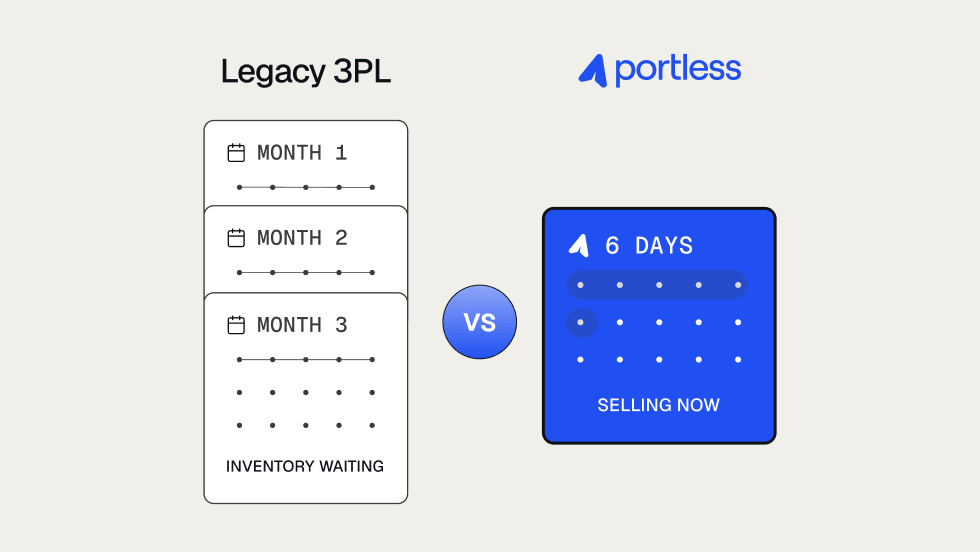
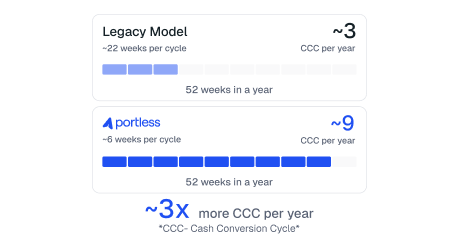
Working capital impact: the legacy model requires paying for 60 to 90 days of inventory upfront, with duties paid at import before a single unit sells. Direct fulfillment matches duty and freight cost to the order itself, compressing the cash conversion cycle to five to nine days.
At 1,000 monthly units, that's $30,000 in annual cost savings plus significantly improved cash flow. To pressure-test these numbers, model your fulfillment ROI against your actual numbers instead of relying on category averages.
Most suitable categories:
- Apparel basics
- Home goods
- Pet accessories
- Simple electronics accessories
- Lightweight consumer goods
Caution categories:
- Cosmetics and high-return electronics
Phase 3: Test with limited SKUs (months two to four)
Start with three to five top SKUs.
Split orders: 70% through your existing 3PL, 30% through direct fulfillment.
Track:
- Delivery time (under 14 days target)
- Damage rate (under 2%)
- Customer satisfaction
- Actual vs. projected savings
Red flags: Delivery times over 15 days, damage rates over 3%, or service tickets increasing faster than savings.
Phase 4: Scale strategically (months four to six)
If the test hits your performance targets:
- Months four to five: add five to 10 SKUs
- Months five to six: move toward a 50/50 split
- Month six and beyond: expand to more categories and markets
Your 3PL remains important. Direct fulfillment handles predictable volume. 3PL handles fast ship, peak seasons, and bulky SKUs.
How Portless operationalizes direct fulfillment
Most brands don't have the infrastructure to manage cross-border logistics in-house. You need customs expertise, carrier relationships across 20+ last-mile networks, DDP duty handling, and systems that route orders intelligently between origin and any existing domestic fulfillment.
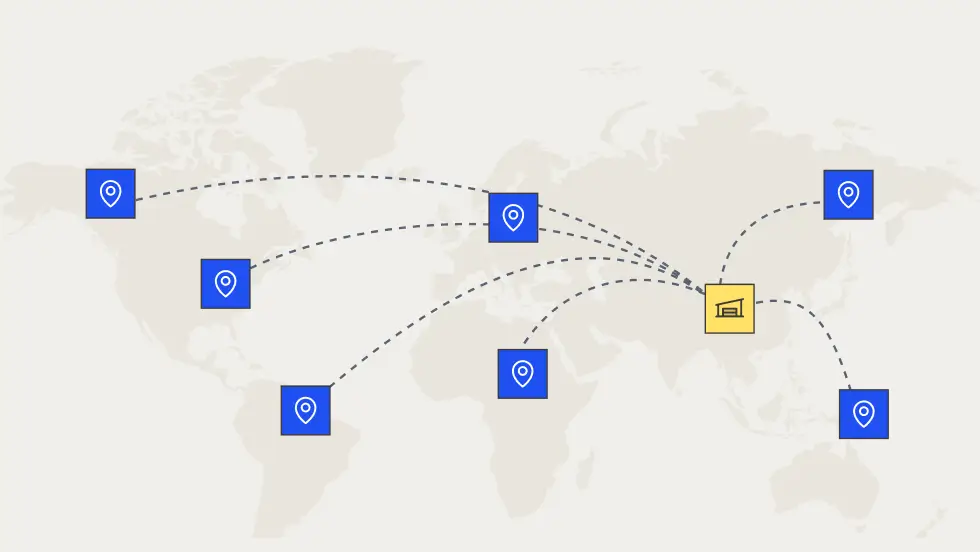
Portless operates this layer from a central fulfillment center in Shenzhen, shipping to 75+ countries with domestic last-mile carriers handling delivery in each market. You bring your manufacturing partners. We handle:
- Receiving and quality-checking inventory at the factory-adjacent hub, with defects flagged within hours instead of weeks (inside the Portless Shenzhen operation)
- Routing each order across more than 20 last-mile carriers based on destination and real-time performance
- Customs clearance and DDP duty handling, so duty is paid at fulfillment against the revenue from the order
- Shopify and WooCommerce integration with real-time inventory and tracking
- Hybrid routing for brands that want to keep their existing 3PL for heavy or peak-season SKUs
Case study: &Collar went from 5% in-stock to a record peak season in 30 days
&Collar, a DTC menswear brand past $10M in annual revenue, hit Father's Day 2023, their second-biggest sales event, at 5% in-stock on their hero SKU. Inventory was still in production in China. Legacy ocean freight wouldn't get it there in time. Air freighting 50,000 units would have gutted their margins.
They onboarded with Portless in 30 days, rerouted 40,000 units through direct fulfillment, and went from 5% in-stock to 100%. They posted a 35% year-over-year revenue increase that peak season.
"Portless legitimately saved our year that year. If we ended 40% down YoY on Father's Day, that would've ruined the rest of our year." — Mark Brown, Founder, &Collar
Your 30-day direct fulfillment pilot roadmap
Week 1: Analyze your data. Identify top 20% SKUs, all-in costs, and return rates.
Week 2: Assess feasibility. Filter for products suitable for direct fulfillment. Estimate potential savings.
Week 3: Explore partners. Explore direct fulfillment capable partners. Request pricing and case studies from brands at your scale.
Week 4: Decide and test. Compare savings vs. platform fees. Start with a small pilot and measure results.
What direct fulfillment actually unlocks for DTC brands
Temu's strength wasn't advertising. It was structure. Per-order shipments replaced bulk imports. Origin hubs replaced domestic warehouses. Duties got paid against revenue, not against forecasts.
You don't need Temu's scale to use the same structure. You need:
- 200+ monthly orders on a SKU before testing it through direct fulfillment
- A landed cost model that compares your real 3PL all-in cost against per-order shipment from origin
- A 30% pilot split that lets you measure delivery time, damage rate, and savings before scaling
- A partner that handles customs, carriers, and DDP so duty timing matches the sale
The brands treating fulfillment as a profit lever, not a fixed cost, are the ones with cash left over to fund acquisition, test new SKUs, and absorb the next tariff shock. The brands treating it as sunk overhead are the ones raising prices.
Build the structure, not the budget
Temu's pricing advantage isn't a marketing problem you can outspend. It's a supply chain structure you can replicate, at your scale, on the SKUs where it matters most. If you want to pressure-test what direct fulfillment would do to your landed cost and cash cycle, talk to our team about running a pilot against your actual SKU mix.
FAQ
What is direct fulfillment in Ecommerce?
Direct fulfillment is a model where customer orders ship from a fulfillment center near the manufacturer — typically in China — directly to the end customer. It eliminates bulk importing, domestic warehousing, and the upfront duty payments tied to legacy 3PL models.
How is direct fulfillment different from Amazon Direct Fulfillment?
Amazon Direct Fulfillment is a dropship program where vendors ship orders on Amazon's behalf for Amazon-listed products. Direct fulfillment in the Portless sense ships your DTC brand's orders from origin to your customer worldwide, with your branding, your tracking, and your customer relationship intact.
How is direct fulfillment different from dropshipping?
Dropshipping ships unbranded product from a third-party seller to a customer, with no control over quality, packaging, or speed. Direct fulfillment ships your own inventory from a factory-adjacent hub with branded packaging, integrated tracking, and quality control before each shipment.
How much can a DTC brand save by switching to direct fulfillment?
Brands typically cut per-unit landed cost by 10–15% and compress the cash conversion cycle from 60–90 days to five to nine days. At 1,000 monthly units, that equals roughly $30,000 in annual cost savings plus the working capital freed up from inventory no longer sitting in domestic warehouses.
Which products work best with direct fulfillment?
Lightweight products under 3.5 lbs in apparel, beauty, electronics accessories, home goods, and toys work best. Fragile items, heavy goods, regulated categories, and high-return cosmetics are weaker fits and often need a hybrid approach.







.jpg)
.jpg)
%20(1).jpg)