“We generated $70K in package protection revenue in a single quarter by adding a simple $4 protection option at checkout — plus an additional $12K from cashbacks. Customers get peace of mind, and we're making a profit on every protected order with zero effort."
“We generated $70K in package protection revenue in a single quarter by adding a simple $4 protection option at checkout — plus an additional $12K from cashbacks. Customers get peace of mind, and we're making a profit on every protected order with zero effort."
Two Ecommerce brands sell the same products and pay the same duty rates. One grows profitably with strong cash flow. The other struggles with capital constraints and inconsistent international conversions.
The difference is not what they pay in duties. It is when they pay them.
Most brands obsess over duty rates. They spend months reviewing HS codes, chasing preferential tariffs, and looking for classification changes that might save a few points. Meanwhile, they ignore a far bigger driver of cost and growth.
Duty timing, not duty rates, drives cash flow, sell-through speed, and working capital availability.
In cross-border Ecommerce, timing often matters more than rate. Yet almost no one talks about it.
Two cost levers most brands misunderstand
Duty rates: the lever everyone knows
Duty rates are the percentages governments charge on imported goods. They are based on Harmonized System codes, country of origin, material composition, and trade agreements. Getting classification right matters: misclassified SKUs can mean overpaying duty on every unit imported. See Customs valuation after de minimis for how brands are tightening this up post-2025.
Tariffs are not the same as duty rates. Tariffs are surcharges applied on top of base duty rates through trade actions like Section 301 (in place on Chinese imports since 2018) and IEEPA reciprocal tariffs introduced in 2025. They stack on top of base HTS rates and can push total duty exposure on apparel from China above 50%.
Some advanced strategies reduce landed cost. First Sale methodology, cross-border duty strategies, multi-tier valuation, and precise product classification can create savings. But these strategies require legal review, operational stability, and meaningful volume. They typically deliver small, incremental improvements.
For most DTC brands, optimizing duty rates alone does not materially change the business.
Duty timing: the lever everyone ignores
Duty timing refers to when duties are paid relative to production and sales.
And when it comes to Ecommerce, only two models matter:
The legacy import model
The Portless model
This is the comparison most operators are missing.
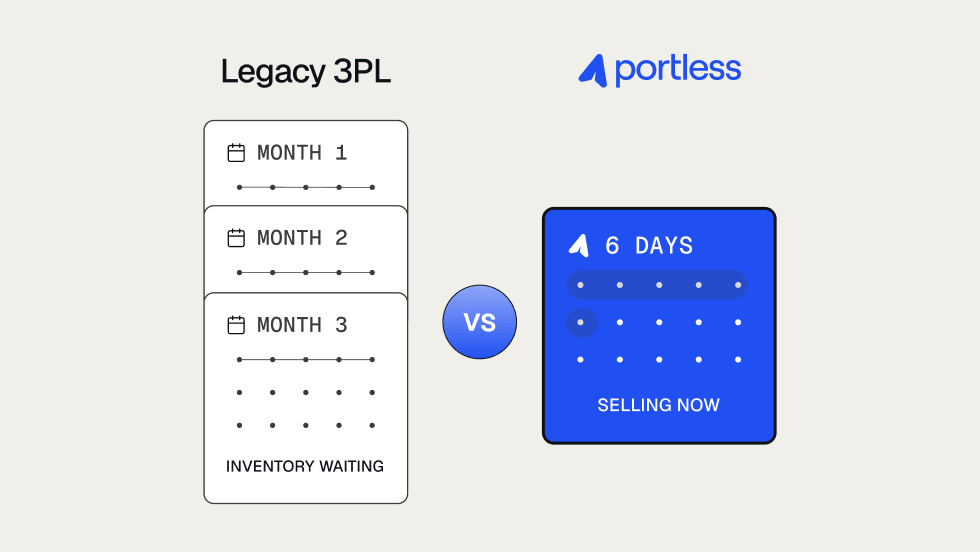
Legacy import model vs Portless model
Legacy import model (containers + warehouses)
In the legacy import model:
Brands pay duties upfront on bulk imports
Taxes and tariffs are paid before selling a single unit
Capital sits locked for 120 to 180 days
Duties apply to unsold inventory
Forecasting errors create risk
Replenishment runs slow
Brands finance inventory long before it generates revenue
This model forces brands to prepay significant duty and tax outlays long before revenue arrives.
Portless model (overseas inventory + per-order duty payment)
The Portless model reverses the cash-flow burden:
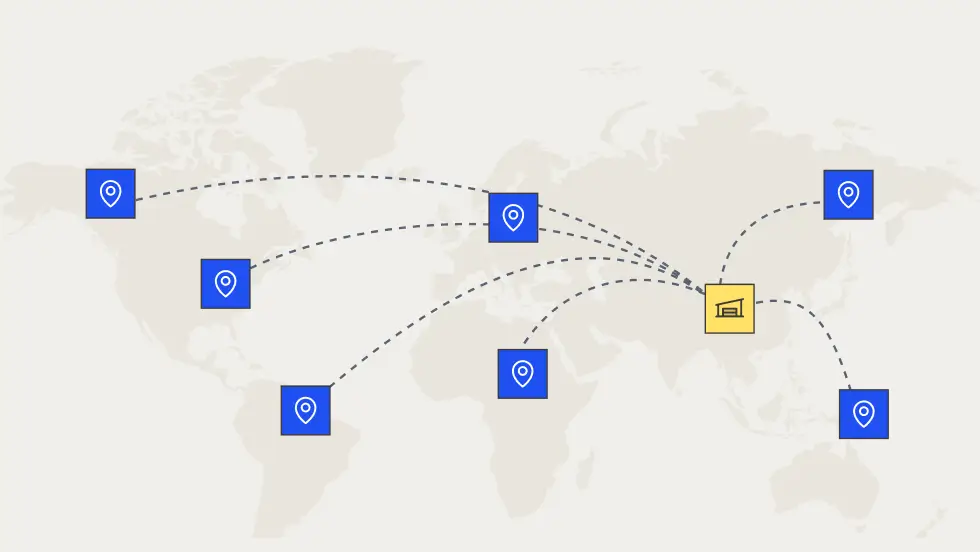
Goods remain in country of origin until customers place orders
Duties apply only when a unit sells, not months earlier
Cash conversion cycle shrinks from 60 to 180 days under the legacy model to seven to 10 days under direct fulfillment, based on results across Portless customers including Foreign Resource, who reached a near-negative cycle
No duties on unsold units
Sell-through improves because brands can produce and sell inventory in the same week
No warehouses, no carrying cost, no capital lockup
This is tariff deferment in action: duty payment finally aligns with revenue.
The hidden costs of bad timing
Cash flow locked in transit
Under the legacy model, duties hit your P&L months before the matching revenue does. A $100,000 shipment at a 25% duty rate means wiring $25,000 to US Customs before a single unit ships from your warehouse. That capital then sits idle through 45 to 60 days of ocean freight, customs clearance, warehouse inbound, and sell-through.
For a brand doing 5,000 orders a month at a $40 AOV, this isn't a one-time hit. It compounds every reorder cycle. At four reorder cycles per year, that's $100,000 in duty payments cycling through capital that could otherwise fund paid acquisition, product development, or inventory in a new market.
Inventory carrying costs typically run 20% to 30% of total inventory value annually, according to APICS supply chain benchmarks. A brand holding $500,000 in domestic stock spends up to $150,000 a year on storage, handling, and insurance, on top of the duty paid upfront.
Cost of capital matters too. If you're financing inventory through a line of credit at 10% APR, every dollar of duty paid 90 days early is a dollar paying interest with no return. According to the JPMorgan Chase Institute, the median small business holds fewer than 15 days of cash buffer. Duties paid 90 days ahead of revenue burn through that buffer faster than most operators realize. This is the core mechanic behind why most DTC brands fail: the cash flow trap.
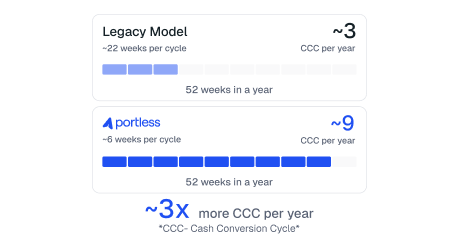
Under direct fulfillment, duties apply per order at the point of parcel export. The cash cycle compresses to days. The $25,000 that used to sit locked in inventory now moves through your business 12 to 18 times a year instead of four — same product, same duty rate, structurally different cash flow.
Operational simplicity and faster replenishment
Legacy importing traps capital in three places at once: in production, in transit, and in domestic warehouse inventory. Every dollar locked in any of these stages is a dollar you can't deploy. The result is brands that look profitable on a P&L but feel cash-poor every quarter.
Per-order duty payment paired with direct fulfillment changes how replenishment works in practice:
Reorder against actual demand signals, not 90-day forecasts that are wrong by definition
Test new SKUs in batches of 250 to 500 units instead of full container minimums of 2,000 to 3,000
Stay in stock through demand spikes without air-freighting emergency inventory at 4x the per-unit cost
Scale into new markets without building or contracting domestic warehouses in each region
This is the operational difference &Collar saw firsthand: when their hero SKU dropped to 5% in stock entering Father's Day weekend, the legacy model gave them two options: run out, or air-freight 50,000 units and gut margins. Direct fulfillment gave them a third: reroute 40,000 units, recover the season, and post 35% YoY growth.
When timing beats rates: a simple framework
Duty timing will outperform rate optimization when:
Your AOV is high. A higher price means greater sensitivity to unclear fees.
Your cash conversion cycle exceeds 30–45 days. Early duty payment strains working capital.
Your international conversion rate trails your domestic rate. Lack of landed-cost clarity is often the cause.
You want a smoother post-purchase experience. Predictability improves repeat purchases.
Rate optimization makes sense when:
You purchase more than $2M from a single supplier
You sell B2B to professional importers
You can redesign your supply chain
Most sophisticated operators eventually optimize both timing and rates. But timing delivers faster and more universal gains for most DTC brands.
How to fix your duty timing strategy
Most operators know their duty timing is suboptimal but can't quantify the cost. Here's how to actually audit it.
1. Calculate your duty-to-revenue lag
Pull your last four reorder cycles. For each, log the date duty was paid at import and the date revenue was collected on the average unit sold from that shipment. The gap between those dates, multiplied by your monthly duty spend, is your duty timing drag.
If the gap exceeds 30 days and duty spend exceeds $10,000 per cycle, timing is materially hurting your cash flow.
2. Map cart abandonment to landed cost transparency
Pull abandonment rates for international vs domestic checkout. Baymard Institute data shows 39% of shoppers abandon checkout over unexpected costs and 14% abandon when they can't see total cost upfront. If your international abandonment rate is 10+ points higher than domestic, your duty model is leaking revenue at the checkout, not just at customs.
3. Model your cash conversion cycle under both scenarios
Cash conversion cycle (CCC) = Days Inventory Outstanding + Days Sales Outstanding − Days Payable Outstanding. Calculate it once with duties paid upfront at bulk import. Calculate it again with duties paid per order at fulfillment. The Portless direct fulfillment ROI calculator models this against your actual numbers.
4. Quantify duty paid on unsold inventory
Look at your slowest-moving 20% of SKUs from the last 12 months. Sum the duty paid on units that haven't sold. That number is pure capital loss under the legacy model, and would be zero under per-order duty payment.
5. Pressure-test against tariff scenarios
Model landed cost at current rates, +10%, and +25%. If a 10% rate change blows up your margin floor, your supply chain has no slack, and timing optimization is the fastest way to add it back.
How the Portless model changes duty timing in practice
The impact of duty timing vs duty rates becomes real when brands shift from bulk prepayment to per-order duty payment. Once duties align with revenue instead of production, three things happen immediately:
Cash flow unlocks
Sell-through accelerates
Inventory risk collapses
For a deeper read on structuring duties around order flow rather than container arrival, see Tariff deferment.
This is exactly what happened with Foreign Resource, a premium streetwear brand that cut their manufacturing-to-shipping timeline from 21+ days to two days after switching to Portless.
Founder Matias Belete put it simply:
"I can almost achieve a negative cash conversion cycle. I can get paid before I'm paying for shipping, and sometimes, with good factory terms, even before that."
By storing inventory overseas and paying duties only when orders are placed, Foreign Resource turned production into liquidity and freed the founder to focus on product and marketing rather than ops firefighting.
Foreign Resource founder Matias Belete
&Collar: peak-season recovery and sell-through
&Collar saw the same pattern. After removing upfront duty payments and shifting inventory overseas, they moved from 5% in stock to nearly 100%, recovering a peak season that would have otherwise been lost and driving a 35% year-over-year lift during Father's Day.
&Collar's founder and cofounder: Ben Perkins and Jordan Larsen
Independent research backs this up
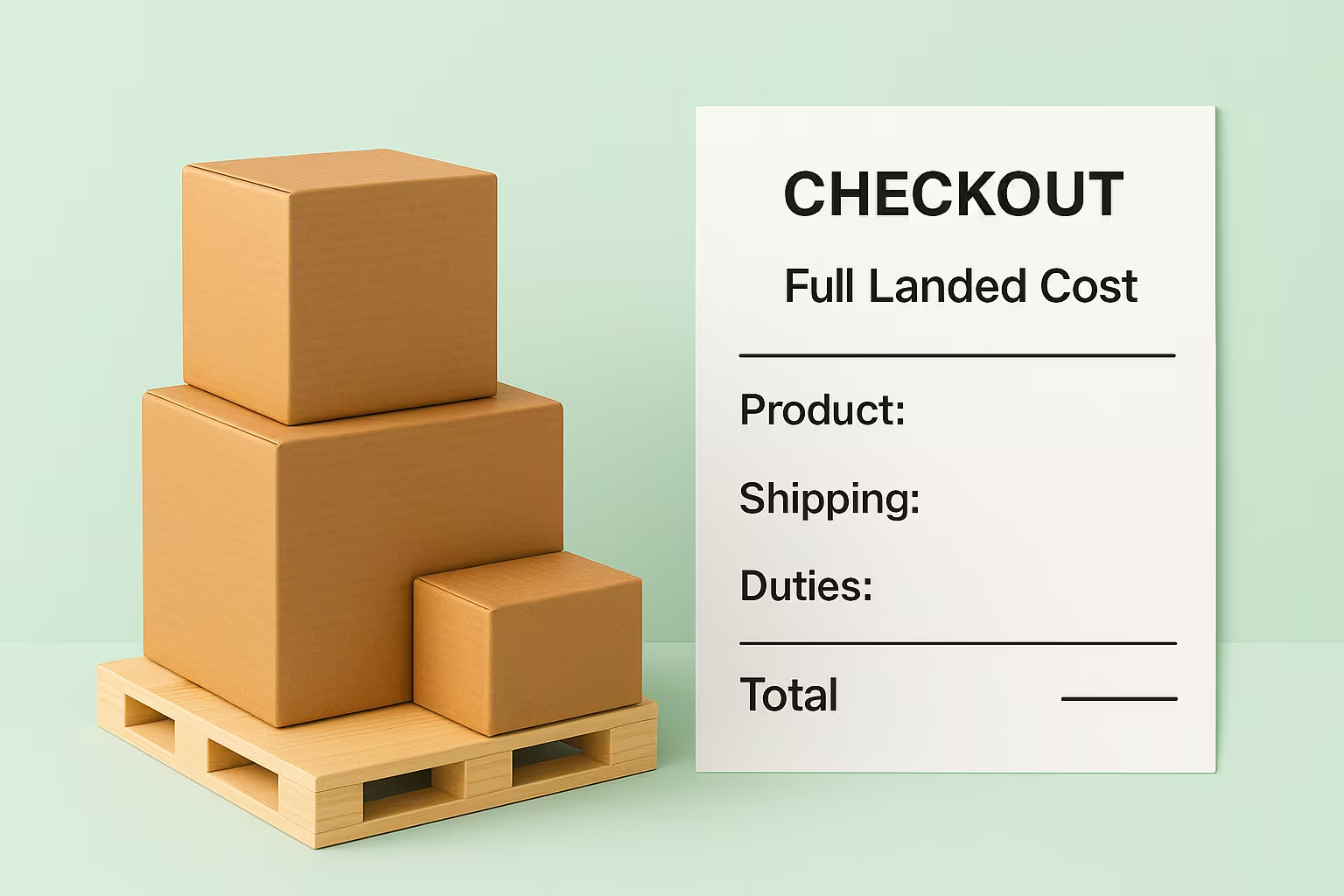
Baymard Institute's checkout research shows 39% of US shoppers abandon checkout over unexpected costs including shipping, taxes, and duties, and 14% abandon when they can't see total cost upfront. Both failure modes are common under DDU shipping with bulk-import duty timing.
Duty timing is not just a finance fix. It is an operational unlock across the entire customer and inventory lifecycle.
Stop leaving money on the table
Paying duties upfront drains capital. Paying duties only when a unit sells frees capital to grow. Most brands focus on shaving a few points off duty rates while losing far more to cart abandonment, tied-up capital, and poor customer experience. If duty timing is dragging on your cash flow, it's worth talking to our team about how per-order duty payment would reshape your unit economics.
FAQ
What is duty timing?
Duty timing is when import duties are paid relative to production and revenue. Under the legacy model, duties are paid upfront on bulk shipments. Under direct fulfillment, duties are paid per order, only after a customer buys.
Is duty timing more important than duty rates?
For most DTC brands doing $1M–$15M, yes. Rate optimization saves a few margin points and takes months of legal review. Timing optimization unlocks 60 to 90 days of working capital and starts on the next shipment.
How does per-order duty payment work?
Inventory stays in the country of manufacture. When a customer orders, the unit ships direct with duties applied to that single parcel at fulfillment. You pay duties matched to revenue, not on forecasted inventory.
Can I defer duties without changing my supply chain?
Bonded warehouses and Foreign-Trade Zones defer duty until withdrawal, but goods still sit in inventory. Direct fulfillment goes further: duties only apply when an order ships, eliminating duty exposure on unsold units entirely.
How much capital can better duty timing free up?
A brand paying $25,000 in duties per $100,000 shipment cycles that capital every 120 to 180 days under the legacy model. Per-order duty payment cycles it in seven to 10 days. Use the Portless ROI calculator to model your specific savings.
Does duty timing affect international conversion rates?
Lorem ipsum dolor sit amet, consectetur adipiscing elit. Suspendisse varius enim in eros elementum tristique. Duis cursus, mi quis viverra ornare, eros dolor interdum nulla, ut commodo diam libero vitae erat. Aenean faucibus nibh et justo cursus id rutrum lorem imperdiet. Nunc ut sem vitae risus tristique posuere.
Get operator-level supply chain insights
Thank you! Your submission has been received!
Oops! Something went wrong while submitting the form.









.jpg)