“We generated $70K in package protection revenue in a single quarter by adding a simple $4 protection option at checkout — plus an additional $12K from cashbacks. Customers get peace of mind, and we're making a profit on every protected order with zero effort."
“We generated $70K in package protection revenue in a single quarter by adding a simple $4 protection option at checkout — plus an additional $12K from cashbacks. Customers get peace of mind, and we're making a profit on every protected order with zero effort."
Most DTC brands think of their marketing budget as a number they set at the beginning of the quarter. In practice, it's set by something they rarely examine: how long their capital is locked in inventory before it turns into cash they can spend.
Taylor Holiday, CEO of Common Thread Collective, works with consumer brands doing $5M to $200M in revenue. He sees this constantly — brands trying to squeeze growth out of their ad account when the real constraint is their cost structure.
But when your COGS or fulfillment costs come down, your gross margin per unit goes up. That means you can afford to acquire customers at a higher cost and still be profitable. He discussed this in depth with Portless CEO Izzy Rosenzweig on The Modern Supply Chain:
If you would scrutinize [your cost of goods and fulfillment] with the same level that you are your Facebook ROAS, you might unlock the reality that if you could spend more on [ads] and still get to the same marginal dollar value, that's how the business might grow more.” — Taylor Holiday, CEO at Common Thread Collective
How your cash conversion cycle caps your marketing spend
This isn't just a Portless theory. eComFuel's 2026 Trends Report, based on 300 Ecommerce owners representing $3.5B in revenue, found that brands who own their warehouses grew revenue at just 3.9%, while brands who lease or outsource fulfillment grew at 30–33%.
The report's takeaway: the operators winning today are the ones who own the least and stay the leanest. The brands growing fastest aren't the ones with the best ad creative or the highest ROAS. They're the ones whose operating structure doesn't trap their capital.
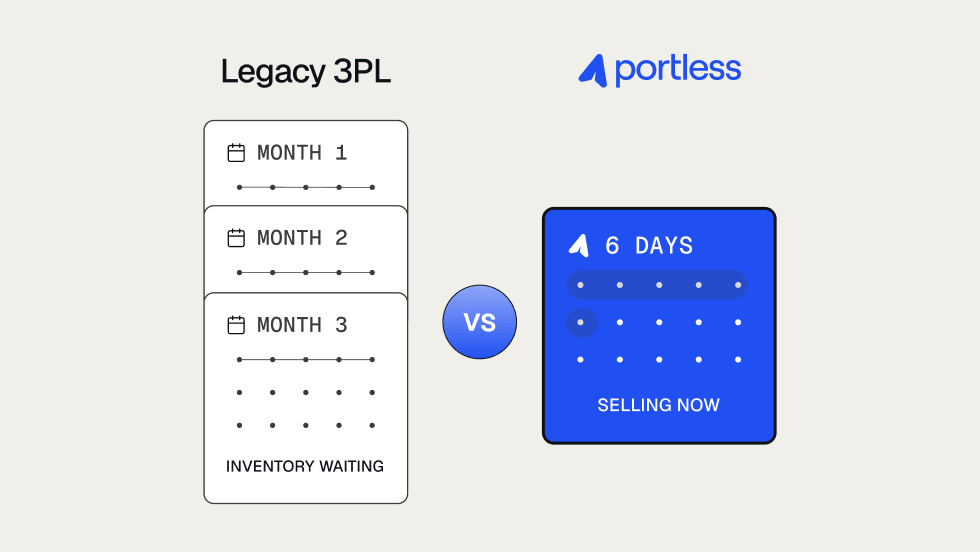
The mechanism that connects your supply chain to your marketing budget is your cash conversion cycle (CCC). This is the number of days between paying your manufacturer and receiving cash from a customer. For brands running the legacy model (bulk POs, ocean freight, domestic warehouse), that cycle is typically 60 to 90 days. Meaning everything you invest in inventory in January doesn't become spendable cash again until March or April.
Say you’re a $10M brand with a 90-day cash conversion cycle. At any given time, roughly $2.5M of your capital is locked in inventory that hasn’t sold yet. That’s $2.5M you can’t allocate to Meta, Google, or any other growth channel. Your marketing budget isn’t a strategic decision. It’s whatever’s left after your supply chain takes its cut.
Now compress that cycle to 10 days. The same $10M brand now has roughly $275K locked in inventory instead of $2.5M. The difference — over $2M in freed capital — can go directly into customer acquisition, product development, or the founder’s pocket.
::table
Cash conversion cycle;Capital locked in inventory ($10M brand);Available for marketing and growth
90 days;~$2.5M;Constrained by working capital
60 days;~$1.7M;Moderate flexibility
30 days;~$830K;Meaningful reinvestment capacity
10 days;~$275K;Maximum growth flexibility
:table
This is what Taylor means when he says the scoreboard is in the financial documents. Your Facebook ROAS can be excellent and your business can still be capital-constrained if your supply chain is eating all the cash.
MOST PORTLESS CUSTOMERS ACHIEVE A <30 DAYS CCCAnd some go negative, meaning they're collecting revenue from customers before their supplier payment is even due. Foreign Resource is a strong example: they moved to direct fulfillment and achieved a near-negative cash conversion cycle while scaling their global streetwear brand. Read their success story.
The $50M brand that couldn’t pay its founders
Taylor described a brand he worked with doing $50M in revenue with $12M in EBITDA. On paper, wildly successful. In practice, the founders had never taken a dollar out.
Every year, to fund the next 30% of growth, they had to reinvest everything into inventory. Manufacturing took two to three weeks. Ocean freight took five more. Domestic receiving and distribution added another week or two. By the time finished goods were sellable, the capital had been locked for 60 to 90 days.
“I realized that the scoreboard of business is in the financial documents. My success and failure is defined by what happens on my P&L, my balance sheet, and my cash flow statement.” — Taylor Holiday, CEO at Common Thread Collective
The brand was P&L rich and cash poor. Inventory carrying costs typically run 20 to 30% of total inventory value annually. Applied to a growing inventory base, those costs compound. The founders became desperate to sell the business because that felt like the only way to realize any value. But the offers came with onerous terms and debt that made the exit worse than they’d hoped.
This isn’t a niche story. It’s the default state for DTC brands running the legacy supply chain: profitable on the P&L, constrained by the balance sheet.
What’s actually locking your capital
The traditional DTC supply chain has four stages that each lock capital for days or weeks. Understanding where the time goes is the first step to compressing it. For a full breakdown of each stage, see our Ecommerce supply chain management guide.
Manufacturing: 2–4 weeks
You place a PO, and your factory begins production. Capital is committed the moment the PO is placed. For many brands, this includes a deposit of 30 to 50% upfront.
Ocean freight: 4–6 weeks
Your finished goods sit in a container crossing the Pacific. During this time, your capital is literally at sea. You can’t sell, can’t fulfill, can’t generate revenue from these units.
Domestic receiving and distribution: 1–2 weeks
Your 3PL receives the container, checks in inventory, distributes to shelves. More dead time before any unit is sellable.
Sell-through: variable
Once inventory is live, how fast it sells depends on your marketing and demand. But the hidden costs of holding that inventory accumulate every day it sits unsold: storage fees, insurance, depreciation, and the opportunity cost of that capital.
Add it up: 8 to 12 weeks of locked capital before you see a dollar back, plus ongoing carrying costs on whatever doesn’t sell immediately. That’s the real cost of the legacy model, and it’s invisible on most dashboards.
How direct fulfillment changes the math
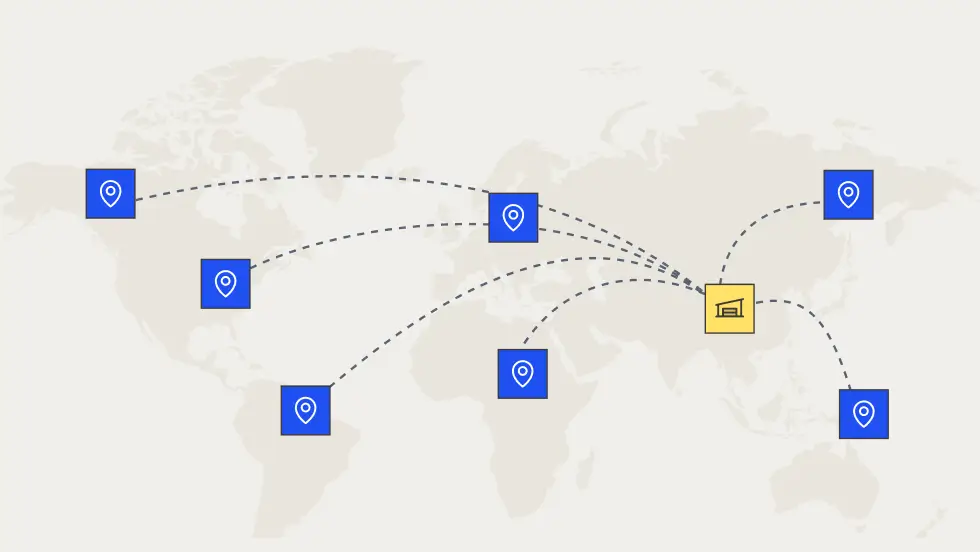
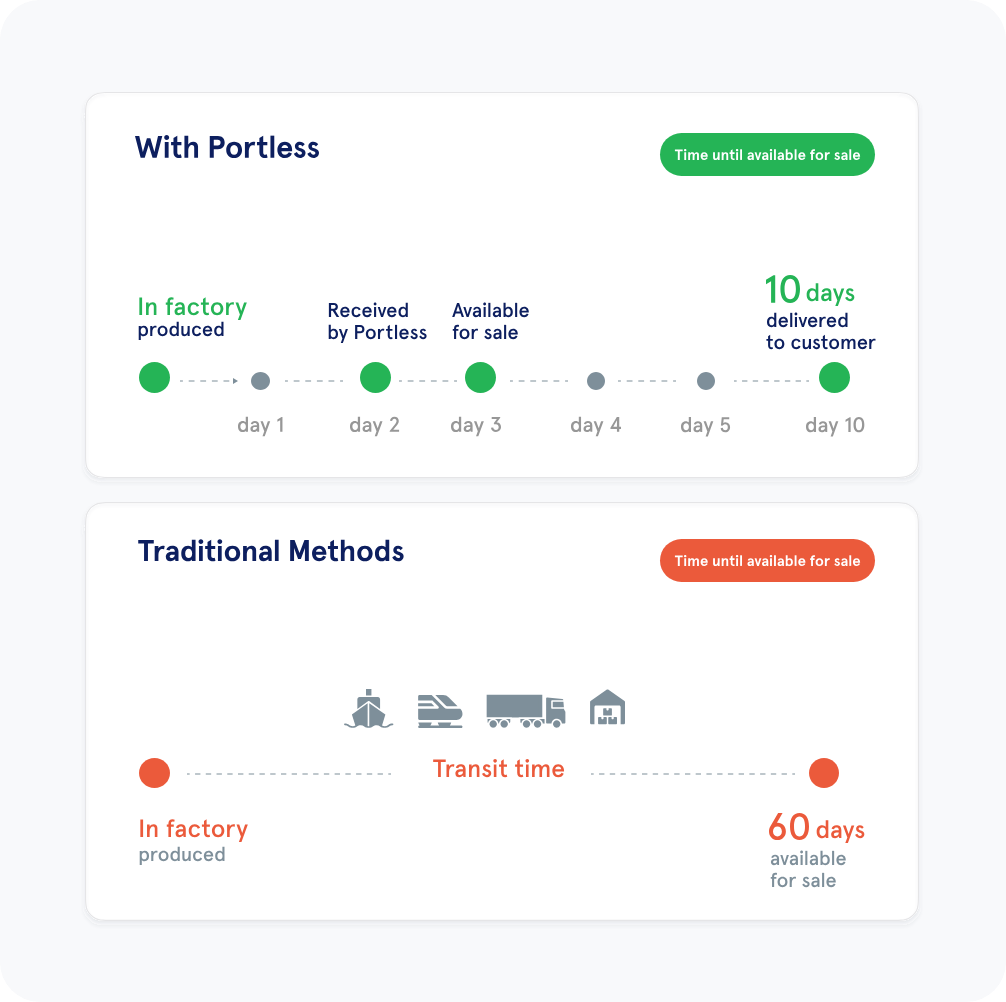
Direct fulfillment compresses the cash conversion cycle by eliminating the two longest stages: ocean freight and domestic receiving. Instead of shipping a container to a US warehouse, finished goods move to a fulfillment center near the factory and are sellable within days of production.
Orders ship direct to customers by air, with duties applied at the parcel level as each order crosses the border. You’re not paying a lump-sum duty bill on a container of unsold inventory. You’re paying duty per order, matched against the revenue from that specific sale.
The effect on your marketing budget is direct: capital that was locked for 60 to 90 days is now locked for less than 10. That freed-up cash can go straight into customer acquisition.
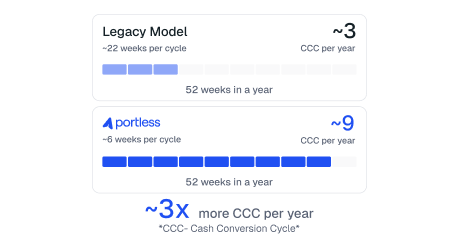
Craft Club experienced exactly this. The craft kit brand was managing inventory across three warehouses, with all cash cycling back into production. After switching to direct fulfillment with Portless, they saw a 3x drop in their cash conversion cycle and 300% growth. The marketing didn’t change. The financial foundation underneath it did.
RUN THE NUMBERS FOR YOUR BRANDHow much capital is locked in your current supply chain? Use our direct fulfillment ROI calculator to model what your cash conversion cycle looks like under a different fulfillment model.
What this means for your marketing decisions
When your cash converts faster, three things change in how you can run marketing:
You can reinvest revenue faster. Revenue from this week’s sales is available to fund next week’s ad spend. You’re not waiting three months for your inventory investment to come back. This creates a compounding effect: faster cash conversion means faster reinvestment means faster growth.
You can test more aggressively. When you don’t need to commit $50K to a container before you know if a product will sell, you can test smaller quantities, read demand signals in real time, and scale the winners. Your marketing budget isn’t held hostage by a single large inventory bet.
You can set different CAC targets. A brand with a 10-day cash conversion cycle can afford to acquire customers at a higher upfront cost because the capital comes back faster. A brand stuck at 90 days has to be conservative because every dollar deployed takes a quarter to return. Same product, same margin, different marketing capacity based entirely on supply chain structure.
According to Deloitte’s 2026 retail outlook, 82% of retail executives are now prioritizing margin improvement over revenue growth. The brands that can fund growth from operating cash flow, rather than external capital, have a structural advantage. Your supply chain is what determines which side of that equation you’re on.
Watch the full episode
Portless CEO Izzy Rosenzweig sat down with Taylor Holiday of Common Thread Collective on The Modern Supply Chain to go deeper on how the best brands connect finance to marketing, why the growth-at-all-costs era created a generation of cash-poor brands, and what the playbook looks like in 2026. Watch below, or listen on Spotify and Apple Podcasts.
Stop letting your supply chain set your marketing budget
Your marketing budget isn’t really set by your CMO or your CFO. It’s set by how fast your supply chain converts inventory into cash. Compress that cycle and you unlock capital that goes straight into growth. Talk to our team to see what your cash conversion cycle looks like under a direct fulfillment model.
FAQ
How does my supply chain affect my marketing budget?
Your supply chain determines your cash conversion cycle — the number of days capital is locked in inventory before it becomes revenue. A 90-day cycle means $2.5M of a $10M brand’s capital is tied up at any given time. Compressing that cycle to 10 days frees over $2M that can be reinvested in customer acquisition and growth.
What is the cash conversion cycle?
The cash conversion cycle measures how many days it takes from paying your manufacturer to receiving cash from a customer. Under a traditional supply chain with ocean freight and domestic warehousing, that’s typically 60 to 90 days. Under a direct fulfillment model, it can be compressed to under 10 days. For a full breakdown, see our cash conversion cycle guide.
How does direct fulfillment shorten the cash conversion cycle?
Direct fulfillment eliminates ocean freight and domestic warehouse receiving — the two longest stages in the traditional supply chain. Finished goods move to a fulfillment center near the factory and are sellable within days. Duties are paid per order at the parcel level rather than as a lump sum on a container of unsold goods.
Can I really grow faster just by changing my fulfillment model?
Yes. Craft Club saw 300% growth after switching to direct fulfillment with Portless. The marketing didn’t change. What changed was their cash conversion cycle, which dropped by 3x. Faster cash conversion meant more available capital to reinvest in marketing, which meant faster growth. The supply chain was the bottleneck, not the ads.
How do I calculate how much capital my supply chain is locking up?
Take your annual COGS and divide by 365 to get your daily inventory cost. Multiply by the number of days in your cash conversion cycle. That’s roughly how much capital is locked at any given time. Use our ROI calculator to model this against a direct fulfillment scenario.
Frequently asked questions
Heading
Lorem ipsum dolor sit amet, consectetur adipiscing elit. Suspendisse varius enim in eros elementum tristique. Duis cursus, mi quis viverra ornare, eros dolor interdum nulla, ut commodo diam libero vitae erat. Aenean faucibus nibh et justo cursus id rutrum lorem imperdiet. Nunc ut sem vitae risus tristique posuere.
Get operator-level supply chain insights
Thank you! Your submission has been received!
Oops! Something went wrong while submitting the form.








%20(1).avif)
.jpg)
.jpg)