“We generated $70K in package protection revenue in a single quarter by adding a simple $4 protection option at checkout — plus an additional $12K from cashbacks. Customers get peace of mind, and we're making a profit on every protected order with zero effort."
“We generated $70K in package protection revenue in a single quarter by adding a simple $4 protection option at checkout — plus an additional $12K from cashbacks. Customers get peace of mind, and we're making a profit on every protected order with zero effort."
You pay your manufacturer in January. The goods ship by ocean freight, clear customs, land in a warehouse, and sit there until a customer finally orders. You don’t see that cash again until April.
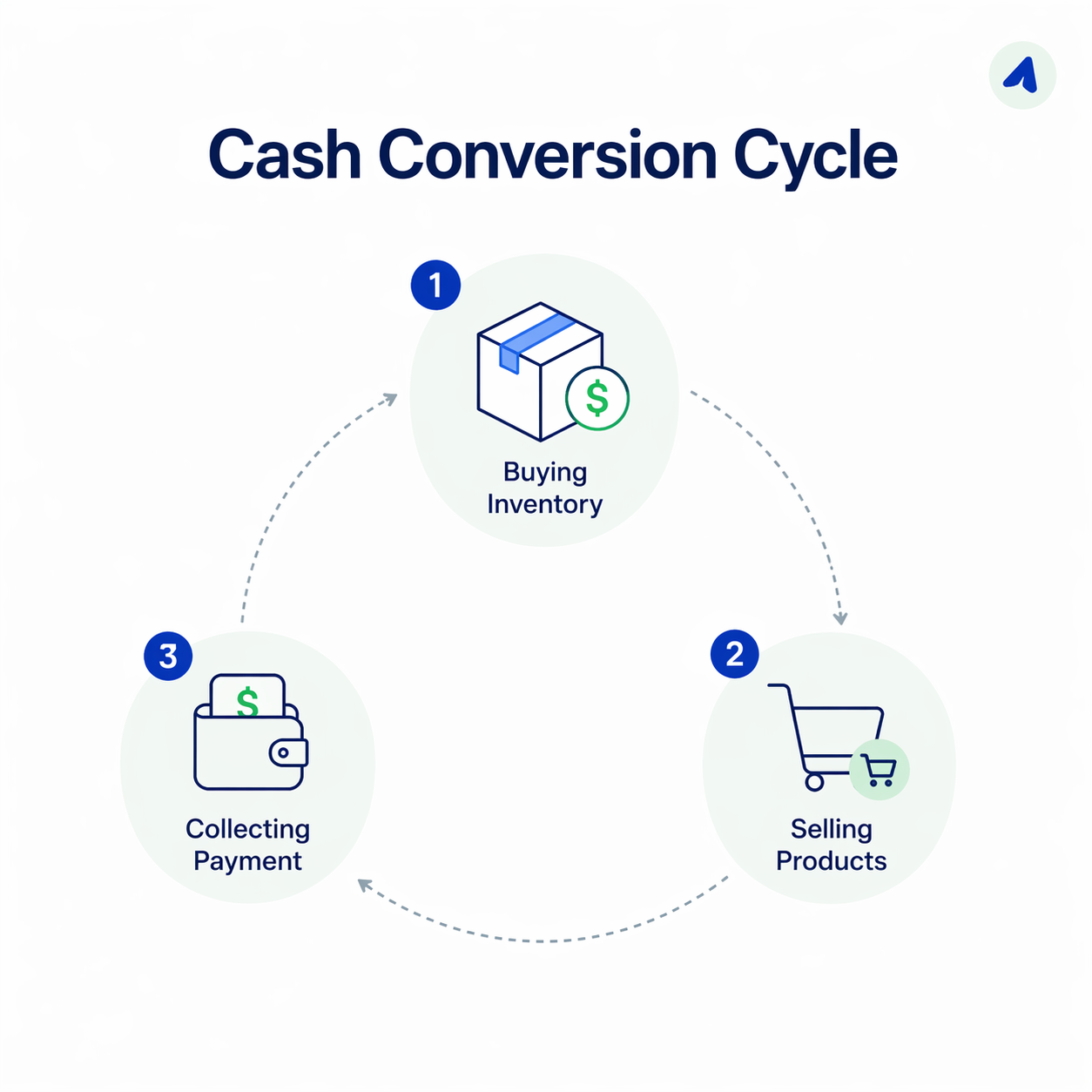
That gap — the time between spending money on inventory and getting it back from customers — is your cash conversion cycle (CCC). It connects three stages: buying inventory, selling products, and collecting payment.
A shorter cycle means you get cash back into your business faster. A longer cycle means more money sits locked in unsold goods and unpaid invoices. For DTC brands that manufacture overseas, the CCC reveals how efficiently your supply chain turns production spend into revenue.
And the faster that cash comes back, the faster you can reinvest it into marketing, product development, and inventory — the things that actually generate your next round of sales.
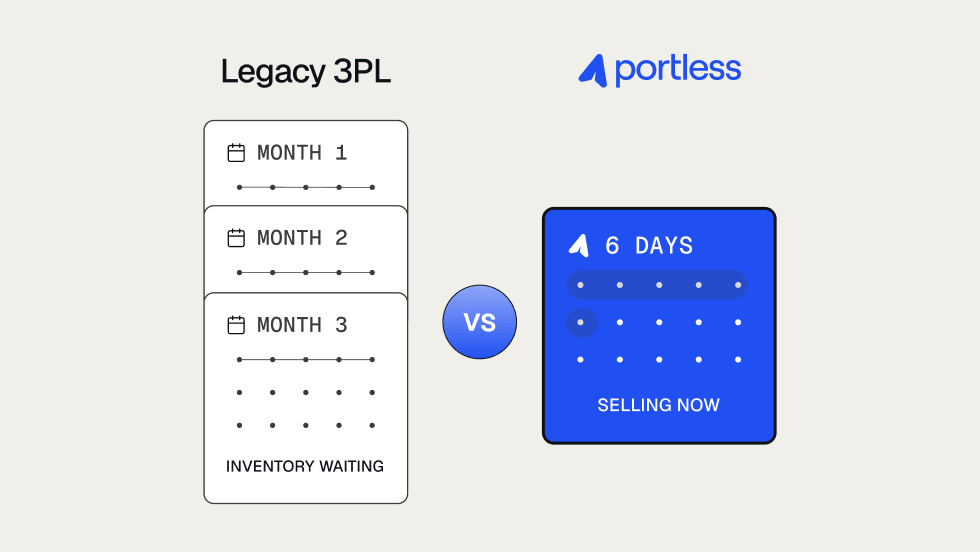
Most Ecommerce brands carry far more inventory than they need because the legacy model forces them to. You order in bulk, ship by ocean freight, wait 60–90 days for goods to reach a domestic warehouse, and then hope your demand forecast was right. That model creates a long cash conversion cycle by design.
Why the cash conversion cycle matters
Every dollar tied up in inventory is a dollar you can't spend on ads, new product development, or international expansion. The CCC puts a number on that problem. If you want to see exactly how much working capital your current supply chain is locking up, run your numbers through our ROI calculator — it breaks down shipping costs, holding costs, and cash conversion cycle impact side by side.
Short CCC (under 30 days): You reinvest revenue in weeks, not quarters — freeing up capital for your next product launch or ad campaign.
Long CCC (60–120+ days): A brand carrying $500K in inventory with a 90-day CCC has half a million dollars locked up for three months.
Negative CCC: You collect cash from customers before paying suppliers, meaning your business generates cash as it operates.
Who should track the cash conversion cycle?
The CCC applies to any business that buys and sells physical goods. It’s especially useful for DTC Ecommerce brands that pre-purchase inventory from overseas manufacturers, retail operators managing seasonal inventory, and operations and finance leaders responsible for working capital. If you buy inventory before you sell it, your CCC tells you how long your cash is trapped in that cycle.
How to calculate the cash conversion cycle
The cash conversion cycle formula has three components:
CCC = DIO + DSO – DPO
Each component measures a different stage of the cash cycle. Together, they tell you the total number of days between paying your supplier and collecting cash from your customer.
Breaking down each component
Days Inventory Outstanding (DIO): The average number of days your inventory sits in stock before you sell it. A high DIO means products sit too long, tying up cash.
Days Sales Outstanding (DSO): The average number of days it takes to collect payment after a sale. For most Ecommerce brands selling direct to consumers, DSO is low because customers pay at checkout.
Days Payable Outstanding (DPO): The average number of days you take to pay your suppliers. A high DIO means products sit too long, tying up cash and increasing your inventory holding costs.
Cash conversion cycle calculation example
Here’s a step-by-step example using realistic Ecommerce numbers:
This brand waits 59 days between paying for inventory and getting that cash back from customers. That’s 59 days of working capital locked in the cycle.
What does a negative cash conversion cycle mean?
A negative CCC means you collect cash from customers before you pay your suppliers. For most DTC brands, a negative CCC is hard to achieve with legacy supply chain models. But it becomes possible when you shorten DIO dramatically and negotiate favorable supplier payment terms.
What is a good cash conversion cycle?
There’s no single “good” number. Your target CCC depends on your industry, business model, and supply chain structure.
That said, most Portless customers achieve a CCC under 30 days, and some go negative, meaning they're collecting revenue from customers before their supplier payment is even due.
Foreign Resource is a strong example: they moved to direct fulfillment and achieved a near-negative cash conversion cycle while scaling their global streetwear brand.
Cash conversion cycle benchmarks by industry
::table
Industry;Typical CCC range
Ecommerce / DTC;30–90 days
Retail;20–60 days
Manufacturing;60–120 days
Tech / SaaS;Negative to 30 days
Food and beverage;10–40 days
:table
These ranges vary widely because CCC depends more on supply chain structure than on product category. Two Ecommerce brands selling similar products can have a 60-day difference in CCC based on how they fulfill orders.
Some of the largest companies in the world operate with negative CCCs. But you don’t need that kind of scale to get there — you need the right fulfillment structure.
Why a long cash conversion cycle hurts your business
A long CCC creates a gap between when you spend money and when you get it back. That gap has to be funded — by your cash reserves, a credit line, or outside capital.
Cash flow gaps and working capital strain
When your CCC is 90 or 120+ days, you’re funding the next production run before the last one has paid for itself. This creates a cash flow gap that grows with every new purchase order.
The hidden cost of tied-up capital
Every dollar sitting in inventory could be spent on paid acquisition, new SKU development, or market expansion. A 90-day CCC on $500,000 of inventory means roughly $500,000 in capital that can’t be deployed elsewhere for three months.
How a long CCC gets worse at scale
A long CCC compounds as your business grows. If your CCC is 90 days and you double your order volume, you’ve doubled the amount of cash trapped in the cycle.
Brands with long cash conversion cycles often can’t scale marketing spend because their cash is trapped in inventory. They pass on new product launches because they’re still carrying unsold stock from the last one. Growth slows — not because demand is weak, but because the supply chain consumes all available capital.
Seven strategies to reduce your cash conversion cycle
1. Reduce Days Inventory Outstanding
DIO is the biggest lever for most Ecommerce brands. You reduce it by carrying less inventory, turning it faster, or both.
Order smaller batches more frequently instead of placing large bulk orders quarterly
Use sell-through data to match production to actual demand rather than forecasts
Cut dead stock by identifying slow-moving SKUs early and discounting or discontinuing them
2. Reduce Days Sales Outstanding
Most DTC Ecommerce brands already have low DSO because customers pay at checkout. But if you sell wholesale or B2B alongside DTC, DSO can climb fast. Collect payment upfront, shorten net payment terms on wholesale invoices, and automate invoice reminders to reduce late payments.
3. Negotiate longer payment terms with your suppliers
The longer you take to pay suppliers, the longer cash stays in your account. Negotiate net-60 or net-90 terms where possible, and explore supplier financing or trade credit programs. This is one of the easiest levers to pull. Most manufacturers expect the conversation, especially if you're a reliable, growing account.
4. Ship directly from the source
This is where most DTC brands leave the biggest gains on the table. The legacy model — bulk ocean freight to a domestic warehouse — adds 60–90 days of inventory holding time before a single unit sells.
When you ship directly from your manufacturer to the end customer, you skip the warehouse entirely. Products go from finished production to a customer’s door in days, not months. DIO drops because inventory doesn’t sit in a warehouse waiting to be picked.
5. Use real-time inventory and sales data
Matching supply to demand in real time reduces overstock and shortens the time products sit unsold. Integrate your Ecommerce platform with your fulfillment and production systems so you can reorder based on actual sales velocity — not quarterly guesses.
6. Optimize your supply chain for speed
Every day between finished production and delivered order adds to your CCC. Choose manufacturers with shorter lead times, use air freight from origin countries instead of ocean shipping, and reduce handoffs between production, warehousing, and last-mile delivery. Shipping speed and reliability directly affect how fast you convert production spend into revenue.
7. Rethink your fulfillment model
The strategies above optimize individual components of the CCC. But the biggest reduction comes from changing the model itself. Instead of bulk-import-to-warehouse, direct fulfillment from your manufacturer eliminates the longest stage of the cycle: inventory sitting in a domestic warehouse.
Cash conversion cycle for Ecommerce and DTC brands
Why Ecommerce brands are especially vulnerable
DTC brands that manufacture overseas face a structural disadvantage. The legacy supply chain requires you to forecast demand months in advance, commit capital to bulk production, pay for ocean freight and customs duties, and wait for goods to arrive at a domestic warehouse. Only then can you start selling.
That model creates a CCC of 90–120+ days for many Ecommerce brands. You’re paying for inventory in January that doesn’t generate revenue until April.
How DTC brands can achieve a near-zero or negative CCC
The path to a short CCC runs through DIO reduction. If you get inventory from production to sale in days instead of months, your CCC compresses dramatically.
Combine a short DIO with standard DTC payment collection (customers pay at checkout, so DSO is near zero) and negotiated supplier terms (DPO of 30–60 days), and you can reach a near-zero or even negative CCC.
Before and after CCC with direct fulfillment
::table
;Legacy model;Direct fulfillment model
DIO;90 days (bulk import + warehouse);8 days (production to customer)
DSO;2 days (online payment);2 days (online payment)
DPO;30 days (supplier terms);30 days (supplier terms)
CCC;62 days;–20 days
:table
The difference isn’t incremental. It’s structural. The fulfillment model determines how long your cash stays trapped.
How Portless helps brands shorten their cash conversion cycle
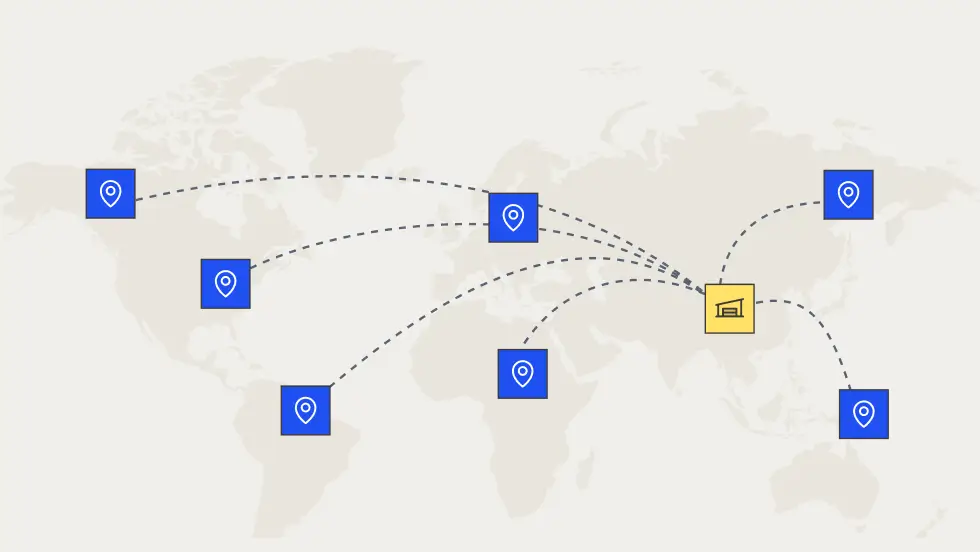
Portless fulfills orders directly from manufacturers in Asia to customers in 85+ countries. Products go from production to a customer’s door in as few as six days. No domestic warehouse. No bulk ocean freight. No 60–90 day wait.
Because Portless ships from the point of manufacture, your inventory becomes available for sale days after production — not months. DIO drops from 60–90+ days to single digits. That’s the single biggest lever you can pull to shorten your cash conversion cycle.
A shorter CCC means less cash trapped in inventory and more capital available for marketing, product development, and international expansion.
Ready to shorten your cash conversion cycle?
Find out how much working capital your supply chain is locking up — and what direct fulfillment could free. Book a demo and find out if Portless is right for your business.
FAQ
What is the difference between the cash conversion cycle and the operating cycle?
The operating cycle measures total time from purchasing inventory to collecting cash (DIO + DSO). The cash conversion cycle subtracts DPO, accounting for how long you delay payment to suppliers — giving you a more complete picture of actual cash flow timing.
Can a small Ecommerce brand have a negative cash conversion cycle?
Yes. A negative CCC depends on your supply chain structure, not company size. DTC brands that collect payment at checkout, ship directly from manufacturers, and negotiate 30–60 day supplier terms can achieve a negative CCC at any revenue level.
How often should Ecommerce brands calculate their cash conversion cycle?
Calculate your CCC monthly or quarterly to spot trends early. Seasonal demand shifts, supplier term changes, or fulfillment model switches can all move your CCC — catching those changes quickly lets you adjust before cash flow tightens.
Does the cash conversion cycle apply to subscription Ecommerce brands?
Yes, though subscription models often have a structural advantage. Predictable recurring revenue reduces DSO, and consistent order volumes make it easier to match inventory to actual demand — both of which shorten the CCC.
Frequently asked questions
Heading
Lorem ipsum dolor sit amet, consectetur adipiscing elit. Suspendisse varius enim in eros elementum tristique. Duis cursus, mi quis viverra ornare, eros dolor interdum nulla, ut commodo diam libero vitae erat. Aenean faucibus nibh et justo cursus id rutrum lorem imperdiet. Nunc ut sem vitae risus tristique posuere.
Get operator-level supply chain insights
Thank you! Your submission has been received!
Oops! Something went wrong while submitting the form.








.jpg)

.avif)