“We generated $70K in package protection revenue in a single quarter by adding a simple $4 protection option at checkout — plus an additional $12K from cashbacks. Customers get peace of mind, and we're making a profit on every protected order with zero effort."
“We generated $70K in package protection revenue in a single quarter by adding a simple $4 protection option at checkout — plus an additional $12K from cashbacks. Customers get peace of mind, and we're making a profit on every protected order with zero effort."
A tech pack is the technical document you hand your manufacturer to tell them exactly how to build your product. It covers every measurement, material, and construction detail a factory needs to turn your design into a finished, repeatable product.
For DTC brands producing overseas, your tech pack is the single most important document in product development, and the one most likely to get skipped or left half-finished.
This guide covers what a tech pack is, what goes in one, and how to create one that gets you a sample that’s right the first time.
What is a tech pack?
A tech pack, short for technical package, is a detailed specification document that tells a manufacturer how to produce your product. It acts as the blueprint the factory follows for every sample and every production run. The brand, or its technical designer, creates the tech pack, and the factory builds against it.
You'll also hear it called a spec sheet, specification pack, technical package, or garment specification sheet. Apparel is where tech packs are most standard, but the same logic applies to bags, accessories, footwear, and plenty of other manufactured products. If a factory has to guess, you've lost control of the outcome.
Tech packs are usually created by technical designers, the specialists who translate a creative concept into manufacturing specs. Per the U.S. Bureau of Labor Statistics, fashion designers select fabrics and patterns and give instructions on how their products should be made. Documenting those instructions in full is exactly what a tech pack does.
Why your tech pack matters more than you think
Your tech pack is the closest thing you have to a production contract. It defines what “correct” means, so when a sample comes back wrong, you have a documented spec to point to instead of an argument.
Leaving it thin is expensive. Without a clear spec, the factory fills the gaps with assumptions, and assumptions show up as defects, wrong measurements, substituted materials, and extra sampling rounds. Each round adds weeks and cost before you've sold a single unit.
A detailed tech pack does the opposite. It:
Cuts sampling rounds by giving the factory an unambiguous target.
Speeds up quoting, since factories can price accurately from a complete spec.
Improves quality control, because inspectors check finished goods against a documented standard instead of memory.
Keeps control with you, not the factory.
That last point alone is huge.
::callout
OWN YOUR SPEC
If you let the factory create your tech pack, you hand it control over your product's measurements, materials, and finish. Owning the spec yourself keeps that control with your brand, and gives you something concrete to point to when a sample doesn't match.
:callout
What goes in a tech pack
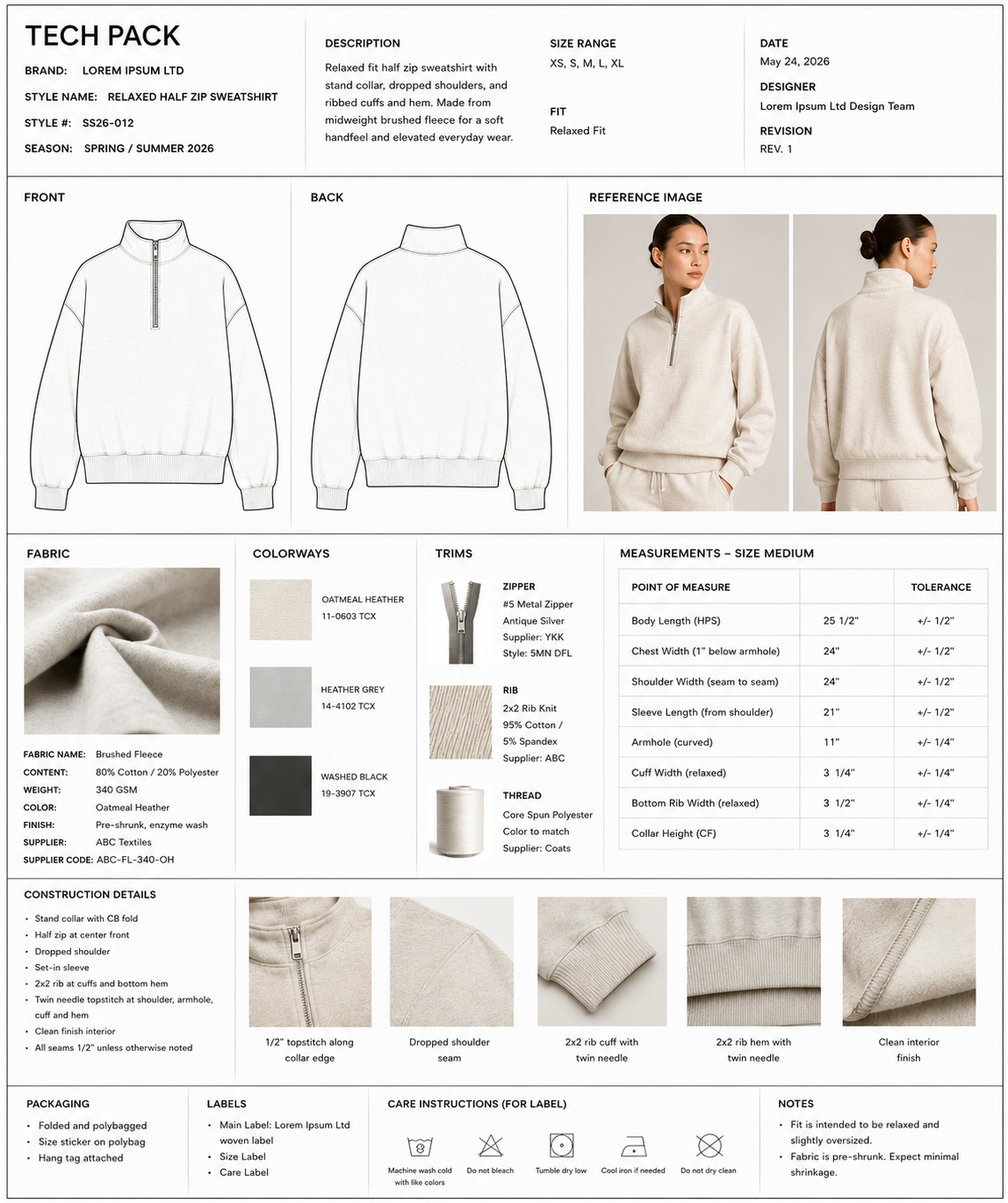
A complete tech pack documents everything a factory needs to build your product without asking questions. The exact sections vary by product, but most include the core components below.
::table
Component;What it covers;Why it matters
Technical flat sketches;Black-and-white line drawings from the front, back, and side, plus detail views;Give the factory its base construction reference, not a styled illustration
Bill of materials (BOM);Every fabric, trim, thread, zipper, button, and label, with placement and supplier;Determines cost, sourcing, and what the factory orders
Colorways;Each color version, specified with a color standard such as Pantone;Keeps color consistent across production runs and suppliers
Measurements and size grading;Points of measure for a base size, graded across your full size run;Controls fit and consistency from sample to bulk
Construction and stitching;Seam types, stitch counts, hems, and finishing callouts;Defines how the product is assembled, not just what it is made of
Labeling and packaging;Brand labels, care labels, hang tags, polybag, and carton specs;Covers compliance and how the product arrives
Annotations and callouts;Zoomed-in notes on specific details with exact measurements;Removes ambiguity on the details most likely to go wrong
Revision history;A dated log of every change to the spec;Keeps you and the factory working from the same version
:table
Four of these carry most of the weight.
Your flat sketches give the factory its primary reference, so they need to show every seam and closure, not just the silhouette.
The bill of materials drives your cost, because it's the list the factory prices and sources against.
Graded measurements control fit across sizes, and one wrong point of measure can ruin an entire run.
Construction details tell the factory how to assemble the product, which is where two factories working from the same sketch can still turn out very different results.
For colorways, most brands specify each color against a standard like the Pantone Matching System, which lets manufacturers in different locations reproduce the same color without ever comparing physical samples. That's especially useful when you're producing overseas.
How to create a tech pack
You create a tech pack by documenting your product one layer at a time, starting with the drawing and ending with packaging. Here's the order most technical designers work in.
Start with technical flat sketches. Draw the product front, back, and side in flat, black-and-white line art, and add detail views for anything complex.
Build the bill of materials. List every material, trim, and component, with placement and, where you have it, supplier information.
Add points of measure and grading. Define how each dimension is measured, record the base-size measurements, then grade across your size run.
Specify construction and finishing. Document seam types, stitching, hems, and any special techniques the factory needs to follow.
Define colorways. Assign a color standard, such as a Pantone code, to each color version.
Document labeling, packaging, and compliance. Cover brand and care labels, hang tags, polybags, cartons, and any market-specific requirements.
Keep a living revision log. Update the tech pack every time something changes, and date each version so you and the factory never work from a stale spec.
You can build a tech pack in a spreadsheet paired with a design tool, or in a dedicated tech pack or PLM platform. The format matters less than the discipline: keep it complete, keep it current, and make sure the version your factory has is the version you mean.
Tech pack vs spec sheet
A spec sheet is a subset of a tech pack, usually just the measurements and materials, while a tech pack is the full production package. For a simple product going to a factory that already knows your standards, a spec sheet may be enough. For a complex product, a new supplier, or a first production run, you want a full tech pack.
The practical rule: the less your factory knows about your product and your standards, the more complete your documentation needs to be. When in doubt, over-document.
Tech packs and manufacturing overseas
When your factory is overseas, your tech pack does even more work, because it's often the only shared language between your brand and the production floor. Distance, time zones, and language differences all raise the cost of a vague spec, so the document has to carry the full weight of your intent.
China is the center of gravity for DTC product manufacturing, and a reliable factory relationship there starts with a clear spec. A complete tech pack lets you compare quotes across suppliers, gives a third-party inspector a documented standard to check against, and keeps quality consistent from your first sample to your hundredth run. If you're working through this, our guide to sourcing products from China walks through choosing a factory, the quality-control step most brands skip, and where the tech pack fits in.
The spec is only the first half of getting a product to your customer. Once your goods are made, they still have to reach buyers, and that's where your fulfillment model comes in. Brands using direct fulfillment ship straight from the manufacturer to the customer, skipping the domestic warehouse entirely.
From factory to front door
A strong tech pack gets your product built right. What happens next, getting it from the factory to your customers, matters just as much to your margins and cash flow.
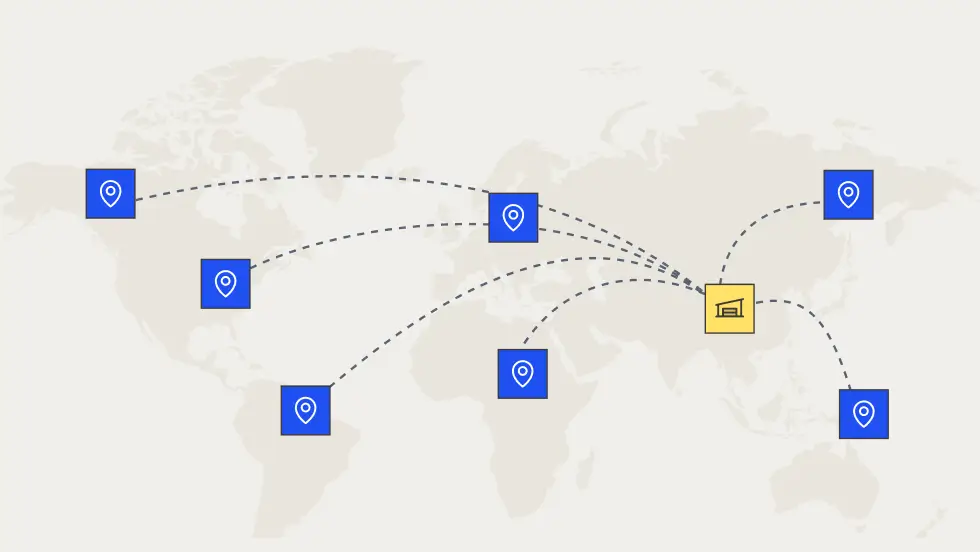
Portless ships Ecommerce orders directly from your manufacturer in China to customers in 85+ countries, with a local delivery experience on the other end and no domestic warehouse in between. If you're producing overseas and want a faster path from production to doorstep, talk to our team.
FAQ
What is a tech pack?
A tech pack is a technical specification document that tells a manufacturer exactly how to build your product. It includes flat sketches, a bill of materials, measurements, construction details, colorways, and labeling and packaging specs. The brand creates it, and the factory builds against it.
What should a tech pack include?
A complete tech pack includes technical flat sketches, a bill of materials, graded measurements, construction and stitching details, colorways, labeling and packaging specs, detail annotations, and a revision history. The exact sections vary by product, but a factory should be able to build your product from the document without asking questions.
Do I need a tech pack, or can the factory make one?
You should create your own tech pack rather than let the factory make it. Handing that job to the factory gives it control over your product's measurements, materials, and finish, and removes the documented standard you would otherwise hold it to. Most reputable factories won't start custom production without one.
What's the difference between a tech pack and a spec sheet?
A spec sheet is usually just the measurements and materials, while a tech pack is the full production package. A spec sheet can be enough for a simple product at a factory that already knows your standards. A full tech pack is the safer choice for complex products, new suppliers, or a first production run.
Can I create a tech pack myself?
Yes, you can create a tech pack yourself using a spreadsheet paired with a design tool, or a dedicated tech pack or PLM platform. The format matters less than completeness and version control. For complex products, many brands work with a technical designer to make sure nothing is missed.
Frequently asked questions
Heading
Lorem ipsum dolor sit amet, consectetur adipiscing elit. Suspendisse varius enim in eros elementum tristique. Duis cursus, mi quis viverra ornare, eros dolor interdum nulla, ut commodo diam libero vitae erat. Aenean faucibus nibh et justo cursus id rutrum lorem imperdiet. Nunc ut sem vitae risus tristique posuere.
Get operator-level supply chain insights
Thank you! Your submission has been received!
Oops! Something went wrong while submitting the form.






.avif)

.jpg)
.jpg)
.jpg)