Shipping is where every supply chain decision shows up. The terminology spans trade law, logistics, finance, and operations, and it's rarely defined with Ecommerce context in mind. This glossary fixes that. Written for operators who need clarity fast, whether you're reviewing a freight contract, comparing fulfillment models, or navigating a tariff change.


How your products physically move from factory to warehouse to customer, including ocean containers, air cargo, drayage, injection models, and everything in between.
The full end-to-end system that moves a product from raw materials to a customer's hands, encompassing sourcing, manufacturing, transportation, warehousing, fulfillment, and delivery.
A fulfillment model where goods are flown from an origin country and injected directly into a domestic carrier's last-mile network, bypassing traditional freight forwarding and warehousing.
A legal document issued by a carrier that serves as a receipt for shipped goods, a contract of carriage, and a document of title. Required for virtually all international ocean shipments.
A government-licensed facility where imported goods can be stored without paying duties or taxes until they're released for sale or re-exported. Useful for deferring tariff payments and managing cash flow.
A facility where less-than-container-load shipments are consolidated into or broken out of full containers. It acts as a staging area between ocean transport and inland distribution.
A shipment that fills an entire shipping container, either a 20-foot (TEU) or 40-foot (FEU) unit. Full container loads (FCL) are more cost-efficient per unit than less-than-container-load (LCL) shipments.
A pricing method carriers use to account for package size, not just actual weight. Calculated by multiplying length × width × height and dividing by a carrier-specific divisor. Bulky, lightweight items often cost more to ship than their actual weight would suggest.
A shipping model where goods are transported from a foreign origin and injected directly into a domestic postal or carrier network near the end customer, skipping intermediate warehousing.
Short-distance trucking that moves containers between ports, rail yards, and warehouses. A small but critical and often expensive leg of the supply chain.
The initial leg of a product's journey, typically from factory or supplier to the first transportation hub, freight forwarder, or port of origin.
Free on Board. An Incoterm that defines the point at which responsibility and cost transfer from seller to buyer. FOB Origin means the buyer assumes risk once goods leave the factory. FOB Destination means the seller carries risk until delivery.
Any shipment over 150 pounds or with dimensions larger than roughly 30" × 30" × 30". Freight moves by ocean, air, rail, or truck and is typically loaded onto pallets or into containers. Smaller shipments are more cost-effectively moved as parcels.
A logistics intermediary that arranges the transportation of goods on behalf of shippers. Freight forwarders coordinate carriers, customs documentation, and routing but typically don't own the ships, planes, or trucks themselves.
A freight shipping mode where a single shipper's goods fill an entire truck, typically 12 to 24 pallets. Faster and more predictable than LTL because there are no consolidation stops, but more expensive per shipment.
A freight shipping mode for loads that don't fill an entire truck, typically one to six pallets. Multiple shippers share trailer space, making LTL cheaper than full truckload but slower due to consolidation stops.
A standard warehouse where all applicable duties and taxes have already been paid on stored inventory. Simpler to operate than bonded facilities, but requires upfront duty payment at the time of import.
Shipping goods by sea in containers. The most cost-effective method for large or heavy shipments, but with significantly longer transit times than air — typically two to six weeks depending on the route.
The designated location (port, airport, or border crossing) where imported goods officially enter a country and are processed by customs authorities.
The company responsible for physically moving a package from origin to destination. Common carriers include USPS, UPS, FedEx, DHL, and Canada Post. Brands typically work with multiple carriers depending on destination, speed, and cost.
A geographic area used by carriers to price domestic shipments, usually numbered 1 through 8. Zone 1 is closest to the originating fulfillment center; Zone 8 is farthest. Transit times and costs both rise as the zone number increases.
The total time it takes for a shipment to travel from origin to destination. This includes transport time but may also factor in customs clearance, transshipment delays, and carrier processing.
A shipping strategy where a brand consolidates orders and trucks them past nearby carrier zones to inject them closer to the end customer's region, reducing per-package shipping costs by avoiding expensive zone-based pricing tiers.

The regulatory layer of cross-border commerce: tariffs, duties, trade programs, and the compliance frameworks that determine what you pay (or don't) to move goods across borders.
U.S. Customs and Border Protection. The federal agency responsible for enforcing trade laws, collecting duties, and screening imports entering the United States.
The Canada-United States-Mexico Agreement, formerly NAFTA. A trade agreement that governs tariff treatment, rules of origin, and market access between the three North American countries.
Delivered Duty Paid. An Incoterm where the seller assumes full responsibility for delivering goods to the buyer's door, including all shipping costs, customs clearance, duties, and taxes.
The declared value below which imported goods are exempt from duties and taxes. In the U.S., this threshold has historically been $800 per shipment under Section 321, though recent policy changes have significantly narrowed its applicability.
The seller bears all cost and risk of delivering goods to the buyer, including import duties and taxes. The buyer receives the goods with no customs obligations.
Now technically replaced by DAP under Incoterms 2020. The seller delivers goods to the buyer's location but the buyer is responsible for paying import duties, taxes, and customs clearance fees. Many contracts and platforms still reference DDU in practice, so you'll encounter the term even though DAP is the current standard.
A refund of customs duties paid on imported goods that are subsequently exported or used in the manufacture of exported products. A legitimate cost-recovery mechanism, but complex to administer.
The European Union's Export Accompanying System. A customs framework that tracks goods being exported from the EU, ensuring compliance with trade regulations and tax obligations.
An Incoterm where the seller makes goods available at their own premises and the buyer takes on all responsibility, cost, and risk from that point forward, including loading, transport, export clearance, and import duties. The most seller-favorable Incoterm.
An Incoterm where the seller delivers goods to a carrier or location chosen by the buyer and handles export clearance. Responsibility transfers to the buyer once the goods are handed off to the named carrier.
A U.S. customs valuation principle that allows importers to calculate duties based on the first (lower) sale price in a multi-tiered transaction. For example, the price from manufacturer to middleman rather than middleman to importer.
A designated geographic area where goods can be imported, stored, handled, manufactured, or re-exported without being subject to standard customs duties.
A standardized numerical code used globally to classify traded products. It determines the duty rate applied to your goods, and getting the classification wrong can mean overpaying or facing compliance penalties.
The entity legally responsible for ensuring imported goods comply with all local laws and regulations, and for paying any applicable duties and taxes. This can be the brand itself, a customs broker, or a third-party service.
International Commercial Terms. A set of standardized trade terms published by the International Chamber of Commerce that define responsibilities between buyers and sellers for shipping, insurance, customs, and risk transfer.
Import One-Stop Shop. An EU VAT collection scheme that allows non-EU sellers to charge and remit VAT at the point of sale for goods valued under €150, simplifying customs clearance and avoiding surprise charges for buyers.
The entity legally responsible for a transaction, including collecting payment, charging taxes, and handling refunds. In cross-border Ecommerce, the MOR structure determines who owns the compliance burden.
One-Stop Shop VAT. An EU system that allows businesses to file a single VAT return covering sales across all EU member states, rather than registering for VAT in each country individually.
A provision of U.S. customs law that allows shipments valued at $800 or less to enter the country duty-free and with simplified customs processing. Widely used in direct-from-China fulfillment models, though increasingly subject to regulatory scrutiny and restrictions.
A government-imposed tax on imported goods, typically calculated as a percentage of the product's declared customs value. Tariffs raise the landed cost of goods and directly affect margin, pricing, and sourcing strategy.
A mechanism that allows importers to delay payment of duties and taxes owed on imported goods, often through bonded warehousing, free trade zones, or government deferral programs. It preserves cash flow without eliminating the obligation.
The legal practice of modifying a product's design, classification, sourcing, or import structure to qualify for a lower tariff rate. Not evasion — strategic use of trade rules to reduce duty exposure.
The price actually paid or payable for goods when sold for export, used as the primary basis for calculating customs duties. Adjustments can apply for commissions, royalties, or assists.
A U.S. customs entry type used for Section 321 (sub-$800) shipments that require formal processing. Type 86 entries are primarily required when goods are subject to partner government agency (PGA) review — for example, from the FDA or CPSC — and also require an HS code classification.
Value Added Tax applied to goods sold in the United Kingdom. Non-UK sellers shipping goods valued at £135 or less must register for and collect UK VAT at the point of sale.
A broad term covering the value-added tax obligations that apply to online sellers operating across international markets, including registration, collection, reporting, and remittance requirements that vary by country.
VAT on E-Commerce. Norway's system requiring non-Norwegian sellers to register, collect, and remit VAT on goods sold to Norwegian consumers valued under NOK 3,000.

Everything that happens once inventory is in-country: warehousing, pick-and-pack, carrier selection, delivery speed, and the operational models that get orders to doorsteps.
Third-party logistics provider. A company that handles warehousing, picking, packing, and shipping on behalf of a brand. The most common outsourced fulfillment model for Ecommerce businesses.
A program that lets sellers use Amazon's fulfillment network to fulfill orders from non-Amazon sales channels like Shopify, wholesale, or their own website.
An order that can't be fulfilled immediately because one or more items are out of stock. The order is held and shipped once inventory replenishes, or split so in-stock items ship first.
A warehouse process where a picker collects inventory for multiple orders in a single trip through the facility rather than making a separate trip per order. Reduces labor cost per order and speeds up high-volume fulfillment days.
A model where orders are shipped directly from the manufacturer or supplier to the end customer, bypassing the brand's own warehouse entirely. Reduces inventory risk but limits control over packaging and speed.
A business model where brands sell directly to end customers through their own website, app, or retail presence, without intermediary retailers or wholesalers. Gives brands full control over pricing, margins, and the customer relationship.
A fulfillment model where the brand never handles inventory. When a customer places an order, it's forwarded to a third-party supplier who ships directly to the customer, typically in generic packaging with long transit times and no brand control over the unboxing experience. Dropshipping is often confused with direct fulfillment, but they're distinct models: direct fulfillment ships from a brand's dedicated manufacturing partner under the brand's own packaging, quality standards, and terms.
The logistics operations behind a direct-to-consumer business: receiving inventory, storing it, picking and packing individual orders, and shipping them to end consumers, typically through a 3PL or in-house warehouse.
A standardized format for exchanging business documents between systems, including purchase orders, invoices, and advance ship notices. Most large retailers require EDI for wholesale and B2B transactions.
Amazon's end-to-end fulfillment service. Sellers ship inventory to Amazon's warehouses, and Amazon handles storage, picking, packing, shipping, and customer service for orders placed on the platform.
A selling model on Amazon where the seller, not Amazon, is responsible for storing inventory, packing orders, and shipping them to customers. The seller also handles returns and customer service.
A large-scale warehouse operation designed for Ecommerce order processing. Unlike traditional warehouses that store bulk inventory, fulfillment centers are optimized for receiving, picking, packing, and shipping individual consumer orders at high volume.
The process of grouping multiple individual items into a single SKU for storage and fulfillment. Common for variety packs, subscription boxes, and bundles. Can happen at the fulfillment stage or during production.
The final leg of a product's journey, from the local distribution hub or carrier facility to the customer's door. Typically the most expensive and operationally complex segment of the delivery chain.
A distribution strategy that spreads inventory across multiple warehouse locations to reduce shipping distance and transit time to end customers. Improves delivery speed and can lower per-order shipping costs, but adds inventory planning complexity.
Software that centralizes and coordinates the full lifecycle of a customer order, from purchase through fulfillment, shipping, tracking, and returns, across multiple sales channels and fulfillment locations.
The warehouse process of selecting individual items from inventory and packaging them for shipment. A core fulfillment operation that directly affects accuracy, speed, and cost per order.
The process of handling returned products, from customer return initiation through transportation, inspection, restocking, refurbishment, or disposal. A major cost center for Ecommerce brands, especially in apparel.
When a single customer order is sent in more than one package. Typically happens when items are stored in different locations, one item is backordered, or package size limits require multiple boxes.
The full end-to-end system that moves a product from raw materials to a customer's hands, encompassing sourcing, manufacturing, transportation, warehousing, fulfillment, and delivery.
Fulfillment operations designed for bulk or B2B orders rather than individual consumer shipments. Involves palletized shipping, retailer compliance labeling, EDI documentation, and routing to distribution centers.

The math and strategy behind how much to buy, when to reorder, and how to avoid the twin killers of Ecommerce inventory: stockouts and dead stock.
A method of categorizing inventory into three tiers based on revenue contribution. A items are high value and low quantity, B items are moderate, and C items are low value and high quantity. Helps prioritize where to focus planning and investment.
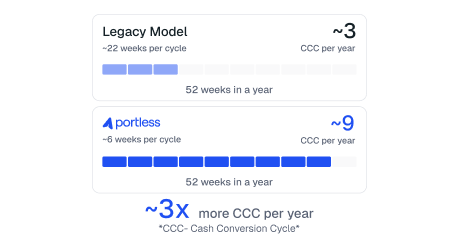
The number of days it takes to convert inventory investment back into cash from sales. Calculated as days inventory outstanding plus days sales outstanding minus days payable outstanding. A shorter cycle means healthier cash flow.
The average number of days a company holds inventory before selling it. A key efficiency metric: too high means cash is tied up in unsold stock, and too low can signal stockout risk.
Inventory that hasn't sold and likely won't, whether due to demand miscalculation, seasonal expiry, or product obsolescence. Ties up capital, takes up warehouse space, and often ends up liquidated at a loss.
The process of predicting future customer demand using historical sales data, market trends, seasonality, and other signals. Drives purchasing, production, and inventory allocation decisions.
A formula that calculates the optimal order size to minimize total inventory costs, balancing ordering costs like freight and processing against holding costs like warehousing and capital. Most useful for stable-demand, replenishable SKUs.
A ratio that measures how many times inventory is sold and replaced over a given period. Higher turnover generally indicates strong sales and efficient inventory management. Low turnover can signal overstocking or weak demand.
The inventory level at which a new purchase order should be placed to replenish stock before it runs out. Calculated based on lead time, average daily sales velocity, and safety stock buffer.
Extra inventory held as a buffer against demand variability and supply chain disruptions. Protects against stockouts, but carrying too much increases holding costs and ties up working capital.
Stock Keeping Unit. A unique identifier assigned to each distinct product variant (size, color, configuration) in your inventory. The foundational unit for tracking, ordering, and fulfillment operations.
When a product is completely unavailable for purchase, either in-warehouse or on a sales channel. Stockouts result in lost revenue, damaged customer trust, and on platforms like Amazon, reduced search ranking.

Upstream decisions that shape everything downstream: supplier selection, production terms, quality gates, and the documents that govern how and how much of your product gets made.
A comprehensive list of all raw materials, components, and sub-assemblies required to manufacture a finished product, including quantities, specifications, and sometimes cost. The foundation of production planning.
The total elapsed time from placing a purchase order to receiving finished goods. This includes manufacturing time, quality inspection, inland transport, and international shipping, and it's one of the most commonly underestimated variables in Ecommerce operations.
The smallest number of units a supplier will produce or sell in a single order. MOQs affect cash outlay, inventory risk, and which suppliers a brand can realistically work with at its current scale.
Products manufactured by one company and sold under another company's brand. The brand controls the branding, packaging, and pricing while outsourcing production. Common in Ecommerce categories like beauty, supplements, and home goods.
A formal document issued by a buyer to a supplier authorizing the production or delivery of goods at agreed-upon terms, including quantity, price, delivery date, and payment terms. The legal backbone of the buyer-supplier relationship.
The systems and processes used to ensure products meet defined standards before they ship, including factory inspections, sample testing, defect tolerances, and pre-shipment checks. Catching issues at the source is exponentially cheaper than handling returns.
The percentage of inventory sold within a given time period relative to the amount received. A key metric for evaluating product-market fit, pricing effectiveness, and buying accuracy.

The financial metrics and cost structures that connect your supply chain to your P&L, from landed cost and contribution margin to the unit economics that determine whether your brand actually makes money.
The average dollar amount spent per transaction. Calculated by dividing total revenue by number of orders. A core metric for understanding customer purchasing behavior and evaluating the profitability of acquisition spend.
A financial statement that shows what a company owns (assets), what it owes (liabilities), and the residual equity at a specific point in time. For Ecommerce brands, inventory is often the largest asset on the balance sheet.
Customer Acquisition Cost. The total cost of acquiring a new customer, including ad spend, creative production, platform fees, and any associated overhead. One half of the CAC-to-LTV equation that determines growth sustainability.
The number of months it takes to recover the cost of acquiring a customer through the gross profit generated by their purchases. A shorter payback period means faster reinvestment into growth.
The total cost of holding inventory over time, including warehousing, insurance, depreciation, shrinkage, and the opportunity cost of capital tied up in stock. Typically expressed as a percentage of total inventory value.
The net movement of money in and out of a business over a given period. For Ecommerce brands, cash flow is heavily influenced by inventory purchasing cycles, payment terms, and the timing gap between paying suppliers and collecting revenue.
Cost of Goods Sold. The direct costs attributable to producing or purchasing the products a company sells, including raw materials, manufacturing, freight, and duties. The starting line for calculating gross margin.
Revenue minus all variable costs associated with fulfilling an order, including COGS, shipping, pick-and-pack, transaction fees, and returns. Shows how much each order contributes to covering fixed costs and generating profit.
Cost Per Mille, or cost per 1,000 impressions. A standard pricing model for digital advertising. In Ecommerce, CPMs directly affect customer acquisition costs and are a key input to ad-spend efficiency analysis.
The average number of days it takes to collect payment after a sale. More relevant for wholesale and B2B Ecommerce than DTC, where payment is typically immediate, but important for brands with multi-channel revenue.
Earnings Before Interest, Taxes, Depreciation, and Amortization. A measure of operating profitability that strips out financing and accounting decisions. Widely used as a benchmark for business valuation and operational performance.
Revenue minus COGS, expressed as a percentage of revenue. The most fundamental profitability metric for an Ecommerce brand. It tells you how much room you have to cover operating expenses and still make money.
The total expense of storing unsold inventory, encompassing warehouse rent, insurance, capital cost, spoilage, and obsolescence. Often underestimated by brands that focus on product cost without accounting for the cost of keeping it on the shelf.
The total cost of getting a product from the manufacturer to your warehouse, including product cost, freight, duties, taxes, insurance, and any handling fees along the way. The number that actually determines your margin, not just the price on your purchase order.
Lifetime Value. The total revenue (or profit) a business can expect from a single customer over the entire duration of their relationship. Used alongside CAC to evaluate whether acquisition spend is sustainable.
The total number of orders a brand fulfills in a given month. A key operational planning metric that affects warehouse staffing, carrier rate negotiations, and 3PL pricing tiers.
A financial statement that summarizes revenue, costs, and expenses over a specific period, showing whether a business is operating at a profit or loss. The single most important document for understanding financial performance.
The difference between current assets and current liabilities. For Ecommerce brands, working capital determines how much cash is available to fund inventory purchases, marketing spend, and day-to-day operations without taking on debt.