Sell-through rate
Sell-through rate is the percentage of inventory you sold during a defined period, divided by the inventory you received in that same period. It's the cleanest signal of whether a SKU is earning its place in your catalog — or quietly draining cash.
Most Ecommerce brands obsess over revenue and conversion. Sell-through rate is the metric that tells you what's actually happening underneath those numbers: how fast inventory moves off the shelf relative to how much you brought in. A high sell-through rate means demand is matching supply. A low one means capital is sitting in a warehouse, depreciating, while you wait for customers to catch up to your buying decisions. For DTC brands manufacturing in Asia, where production runs are often committed three to six months in advance, sell-through is the metric that exposes whether your forecasting model is working — or whether it's quietly killing your margin.
How to calculate sell-through rate
The formula is simple:
Sell-through rate = (units sold ÷ units received) × 100
If you received 1,000 units of a SKU in January and sold 600 by month-end, your sell-through rate is 60%.
Most retailers calculate sell-through monthly, but the right time window depends on your replenishment cycle. Fast-moving SKUs (apparel basics, consumables) warrant weekly tracking. Seasonal or trend-driven products need 30, 60, and 90-day checkpoints to catch decay early.
What's a good sell-through rate?
Industry benchmarks vary, but most retail operators target a monthly sell-through rate between 40% and 80%, depending on category and replenishment lead time. According to research published in the Journal of Retailing, apparel retailers typically see sell-through rates of 24-40% within the first month of a product launch.
Here's a rough guide:
- Below 40%: likely overstocked, slow-moving, or mispriced
- 40-60%: healthy for most categories with predictable demand
- 60-80%: strong product-market fit, monitor for stockout risk
- Above 80%: you're leaving revenue on the table by understocking
The "right" number depends on your lead time. A brand with 90-day production cycles needs higher sell-through rates than one that can replenish in 10 days, because they're carrying more risk per unit.
Why sell-through rate matters more than revenue
Revenue tells you what sold. Sell-through rate tells you what's working — and what isn't.
A SKU pulling in $50K a month at 30% sell-through is hiding a problem. You're sitting on 70% of the inventory you bought, paying carrying costs, and tying up working capital that could fund new product launches or paid acquisition. The same $50K from a SKU at 75% sell-through is a fundamentally different business.
This is why brands building toward scaling DTC operations increasingly treat sell-through as a primary KPI, not a secondary one. SHEIN reportedly runs initial production batches of 100-200 units specifically to test sell-through before scaling. Winners get reorders within days. Losers get sunset.
What kills sell-through rate
Four common culprits:
- Forecasting on intuition instead of data. Most brands order based on what they think will sell, not what historical velocity suggests
- Long production lead times. When you commit to inventory 90 days out, you're betting on a market that may not exist when stock arrives
- Single-batch ordering. Buying a full season's inventory in one production run amplifies the cost of being wrong
- Slow replenishment cycles. If your winners stock out for three weeks while you wait for the next container, sell-through suffers across the catalog
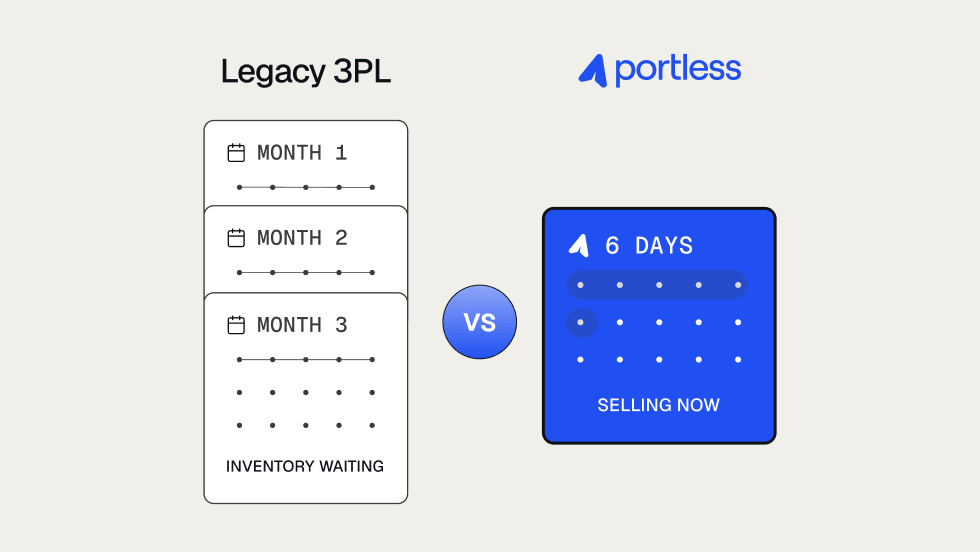
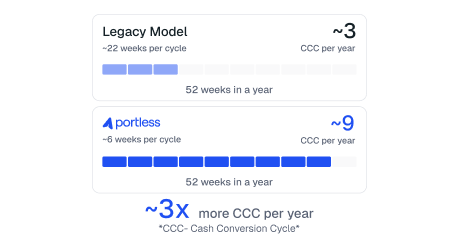
The legacy model — bulk ocean freight, domestic 3PL storage, three-month cash cycles — structurally locks in low sell-through. You commit cash early, take delivery late, and discover demand last.
How direct fulfillment improves sell-through rate
Sell-through rate is fundamentally a function of how quickly you can match supply to demand. The longer your supply chain, the worse the match.
Direct fulfillment from the point of manufacture changes the math:
- You can test smaller initial production runs and scale only proven winners
- Inventory becomes available for sale days after production, not weeks or months
- You can replenish best-sellers in 10-14 days instead of 60-90, reducing stockout risk on high-velocity SKUs
- Capital isn't locked up in 60 days of domestic warehouse storage, freeing working capital for the SKUs that are actually moving
This is the same structural advantage Shein and Temu use to dominate on price and assortment. They don't forecast better — they shorten the gap between production and customer demand, so sell-through rate becomes a feedback loop instead of a post-mortem.
Fix sell-through at the supply chain layer, not the spreadsheet
You can't forecast your way to a high sell-through rate when your supply chain forces you to commit inventory three months before you see demand. The fix isn't a better model — it's a shorter cycle. Portless ships orders directly from manufacturers in Asia to customers in 85+ countries in five to eight days, which means you can test smaller, replenish faster, and turn sell-through rate into a real-time decision instead of a quarterly autopsy.
Contact us to see how direct fulfillment changes the math on your inventory.
← Back to the Ecommerce supply chain glossary