Inventory turnover
Inventory turnover is a financial ratio that measures how many times a business sells and replaces its stock over a defined period, typically calculated as cost of goods sold divided by average inventory. Higher turnover signals efficient inventory management and stronger cash flow, while lower turnover indicates overstocking, weak demand, or capital trapped in unsold goods.
For DTC Ecommerce brands, inventory turnover is one of the clearest signals of how healthy your supply chain actually is. Revenue can look strong on a P&L while your bank balance shrinks — and the gap is almost always sitting in slow-moving inventory. Turnover translates that hidden drain into a single number you can act on: how many times your stock cycles through the business each year. Brands with high turnover free up cash, reduce markdown risk, and respond faster to demand shifts. Brands with low turnover pay storage fees on products that aren't earning their keep.
How to calculate inventory turnover
The standard formula is:
Inventory turnover = cost of goods sold (COGS) / average inventory
Average inventory is typically calculated as (beginning inventory + ending inventory) / 2 over the period you're measuring. Most brands run this annually, though monthly or quarterly turnover calculations are more useful for fast-moving Ecommerce categories.
A related metric, days of inventory outstanding (DIO), tells you how many days of stock you're holding on average. The formula is 365 / inventory turnover. So a turnover ratio of 6 means roughly 60 days of inventory on hand.
Worked example: if your COGS for the year is $2M and your average inventory value is $400K, your inventory turnover is 5. You're cycling stock five times per year, or roughly every 73 days.
What's a good inventory turnover ratio?
There's no universal benchmark. Healthy turnover depends on your category, price point, and business model.
- Apparel and fashion brands typically aim for four to six turns per year
- Beauty and personal care often run six to 12 turns
- Electronics and home goods range from four to eight
- Commodity consumables can exceed 12 turns
According to Investopedia's overview of inventory turnover, comparing your ratio to industry peers is more useful than chasing an absolute number. A turnover ratio that looks low for fast fashion might be excellent for premium home goods.
The bigger question is the trend. If your turnover is dropping quarter over quarter, you're accumulating dead stock faster than you're selling through it. That's a margin and cash flow problem, regardless of category.
Why inventory turnover matters for cash flow
Every unit sitting in a warehouse is cash you can't deploy elsewhere. Slow turnover means capital trapped in stock, carrying costs eating margin, and growing exposure to markdowns or obsolescence.
According to IHL Group research, inventory distortion — the combined cost of overstocks and stockouts — costs retailers roughly $1.7T globally every year. For a DTC brand, that shows up as cash trapped in slow-moving SKUs, storage fees on products that aren't earning, and margin lost to markdowns when you finally clear the surplus.
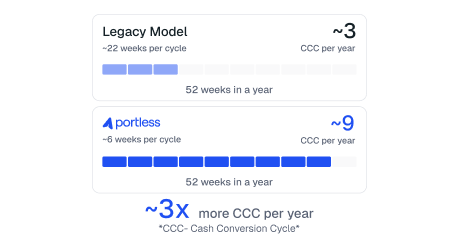
This is why turnover is more than an accounting metric. It's a direct input to your cash conversion cycle and your ability to fund growth without raising capital.
What drives low inventory turnover
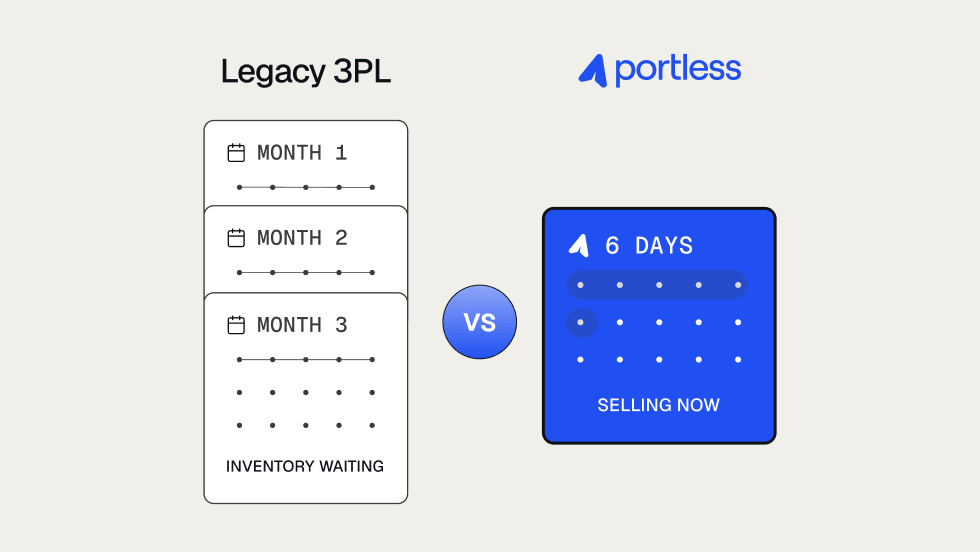
The legacy bulk freight model is built for low turnover. You commit to large production runs months in advance, ship containers across the ocean, pay duties upfront, and store everything in a domestic 3PL hoping the forecast was right. By the time inventory arrives, market signals have shifted — and you're stuck with what you ordered.
Common causes:
- Overcommitting on production runs based on forecasts that don't survive contact with real demand
- Long ocean freight lead times that force early, large bets on unproven SKUs
- Poor SKU-level visibility, so slow movers go undetected until they become dead stock
- Pre-paying duties and freight on inventory that may never sell at full price
- Fragmented inventory across multiple domestic 3PL nodes, which inflates safety stock requirements
How to improve inventory turnover
Improving turnover isn't about ordering less — it's about shortening the distance between production and the customer, so you commit smaller and react faster.
Move to smaller, more frequent production runs. Instead of placing one bet on 10,000 units, run 2,000-unit batches and replenish based on actual sell-through. This is the foundation of agile inventory planning.
Tighten replenishment cycles. When factory-to-customer delivery takes five to eight days instead of 60 to 90, you can replenish weekly instead of quarterly. Demand signals reach production while they still matter.
Segment your catalog. Not every SKU should be managed the same way. Core heroes, seasonal bets, and tests each have different turnover targets and different risk profiles.
Use direct fulfillment to delay commitment. Holding inventory near production rather than pre-positioning it in domestic warehouses gives you more chances to act on real demand data. This is the model behind made-to-order and just-in-time Ecommerce.
Inventory turnover and the legacy fulfillment problem
Legacy bulk freight forces structurally low turnover. You pay for production, freight, and duties months before you know what sells. Even efficient operators inside that model are capped by its physics — 30 to 45 days of ocean transit plus weeks of warehouse receiving means your turnover ceiling is set by your shipping lane, not your demand.
Brands like Shein and Temu have rewritten this entirely. By shipping direct from factories to customers, they operate with turnover ratios that legacy DTC brands can't match — because their inventory cycles in days, not months.
How Portless improves inventory turnover for DTC brands
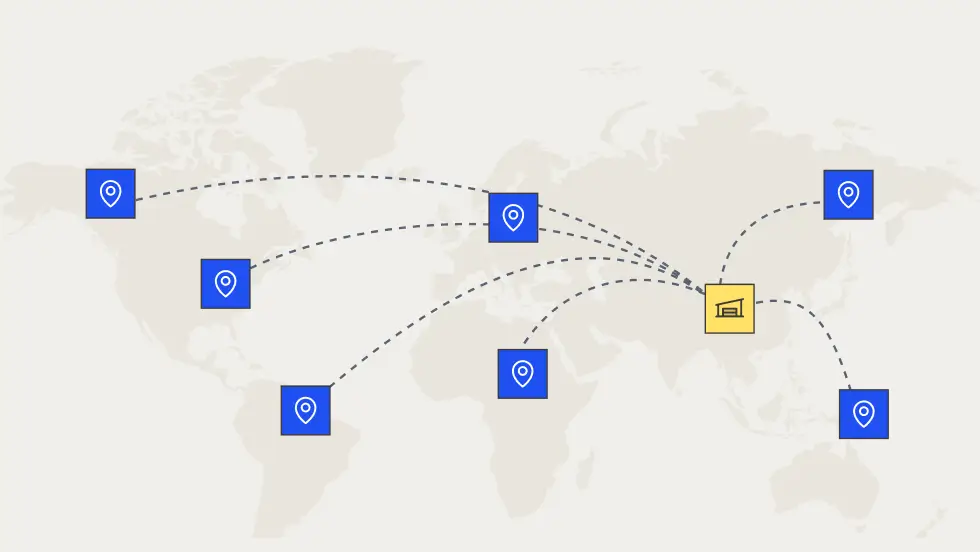
Portless replaces the bulk ocean freight + domestic 3PL model with direct fulfillment from manufacturers in Asia. Inventory becomes available for sale days after production, not weeks. Orders ship factory-to-customer in five to eight days. You commit smaller batches, replenish faster, and convert production spend into cash in days instead of months.
For brands managing inventory turnover as a core metric, that structural shift is the difference between cycling stock five times a year and cycling it 12 or more.
To see how this plays out with your own numbers, run them through the direct fulfillment ROI calculator or contact us to walk through your specific catalog.
← Back to the Ecommerce supply chain glossary