Cash flow
Cash flow is the net movement of money into and out of your business over a given period. For Ecommerce brands, it's primarily shaped by the timing gap between paying suppliers for inventory and collecting revenue from customers.
Cash flow is the single most important financial metric for a growing Ecommerce brand, and it's the one most often confused with profit. You can be profitable on paper and still go out of business if your cash is locked up in inventory sitting on a boat, in a bonded warehouse, or on a 3PL's shelf. Cash flow measures whether you have the money to fund your next production run, your next ad campaign, or your next hire — right now, not in 90 days.
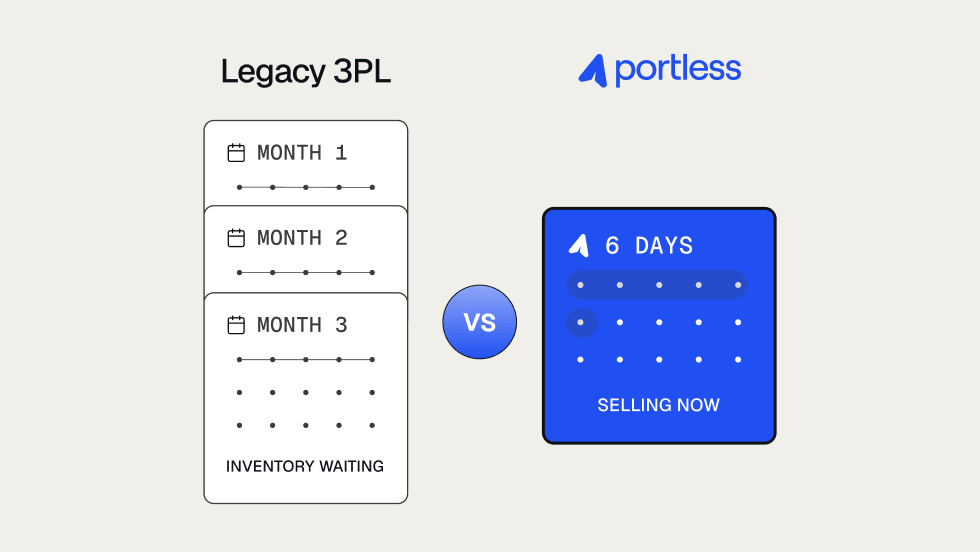
For brands manufacturing in Asia selling into the US, EU, or UK, cash flow problems usually aren't a revenue problem. They're a timing problem. You pay your supplier on day one. Goods spend 30 to 45 days on the ocean. They sit at a 3PL for another two weeks before selling through. By the time cash hits your account, 60 to 90 days have passed since you paid for the inventory. That gap is where DTC brands quietly die.
How cash flow works in Ecommerce
Cash flow is the inflows and outflows of money across a defined period — usually a month, quarter, or year. According to Investopedia's definition of cash flow, positive cash flow means more money comes in than goes out, while negative cash flow means the opposite.
For an Ecommerce brand, the major inflows and outflows look like this:
- Inflows: customer payments, refunds recovered, financing draws, investor capital
- Outflows: supplier payments, freight, duties, 3PL fees, ad spend, payroll, software, returns
The challenge is that most of those outflows happen weeks or months before the inflows arrive. That's why two brands with identical revenue and identical margins can have wildly different cash positions.
Why the legacy supply chain model breaks cash flow
The legacy model — bulk ocean freight, domestic 3PL, upfront duties — is built around predictability that no longer exists in Ecommerce. You're forced to forecast demand months in advance, commit capital to container-sized orders, and pay duties on inventory you haven't sold yet.
Research from the JPMorgan Chase Institute found that the median small business holds fewer than 15 days of cash buffer. One missed forecast or slow-moving SKU can put the whole brand at risk. The structural problems with the legacy model:
- Capital tied up in inventory for 60 to 90 days before the first sale
- Storage fees that compound regardless of sell-through
- Upfront duties paid on goods that may never sell
- Forced bulk commitments that punish product testing
The brands navigating this best aren't trying to forecast harder. They're restructuring the supply chain so cash moves faster. For a deeper breakdown, see why most DTC brands fail because of the cash flow trap.
The cash conversion cycle
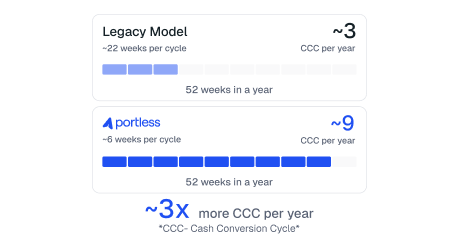
The cleanest way to measure cash flow health in Ecommerce is the cash conversion cycle (CCC) — the number of days between paying suppliers and collecting cash from customers. A shorter cycle means cash turns faster and funds more growth with the same working capital.
Here's the math on a $200,000 working capital base:
- Legacy model: four turns per year equals $800,000 throughput
- Direct fulfillment: 14 turns per year equals $2.8M throughput
Same capital, 3.5x the volume. That's not a margin improvement — it's a structural one. You can model your own cycle using the Portless direct fulfillment ROI calculator.
Levers that improve cash flow
Most cash flow problems in Ecommerce trace back to four levers. Pull any one and the cycle shortens.
- Shorten lead times so cash isn't locked in transit
- Reduce MOQs so you commit less capital per production run
- Defer duties and VAT through DDP models or bonded warehousing
- Sell inventory before paying for it by aligning production with demand
The last one is what direct fulfillment actually enables. Instead of pre-buying months of stock, you produce, store near the factory, and ship to the customer once the order is placed. Cash conversion drops from 79 days to roughly 26 in many cases — a 53-day improvement detailed in our 2026 inventory model breakdown.
Common cash flow mistakes Ecommerce brands make
The patterns repeat across brands doing $1M to $15M in revenue:
- Treating peak season as a revenue problem when it's an inventory cash problem
- Ordering 30% more "just to be safe" and locking up cash through Q1
- Ignoring carrying costs (storage, capital, shrinkage) when calculating true SKU profitability
- Funding growth from ad spend instead of inventory velocity
The fix isn't more financing. It's a faster supply chain. For peak-specific tactics, see the 2025 BFCM logistics playbook on protecting cash flow and customer experience.
How Portless changes the cash flow equation
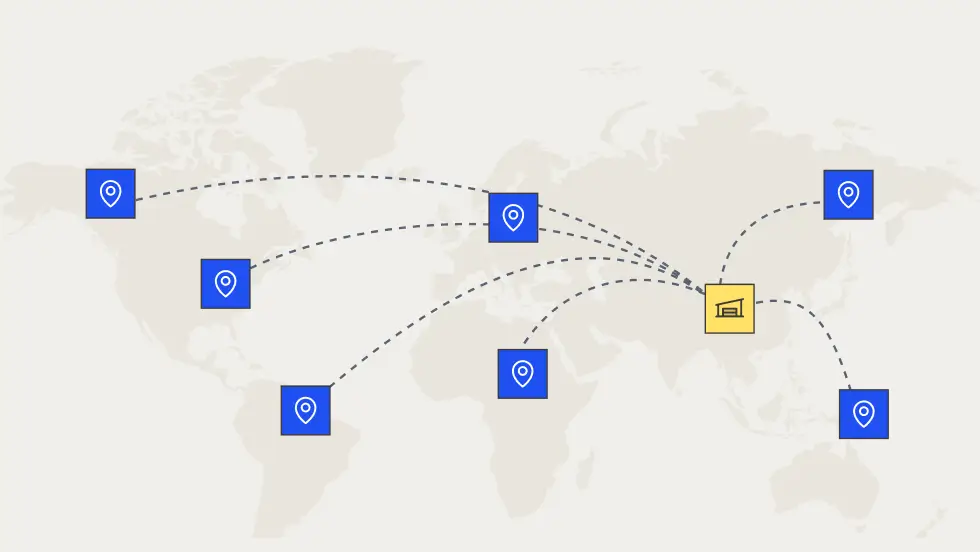
The legacy supply chain treats cash flow as something you manage. Portless treats it as something you design out of the problem. By shipping direct from manufacturers in Asia to customers in 85+ countries, Portless cuts the time between production and revenue from months to days — making inventory available for sale within days of leaving the factory, not weeks. If cash flow is the bottleneck on your growth, contact us to see how the model works against your numbers.
← Back to the Ecommerce supply chain glossary