Cash conversion cycle (CCC)
Cash conversion cycle (CCC) is the number of days it takes a brand to convert cash spent on inventory back into cash from customer sales. For Ecommerce brands, it measures how long your working capital is locked up between paying a supplier and collecting revenue.
For DTC brands manufacturing in Asia, the cash conversion cycle is often the single most important financial metric you're not actively managing. It connects three operational realities — how long inventory sits before it sells, how fast customers pay, and how long you have to settle supplier invoices — into one number that tells you whether your supply chain is funding growth or starving it.
The formula is straightforward:
CCC = Days inventory outstanding (DIO) + Days sales outstanding (DSO) − Days payable outstanding (DPO)
A shorter CCC means cash comes back faster, freeing capital for ads, new SKUs, or international expansion. A longer CCC means you're financing your own supply chain — and for most brands using legacy ocean freight and domestic 3PLs, that cycle stretches to 80–120 days before a single dollar of revenue hits the bank.
How the cash conversion cycle works in Ecommerce
Each component of CCC maps to a specific operational decision:
- Days inventory outstanding (DIO): how long inventory sits between arriving at your warehouse and being sold. Bulk imports stored at a domestic 3PL push this number up.
- Days sales outstanding (DSO): how long it takes to collect cash after a sale. For DTC brands, this is usually one to three days. For wholesale, it can be 30–90.
- Days payable outstanding (DPO): how long you have to pay suppliers. Most factories in China require 30–50% upfront and the balance before shipment, so DPO is often low.
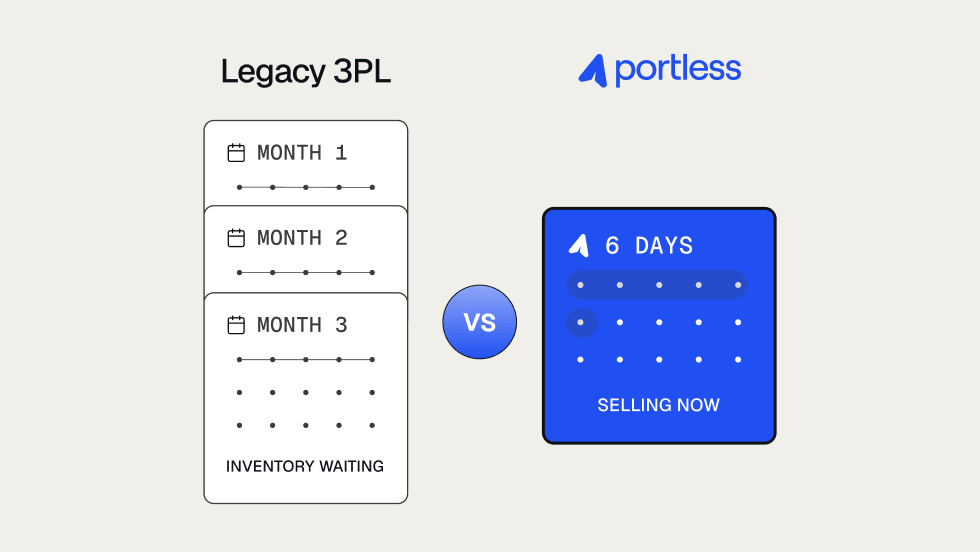
The math punishes the legacy model. You pay your factory on day one, wait 45–60 days for ocean freight, sit on inventory for another 30–45 days at a domestic 3PL, then finally start selling. By the time cash comes back, you're already three months in.
Why CCC matters more than gross margin for growing brands
You can have a 70% gross margin and still go out of business if your cash conversion cycle is too long. According to research from the Bank of Canada on inventory and cash flow cycles, excess inventory directly constrains liquidity and limits a company's ability to invest in growth.
For a brand doing $5M in revenue, a 90-day CCC means roughly $1.25M of working capital is permanently locked in the supply chain. Cut that cycle in half, and you free up $625K — without raising debt or diluting equity.
This is why brands hit a wall between $10M and $50M. Their CCC scales with revenue, but their cash reserves don't. They end up choosing between funding inventory or funding marketing. Most pick inventory, growth slows, and the cycle continues.
How to calculate your cash conversion cycle
Use these formulas with figures from your profit and loss statement and balance sheet:
- DIO = (Average inventory ÷ COGS) × 365
- DSO = (Accounts receivable ÷ Total credit sales) × 365
- DPO = (Accounts payable ÷ COGS) × 365
Add DIO and DSO, then subtract DPO. The result is your CCC in days.
Example: A brand with $2M in average inventory, $8M in annual COGS, $50K in receivables, $10M in sales, and $400K in payables has:
- DIO = 91 days
- DSO = 2 days
- DPO = 18 days
- CCC = 75 days
That's 75 days of cash tied up in every cycle. At scale, that's the difference between funding your next product line and missing payroll.
What lengthens the cash conversion cycle
Most CCC bloat comes from the structure of the supply chain itself, not poor operations. The biggest contributors:
- Ocean freight transit times of 30–45 days that lock cash in goods sitting on a boat
- Bulk inventory commitments that force you to buy three to six months of stock at once
- Upfront duties paid on unsold inventory at the port of entry
- Domestic 3PL storage fees that accumulate while inventory waits to sell
- Container minimums that prevent small test orders and force overcommitment
Each of these is a structural feature of legacy supply chains, not a process you can optimize your way out of. To genuinely shorten CCC, the underlying model has to change.
How direct fulfillment shortens the cash conversion cycle
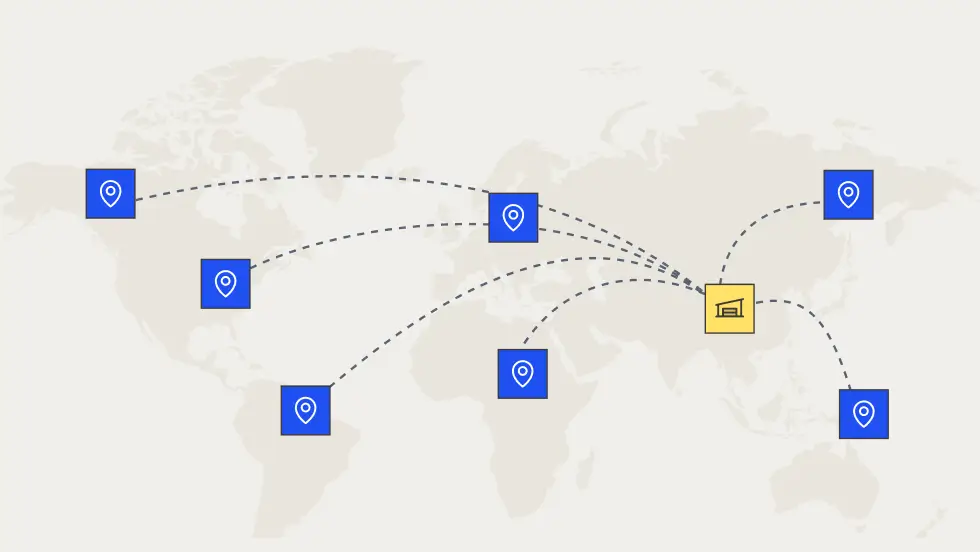
Direct fulfillment compresses CCC by removing the warehouse layer and the ocean freight gap. Inventory ships from factory-adjacent hubs in Asia directly to customers within five to eight days — meaning goods become revenue within days of production, not months.
A typical comparison for a $50,000 production order:
::table
Stage;Legacy model;Direct fulfillment
Pay supplier;Day 1;Day 1
Goods arrive;Day 60;Day 3
First sales;Day 70;Day 5
Cash received;Day 79;Day 26
Total CCC;79 days;26 days
:table
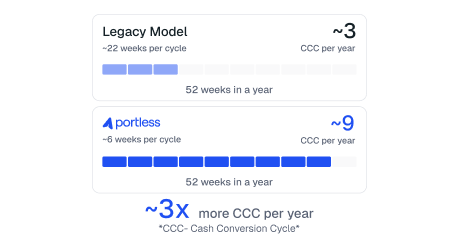
That's a 53-day improvement on the same $50K commitment. With $200K in working capital, the legacy model produces roughly four inventory turns per year. Direct fulfillment produces 14. Same cash, 3.5x more throughput.
Brands like &Collar have used this structural shift to compress their cycle by 15+ days while improving in-stock ratios from 5% to 95%+. See how &Collar restructured their inventory model for peak season for the full breakdown.
What a shorter CCC unlocks
When CCC drops from 80+ days to under 30, the effects compound:
- More inventory turns per year on the same working capital
- Faster response to demand signals because you're not committed months in advance
- Lower exposure to dead stock because production runs are smaller and more frequent
- More room for ad spend since cash isn't tied up in goods in transit
- Less reliance on debt to fund growth
Forecasting also gets easier when the supply chain moves faster. Shorter cycles mean shorter prediction windows, which means more accurate decisions with less capital at risk.
How Portless helps brands cut their cash conversion cycle
Portless shortens your cash conversion cycle by replacing the bulk-import-then-store model with direct fulfillment from manufacturers in Asia to customers in 85+ countries. Inventory becomes available for sale within days of production instead of months, and you only pay duties on what actually sells — not on warehouse stock that may never move.
If you want to model the impact on your own numbers, contact our team or run your figures through the Portless Direct Fulfillment ROI Calculator.
← Back to the Ecommerce supply chain glossary