Direct fulfillment
Direct fulfillment is a logistics model where individual customer orders ship from a fulfillment center near the point of manufacture directly to the end customer, bypassing domestic warehouses and bulk ocean freight. It compresses the supply chain into a single hop: factory to door.
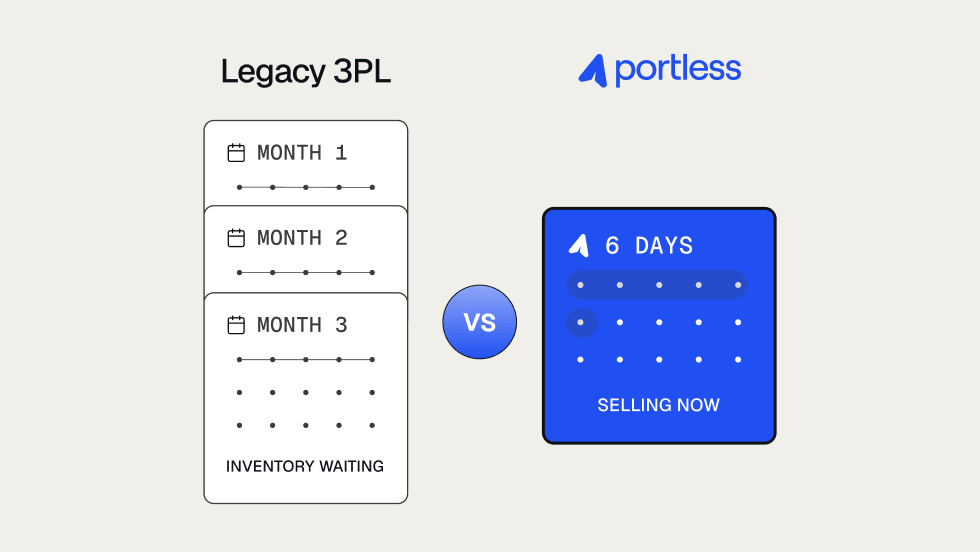
The legacy Ecommerce supply chain is built on a bet. You manufacture in bulk, ship a container by sea for 45 to 60 days, pay duties on the entire load at import, then warehouse the goods domestically while you wait for demand to materialize. Capital leaves the business months before revenue arrives. Direct fulfillment inverts that sequence — you ship confirmed orders, one at a time, from a fulfillment center close to your manufacturer, and revenue arrives within days of production. The model isn't theoretical. Shein and Temu built multi-billion-dollar businesses on it. Now DTC brands are adopting the same structural logic without the venture subsidies.
How direct fulfillment works
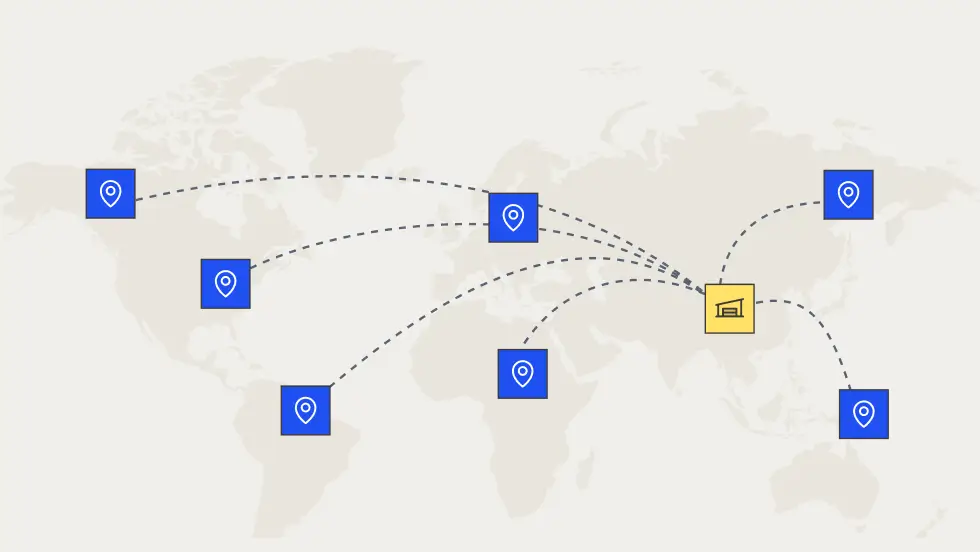
The mechanics are straightforward. A customer places an order on your Shopify or WooCommerce store. The order routes in real time to a fulfillment center near your manufacturer — typically in China. The facility picks, packs, and labels the order against your brand standards, then injects it into an air freight network. From there, a domestic last-mile carrier handles delivery to the customer's door.
The full sequence from order placement to delivery typically runs five to eight days for shipments from China to the US, Canada, the UK, EU, and Australia. The customer's tracking experience looks domestic — they see updates from USPS, Canada Post, or Royal Mail, not an international carrier — because the last-mile leg is handled by the same regional networks a domestic 3PL would use.
The structural difference from a legacy model:
- Orders ship against real demand, not forecasted demand
- Duties apply per parcel at fulfillment, matched to that order's revenue
- No domestic warehousing layer, no inbound freight commitment, no inventory carrying cost on unsold stock
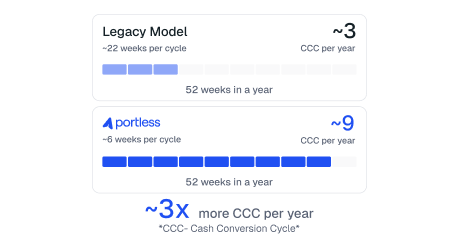
- Capital cycles back into the business in days, not months
For a deeper look at the operational layer, see how direct fulfillment from China actually works.
Direct fulfillment vs. 3PLs, dropshipping, and FBA
The terminology overlaps and the models get conflated. They're distinct.
::table
Model;Where inventory sits;Who ships;Brand control
Direct fulfillment;Fulfillment center near manufacturer;Brand's logistics partner;Full — branded packaging, QC standards, custom inserts
3PL;Domestic warehouse;Third-party logistics provider;High — but inventory must be inbounded first
Dropshipping;Random supplier inventory;Whoever the supplier uses;Low — generic packaging, no QC, long transit
FBA;Amazon fulfillment centers;Amazon;Limited — Amazon controls the customer experience
:table
Direct fulfillment is often confused with dropshipping because both ship from the manufacturer. The difference is control. Dropshipping is supplier-managed, generic, and low-margin. Direct fulfillment runs through a dedicated facility operating under your brand's packaging, quality, and timing standards — closer to a 3PL embedded in your manufacturing market than to a dropship arrangement.
Why brands are moving to direct fulfillment
Three forces are pushing the shift, and they compound.
Cash flow. The cash conversion cycle on a bulk-freight supply chain commonly runs 60 to 90 days. Direct fulfillment compresses that to single digits. Capital that was previously stuck in ocean containers and domestic warehouses cycles back into paid acquisition, product development, and inventory for the next production run.
Tariff exposure. Under bulk import, duties are paid at the point of entry on the entire shipment — before a single unit sells. If rates shift between when you placed the order and when the container lands, your pricing assumptions are wrong and your margin compresses on inventory you've already committed to. Per-parcel duty timing under direct fulfillment matches each duty payment to the revenue from that specific order. According to CBP's trade data, duty collection volume has risen sharply since 2025, making the timing question more material.
International expansion without warehouse overhead. A single fulfillment center in Asia can ship to 85+ countries using domestic last-mile carriers in each market. You don't need to build inventory pools in the EU, UK, and Australia to ship there competitively. For brands selling primarily in North America today but evaluating Europe or APAC, this removes the upfront capital commitment that usually blocks international launches.
Foreign Resource cut their cash conversion cycle from 21-plus days to near-negative — revenue arrives before the next production run needs paying. &Collar onboarded direct fulfillment in 30 days, rerouted 40,000 units, and posted a 35% year-over-year revenue increase during a peak season they were about to miss entirely. The pattern isn't that direct fulfillment is a crisis tool — it's that a supply chain with no slack leaves you no options when conditions change.
Where direct fulfillment fits (and where it doesn't)
Direct fulfillment isn't right for every product or every business model. It works well for:
- Lightweight products under 3.5 lbs that move efficiently via air freight
- Brands manufacturing in Asia selling to markets globally
- Apparel, beauty, electronics accessories, home goods, toys, and adult industry products
- DTC brands doing 1,000 to 15,000 orders per month
- Operators focused on cash flow, international expansion, or tariff resilience
It's less suitable for:
- Oversized or heavy items where air freight economics break down
- Products requiring same-day or next-day delivery as a core value proposition
- Highly regulated categories with complex import restrictions
- Brands that haven't validated demand and need physical retail distribution
If your customers tolerate a five-to-eight-day delivery window, the model penciling out is mostly a question of product weight and margin structure. You can model it against your specific numbers with the direct fulfillment ROI calculator.
Common objections, addressed directly
"Customers won't accept longer delivery times." They already do. The average DTC order in the US takes four to six days to deliver via standard ground shipping. A five-to-eight-day window from China lands in the same range. The customer sees a domestic tracking number from their local carrier, not an international one.
"DDP is too complex to manage." It's complex if you're handling it yourself. Under a Delivered Duty Paid (DDP) model, the logistics partner handles duty calculation and remittance per parcel, so the customer never sees a surprise charge at the door. The complexity sits with the partner, not the brand.
"What about returns?" Returns route to a domestic processing center in the destination market, not back to China. The cost structure is comparable to a standard 3PL return flow.
How Portless powers direct fulfillment
Portless runs direct fulfillment from manufacturers in Asia to customers in 85+ countries. We integrate with Shopify and WooCommerce, handle duties via a DDP model, and deliver within five to eight days using domestic last-mile carriers in each market. Brands moving to Portless typically cut lead inventory times by up to 90% and shift inventory from "weeks of cash locked in transit" to "available for sale days after production."
If you want to see what this looks like against your actual order volume and product economics, contact our team and we'll model it out.
← Back to the Ecommerce supply chain glossary