3PL
A 3PL (third-party logistics provider) is a company that handles warehousing, inventory storage, pick-and-pack, and shipping on behalf of Ecommerce brands. Brands outsource fulfillment to a 3PL to avoid running their own warehouse operations.
The 3PL model has been the default fulfillment infrastructure for Ecommerce brands for the past two decades. You manufacture overseas, ship a container by ocean freight, pay duties at the port, store inventory in a domestic warehouse, and pay the 3PL per order to pick, pack, and ship to your customers. That's the playbook — and it's the one most brands inherit without questioning.
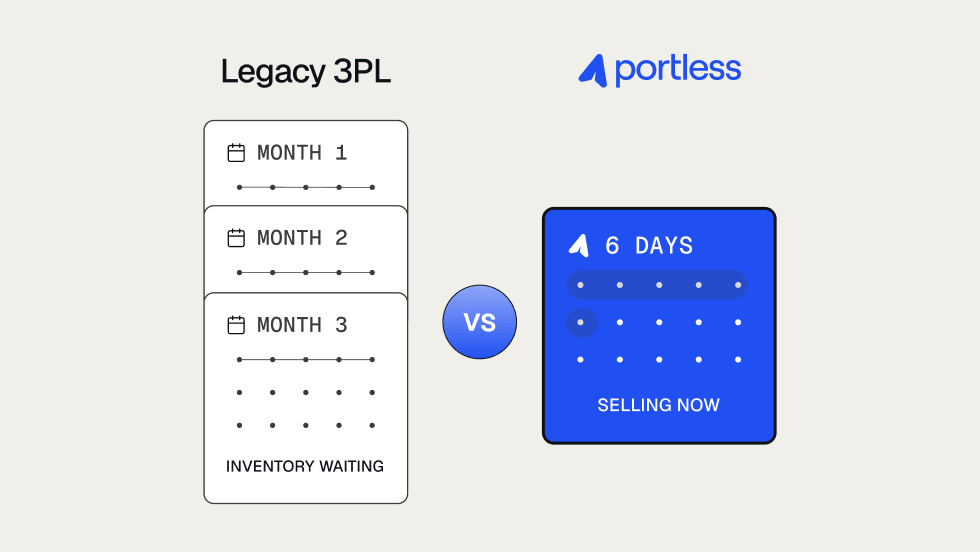
But the legacy 3PL model was built for a different era of commerce. It assumes you can forecast demand months in advance, absorb 60-to-90-day cash conversion cycles, and tolerate inventory sitting in a warehouse while your capital sits with it. For DTC brands manufacturing in Asia and selling globally, that math has stopped working.
What a 3PL actually does
A 3PL takes on the operational layer of fulfillment so you don't have to lease a warehouse, hire pickers, negotiate carrier contracts, or manage shipping software in-house. The core services include:
- Receiving inbound inventory from your manufacturer or freight forwarder
- Storing SKUs in a domestic warehouse, typically charged per pallet or cubic foot
- Picking and packing individual orders as they come in
- Shipping orders through negotiated carrier rates (USPS, UPS, FedEx, DHL)
- Handling returns, exchanges, and reverse logistics
- Integrating with your Ecommerce platform (Shopify, WooCommerce, Amazon)
Most 3PLs charge a combination of receiving fees, storage fees, pick-and-pack fees per order, and outbound shipping costs. Some add peak-season surcharges, special-handling fees, and minimum monthly commitments.
How the legacy 3PL model breaks down at scale
The 3PL invoice is misleading. It shows storage, pick-and-pack, and shipping as clean line items — but the real costs of the model live off the invoice. We've broken this down in detail in The 2026 Inventory Model Starts With Rethinking Your 3PL Location, but the short version:
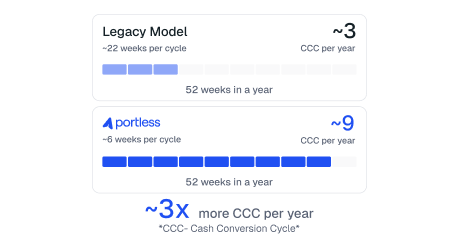
Capital stays locked. From the day you pay your supplier to the day cash hits your account from a customer order, the legacy 3PL model can stretch to 79 days. Ocean freight alone takes 45-60 days. Your inventory then sits in a domestic warehouse waiting to sell.
Zone premiums compound. Carriers price by shipping zone. A two-pound USPS Priority Mail package from a Kentucky warehouse to a California customer costs roughly 52% more than the same package to a Zone 2 address. If you ship 10,000 orders a month and 40% land in far zones, that premium quietly exceeds $20,000 a year.
Quality issues surface too late. If your factory ships 5,000 defective units, your 3PL discovers it during receiving — six weeks after production. By then your options are all expensive: return-to-factory shipping, scrap, liquidation, or ship-anyway and absorb the return rate.
MOQs force conservative decisions. Ocean freight only makes economic sense at container scale. A 20-foot container holds 2,000-3,000 units. Testing a new SKU means committing to volume you can't justify until you've already validated demand — a chicken-and-egg problem that kills product velocity.
When a 3PL still makes sense
A legacy 3PL is a reasonable fit when:
- You're under $500K in revenue and need flexibility without commitment
- Your products are heavy (over 3.5 lbs) or oversized, making air freight uneconomic
- Your customers expect next-day or two-day delivery and tolerate higher prices
- You need domestic returns processing at scale
For brands above $1M in revenue manufacturing in Asia and selling lightweight DTC products globally, the legacy 3PL is rarely the most efficient option. We laid out the financial comparison in Which Fulfillment Model Maximizes Your Profit Margins?.
How to evaluate a 3PL provider
If you're sticking with a legacy 3PL, evaluate on more than per-order price. The cheapest label is almost never the lowest total cost. Look at:
- Pick-and-pack accuracy (top operators hit 99.5%+; warehouse turnover averages 49% per the U.S. Bureau of Labor Statistics, which correlates with accuracy)
- Peak-season performance during BFCM and Q4
- Carrier diversification (single-carrier dependency is a red flag)
- Integration depth with Shopify, WooCommerce, Amazon, and TikTok Shop
- Cost transparency — storage fees, peak surcharges, packaging markups
- Geographic footprint relative to your customer base and your production
We built a full evaluation framework in The Complete 3PL Evaluation Checklist for Growing DTC Brands.
3PL vs. direct fulfillment
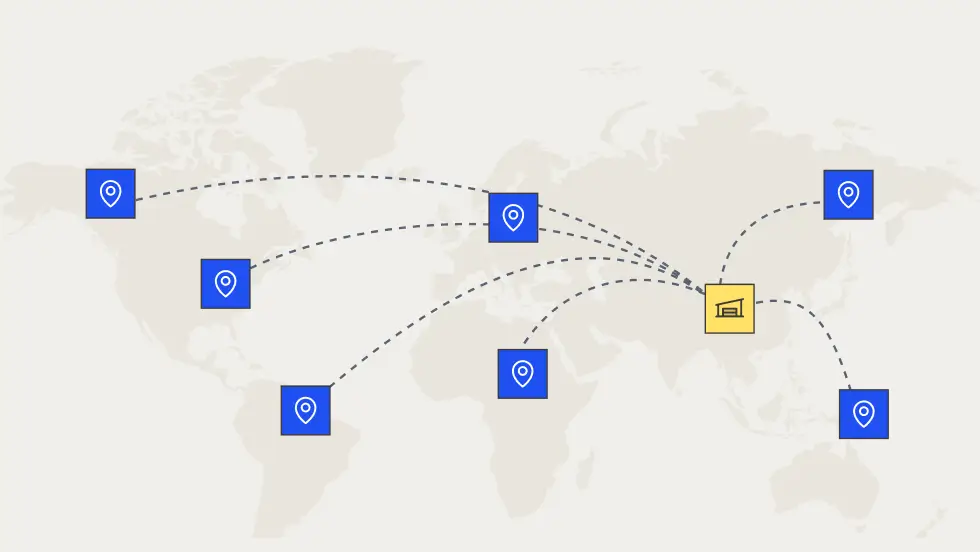
Direct fulfillment is the structural alternative to the legacy 3PL. Instead of moving inventory by ocean freight to a domestic warehouse, you fulfill orders directly from a facility next to your manufacturer in Asia, and ship cross-border into your customer's domestic carrier network.
The differences compound:
- Cash conversion cycle: 26 days with direct fulfillment vs. 79 days with legacy 3PL
- Lead time: 5 days from production to fulfillment-ready vs. 60+ days
- MOQs: test new SKUs at 250 units instead of 2,500
- Quality control: defects caught and corrected at the factory, not after a six-week ocean voyage
- Geographic reach: ship to 85+ countries from a single inventory pool without setting up regional warehouses
Direct fulfillment isn't a faster 3PL. It's a different operating model that eliminates the domestic warehousing layer entirely. Shein and Temu have built their entire businesses on it. DTC brands are now doing the same without sacrificing brand experience or delivery speed.
Why most DTC brands outgrow their 3PL
Portless replaces the legacy 3PL stack with direct fulfillment from manufacturers in Asia to customers in 85+ countries. You cut your cash conversion cycle from 79 days to 26, eliminate domestic warehousing overhead, test new products at low volumes, and deliver to customers in five to eight days under a DDP model. Contact us to see what direct fulfillment looks like for your brand.
← Back to the Ecommerce supply chain glossary