“We generated $70K in package protection revenue in a single quarter by adding a simple $4 protection option at checkout — plus an additional $12K from cashbacks. Customers get peace of mind, and we're making a profit on every protected order with zero effort."
“We generated $70K in package protection revenue in a single quarter by adding a simple $4 protection option at checkout — plus an additional $12K from cashbacks. Customers get peace of mind, and we're making a profit on every protected order with zero effort."
Switching 3PLs costs more than the migration fee. Every week of downtime, every mispick during transition, and every SLA miss compounds into lost revenue and eroded customer trust. The best way to avoid a costly switch is to evaluate providers rigorously before you commit.
This isn't a list of the best 3PLs for DTC brands — it's the framework you use to decide that for yourself. Below you'll find eight evaluation criteria, a vendor questionnaire for each, and a scorecard to compare providers side by side. It's built from what we saw across dozens of DTC brands during BFCM 2025, where the gap between prepared and unprepared brands was measured in lost orders, not just delayed ones.
1. Team stability and retention
Stable, long-tenured teams protect accuracy, speed, and cost. The warehouse industry turnover rate was 49% in 2022 according to the US Bureau of Labor Statistics, and recent data suggests it remains above 40%. High turnover cascades into picking errors, SLA failures, and unexpected rate increases.
Top-tier operations maintain 99.5%+ pick-and-pack accuracy as a median performance benchmark. Stable teams handled BFCM 2025 surges without major accuracy drops. High-turnover operations leaked accuracy, SLA performance, and service costs.
When you evaluate a 3PL, ask for tenure breakdowns by role: warehouse manager, floor supervisors, and quality leads. Ask how long the team that'll handle your account has worked together. Stability compounds. A team that's processed 100+ SKUs together for two or more years will catch edge cases a new provider can't.
3PL questionnaire — team stability:
What's your turnover rate over the last 12 months?
What's your current pick-and-pack accuracy rate?
What's your training program and staffing approach during peak surges?
Can you provide a tenure breakdown for the team assigned to our account?
Red flags: vague turnover data, no training documentation, rotating staff across accounts.
2. Communication and responsiveness
Urgent issues don't happen on a schedule. When something breaks at 2 am, you need a human, not a ticket queue. The speed and quality of communication during your evaluation process is the best preview of what you'll get after go-live.
Brands with true 24/7 coverage or overlapping time zone support adapted in real time. Those stuck with ticket-only systems lost hours waiting for responses while orders piled up.
3PL questionnaire — communication:
Will you assign a named, dedicated account manager to our brand?
What are your response times inside and outside business hours?
Which channels do you support — Slack, email, phone, WhatsApp?
What's your escalation path if our account manager is unavailable?
What time zones does your support team cover?
Red flags: limited hours, slow replies during evaluation, unclear escalation paths, no named contact.
3. Customization and specialized services
Your product category dictates your handling requirements. Fragile goods, cosmetics, batteries, oversized products, and temperature-sensitive items each require different workflows. A 3PL that says "we can do anything" without showing proof is a 3PL that hasn't done it.
Matt Hertz, founder of Third Person (a 3PL matchmaking consultancy), made this point on the The Modern Supply Chain podcast with Portless CEO Izzy Rosenzweig. Your 3PL isn't a transactional vendor, it's a partner whose ability to adapt directly affects whether your brand survives the next disruption:
3PL questionnaire — specialization:
Can you show proof of experience handling our product category?
Do you have photos or videos of how you've handled similar brands?
What custom or branded packaging options do you offer?
Do you have sustainable packaging alternatives?
Red flags: "we can do anything" without proof, rigid packaging rules, no category-specific experience.
4. Scalability and peak-season readiness
A scalable 3PL grows with you without sacrificing accuracy, SLAs, or support. Any provider promising "instant scaling" usually signals temporary labor, manual processes, or unstable systems.
Hiring more than six weeks before peak usually signals poor forecasting. Last-minute hiring means inexperienced hands. Any 3PL offering unconditional SLAs during peak (same 99.5% accuracy in December as May) is either overprovisioned or overpromising. Honest providers cite realistic targets backed by data.
3PL questionnaire — scalability:
How many temporary workers did you hire for your last peak season, and when?
What was your peak-season error rate vs. baseline?
If we do 500% of average daily volume, what's your staffing plan?
What SLAs do you guarantee during peak?
How do you communicate if you approach capacity limits?
Red flags: single-carrier dependency, manual routing, vague peak-season answers, no error-rate data.
5. Technology integration and visibility
Technology determines your visibility, speed to launch, and accuracy. A Warehouse Management System (WMS) that can't answer basic questions in a live demo is a WMS that'll leave you guessing after go-live.
Legacy 3PLs often can't answer these without hedging. Top-tier providers answer all six with "yes" and demo the feature within 15 minutes.For example, Portless integrates directly with major storefronts, giving you per-order visibility and instant reorder triggers.
3PL questionnaire — technology:
Can you pull real-time inventory snapshots?
Do you integrate natively with Shopify or WooCommerce — or do you need a third-party tool that delays sync?
Can you edit orders or cancel them directly?
Do you get alerts on low stock to reorder?
Can you set reorder points and trigger low-stock alerts?
How long is your reporting lag — real-time, end-of-day, or weekly?
Does the system show SKU-level cost tracking, not just volume metrics?
What does onboarding look like — two to four weeks, or 8+?
Red flags: CSV-based workflows, 8+ week onboarding timelines, poor visibility after handoff.
6. Pricing transparency and hidden costs
The cheapest label is almost never the lowest total cost. Most 3PL show only per-unit handling and label costs. They omit surcharges that compound quickly.
Ask vendors to model your actual order mix — fragile items, oversized SKUs, seasonal peaks — rather than accepting their base quote. The difference between a low bid and
an honest forecast often justifies switching to a vendor charging 10–15% more upfront but with predictable ancillary costs. See Why Most DTC Brands Fail: The Cash Flow Trap for more on how storage-dependent 3PLs erode margins.
3PL questionnaire — pricing:
What's your peak-season labor premium? Industry data shows Q4 surcharges of 15–30% are common.
What do you charge for returns processing?
What are your kit assembly fees if we sell bundles?
Do you pocket the difference on carrier rate negotiations, or pass savings through?
Do you profit when products sit in storage?
What are your packaging markups above material cost?
Can you provide a 90-day cost reconciliation showing surcharges by category?
Red flags: opaque pricing, high storage dependence, seasonal cost surprises, no willingness to model your specific order mix.
HOW’S YOUR CURRENT 3PL DOING?Use the eight criteria in this guide to score your current provider. If they can't answer the questions above, it's time to explore alternatives.Book a demo with Portless
7. Strategic alignment and fit
Fit matters. If your brand is too small or too large for a 3PL's core segment, your service quality will reflect that. A provider optimized for enterprise brands won't prioritize a brand doing 500 orders a day. One built for startups won't have the infrastructure for 50,000.
3PL questionnaire — strategic fit:
Can you share examples of brands at our size and in our category?
How did you help those brands scale?
Can we speak with customer references directly?
What's your product and operational roadmap for the next 12 months?
What does your partner ecosystem look like?
Red flags: you're far outside their ICP, no customer references, no roadmap, no case studies.
8. Location strategy and production proximity
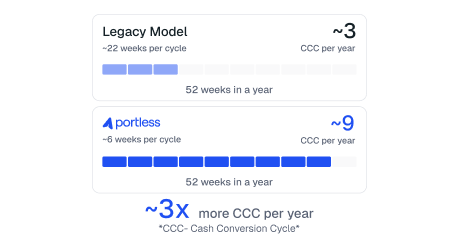
Where a 3PL operates relative to your production determines your lead time, cash conversion cycle, and delivery experience. Location trades off inbound lead time against outbound delivery speed and domestic labor costs.
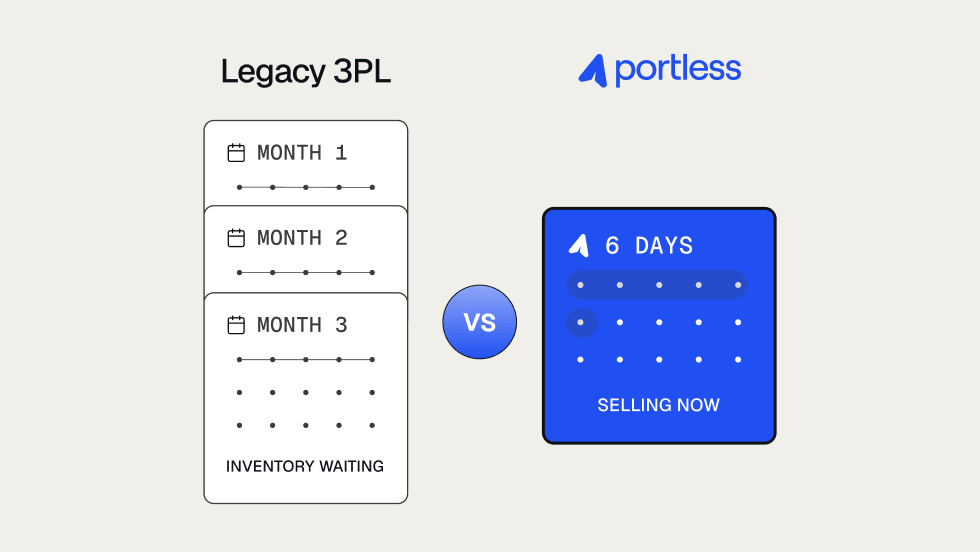
Legacy 3PLs rely on fixed domestic warehouses. Customers far from that warehouse fall into higher shipping zones, which means slower delivery and higher cost. Peak surges hit harder because inventory must already be stored domestically.
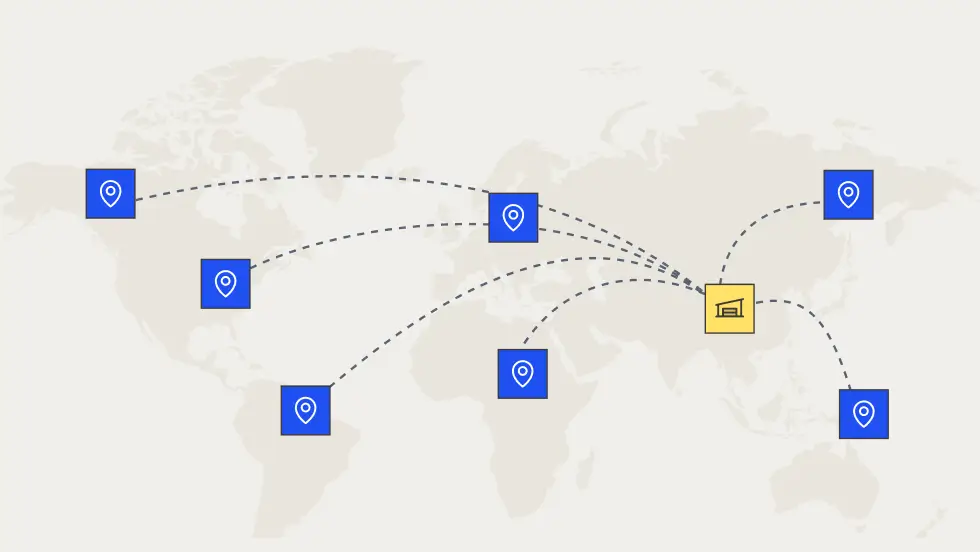
If you manufacture or source from China, a nearshore 3PL cuts your inventory-in-transit time from four weeks (US inbound) to one to three days, freeing working capital. For outbound, proximity to customer density matters more than absolute geography. A 3PL in a secondary US city serves 80% of ZIP codes within two to three days; one in a tertiary location may not.
Zone skipping solves part of this, but only if your 3PL has the right model. Direct fulfillment from Asia compresses 60+ days of lead time into roughly five days, with customer delivery averaging 7.5 days.
3PL questionnaire — location:
What's your median parcel delivery time to California? To Texas?
Do you have teams or facilities near our production location?
Can you inject shipments into regional distribution hubs closer to our customers?
Do you offer zone skipping?
Red flags: destination-only operations, no teams near production, long pre-availability transit.
3PL evaluation in action: how &Collar scaled to peak without service breaks
&Collar, a DTC menswear brand, used this evaluation framework when they outgrew their initial 3PL. As they approached peak season, they faced a choice: migrate to a vendor who could scale or stay with their current provider and risk stockouts.
They evaluated four 3PLs using the criteria in this guide — team tenure, WMS integration, peak-season capacity, and location proximity to their customer base. The winning provider could prove they'd handled similar volume before and could onboard in under 30 days.
Shortlist three to five partners and run structured interviews using this guide.
Speak to references at your scale.
Pilot with a subset of SKUs before full migration.
Document answers, red flags, and outcomes in the scorecard above.
Choose on strategic fit, not sticker price.
Find out how Portless compares
Portless gives DTC brands fulfillment near their manufacturers in Asia, real-time inventory visibility, and delivery to 85+ countries. If you're evaluating 3PLs and want to see how direct fulfillment stacks up against legacy warehouse models, talk to our team.
::dropdown
FAQ
What's the most important factor when evaluating a 3PL?
Team stability and operational consistency matter more than price. A 3PL with low staff turnover, proven peak-season performance, and transparent pricing will cost you less over 12 months than a cheaper provider with hidden surcharges and SLA failures. Start with accuracy and retention data, then layer in technology, location, and pricing.
How many 3PLs should I evaluate before choosing one?
Shortlist three to five providers. Fewer than three limits your comparison data. More than five creates evaluation fatigue and delays your decision without improving outcome quality. Use the eight criteria in this guide to score each provider consistently.
What hidden costs should I watch for in 3PL pricing?
The most common hidden costs are peak-season labor premiums (15–30% markup), returns processing fees ($0.50–$2.00 per return), kit assembly charges ($1–5 per order), and carrier rate negotiation penalties. Ask every vendor to model your actual order mix and provide a 90-day cost reconciliation by surcharge category.
How does 3PL location affect my cash conversion cycle?
If your production is in Asia and your first fulfillment touchpoint is a US warehouse, inventory sits in transit for four or more weeks before it's sellable. A 3PL located near your manufacturing source can cut that to one to three days. Direct fulfillment from Asia compresses 60+ days of lead time into roughly five days, freeing working capital you'd otherwise have locked in inventory.
What red flags should disqualify a 3PL immediately?
Hidden fees, inability to share peak-season error rates, CSV-based workflows with no real-time visibility, single-carrier dependency, and vague answers about staffing during high-volume periods. If a provider can't demo their WMS in 15 minutes or cite their last peak-season accuracy rate, they're not ready for your business.
What questions should I include in a 3PL questionnaire?
A thorough 3PL questionnaire covers eight areas: team turnover and tenure data, communication channels and escalation paths, category-specific handling experience, peak-season staffing plans and error rates, WMS capabilities and integration timelines, full cost modeling with surcharge breakdowns, references from brands at your scale, and median delivery times by region. Each section of this guide includes the specific questions to ask.
What KPIs should I use to measure a 3PL?
Measure a 3PL on pick-and-pack accuracy, staff turnover, peak-season error rate, response time, reporting lag, delivery time, surcharge transparency, and onboarding time. Top-tier operations hold 99.5%+ pick-and-pack accuracy as a median performance benchmark. Staff turnover below 30% over 12 months is a green flag. Ask for the peak-season error rate vs. baseline. Get response times inside and outside business hours. Check whether reporting is real-time, end-of-day, or weekly. Request median parcel delivery time by region and a 90-day cost reconciliation showing surcharges by category. Onboarding should take two to four weeks; eight or more is a red flag.
:dropdown
Frequently asked questions
Heading
Lorem ipsum dolor sit amet, consectetur adipiscing elit. Suspendisse varius enim in eros elementum tristique. Duis cursus, mi quis viverra ornare, eros dolor interdum nulla, ut commodo diam libero vitae erat. Aenean faucibus nibh et justo cursus id rutrum lorem imperdiet. Nunc ut sem vitae risus tristique posuere.
Get operator-level supply chain insights
Thank you! Your submission has been received!
Oops! Something went wrong while submitting the form.








.jpg)

.avif)