Freight forwarder
A freight forwarder is a logistics intermediary that arranges the transport of goods on behalf of shippers. They coordinate carriers, customs paperwork, and routing across ocean, air, rail, or truck — but they don't own the vessels, planes, or trucks themselves.
If you manufacture in Asia and sell anywhere else, you've almost certainly worked with a freight forwarder. They're the middle layer between your factory and your destination warehouse, booking space on container ships or cargo planes, filing customs paperwork, and arranging drayage on the other end. For decades, they've been the default way Ecommerce brands move bulk inventory across borders.
But "default" doesn't mean "best." The freight forwarder model was built for bulk ocean freight into domestic warehousing — a supply chain pattern that's increasingly at odds with how modern Ecommerce brands need to operate. Below, we break down what freight forwarders actually do, where they add value, and where they create friction you can avoid.
What a freight forwarder does
A freight forwarder coordinates the movement of freight shipments across one or more transportation modes. They don't typically operate the carriers themselves — they act as an agent, booking capacity on ocean liners, airlines, and trucking companies on your behalf.
Typical responsibilities include:
- Booking ocean, air, rail, or truck capacity with carriers
- Preparing and filing the bill of lading and other shipping documents
- Coordinating customs clearance at origin and destination, often through a licensed customs broker
- Arranging drayage from port to inland warehouse
- Consolidating less-than-container-load (LCL) shipments at a container freight station
- Providing cargo insurance and tracking visibility
In the US, ocean freight forwarders are licensed and regulated by the Federal Maritime Commission. Air freight forwarders operate under separate IATA accreditation.
Freight forwarder vs. carrier vs. 3PL
These three roles are often confused. Here's the distinction:
- A carrier physically moves goods — Maersk, FedEx, COSCO, a trucking company
- A freight forwarder arranges the movement but doesn't own the vehicles
- A 3PL stores your inventory in a domestic warehouse and ships individual orders to customers
A traditional Ecommerce supply chain stitches all three together: forwarder moves the bulk container from China to a US port, drayage trucks it to a 3PL, and the 3PL fulfills orders one at a time. Each handoff adds cost, time, and points of failure.
Where the freight forwarder model breaks down for Ecommerce
The freight forwarder model was designed for bulk industrial logistics, not for DTC brands selling lightweight products to customers in 85+ countries. Three problems show up consistently:
Lead times are measured in weeks, not days. Ocean freight from China to the US West Coast averages 14–30 days at sea, plus customs clearance and drayage. By the time inventory hits your 3PL, market conditions may have shifted. You're forecasting demand months in advance and betting capital on the prediction.
Duties are paid upfront on inventory that may not sell. When a container clears customs, the importer of record pays duties on the full landed value — whether the goods sell next week or sit on a shelf for a year. With recent IEEPA-authorized tariffs on Chinese imports, that upfront cash outlay has grown significantly.
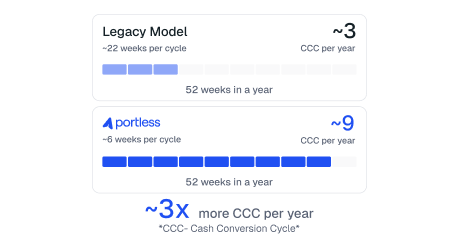
Cash gets locked in transit and storage. Production cash is gone the moment you wire the factory. It doesn't come back until the goods land, get warehoused, sell, and ship. That gap — often 90 to 120 days — is one of the biggest constraints on Ecommerce growth.
When a freight forwarder still makes sense
Freight forwarders aren't going anywhere. They're the right tool for:
- Heavy or oversized products that can't ship by air economically
- Brands with stable, predictable demand and long product lifecycles
- Wholesale and retail distribution where bulk delivery to a DC is required
- Markets where domestic warehousing is genuinely advantageous
If your product is over 3.5 lbs, has high SKU complexity that requires kitting in-country, or sells through brick-and-mortar at scale, the legacy model probably still fits. For most lightweight DTC brands selling online, it doesn't.
How direct fulfillment bypasses the freight forwarder layer
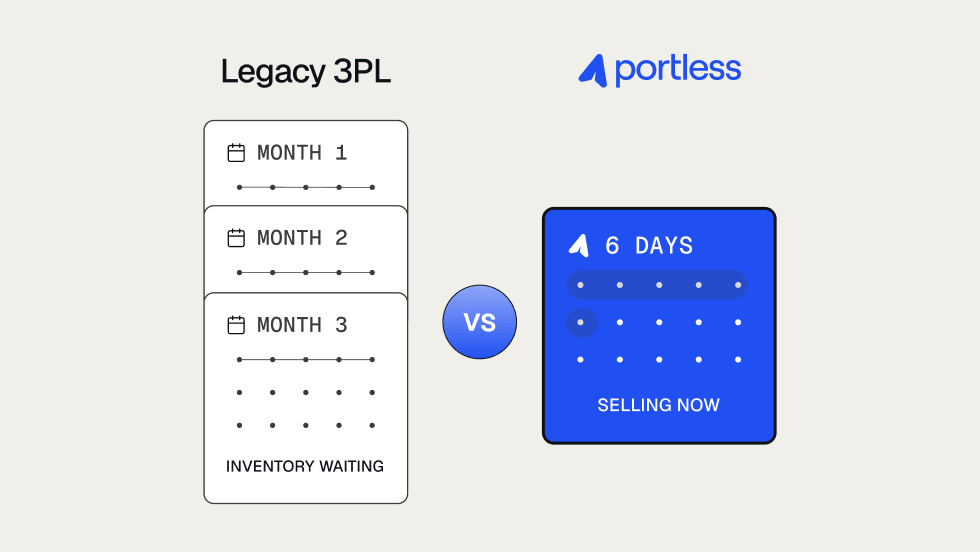
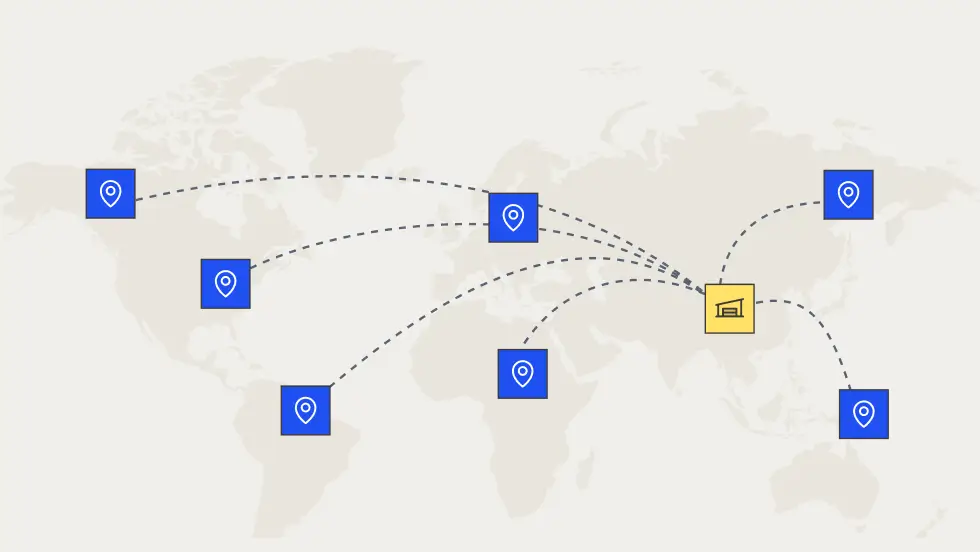
Portless skips the freight forwarder step entirely. Instead of consolidating inventory into containers and shipping it to a domestic 3PL, we fulfill orders directly from our facility next to your factory in Asia — and inject them into the destination country's last-mile carrier network within five to eight days.
That changes the math:
- Inventory becomes available for sale days after production, not months
- You only pay duties on units that actually sell, not on bulk inventory sitting in a warehouse
- You can test new international markets without standing up local warehousing
- Quality defects get caught at receiving, not six weeks later at a domestic 3PL
This is the same model Shein and Temu use to ship globally without bulk freight or domestic warehouses — adapted for DTC brands that want the speed and capital efficiency without operating their own infrastructure.
See how direct fulfillment replaces the freight-forwarder-to-3PL chain
The freight forwarder model isn't broken because forwarders do their jobs poorly. It's broken because the underlying supply chain — bulk ocean freight to domestic warehousing — locks up capital, extends lead times, and forces brands to bet on demand forecasts months in advance. Portless removes those steps entirely.
Contact us to see how direct fulfillment fits your brand's volume, product mix, and target markets.
← Back to the Ecommerce supply chain glossary