SKU
A SKU (stock keeping unit) is a unique alphanumeric code assigned to each distinct product variant — size, color, configuration, or bundle — that a brand sells. It's the foundational identifier used to track inventory, process orders, and report on sales across every system in your supply chain.
Every Ecommerce operation runs on SKUs. They're how your warehouse knows what to pick, how your ERP calculates reorder points, how your finance team values inventory, and how your manufacturer knows what to produce. Get your SKU structure right and the rest of your supply chain gets easier. Get it wrong — duplicate codes, inconsistent formats, untracked variants — and you'll spend the next two years untangling reporting errors and stockouts you can't explain.
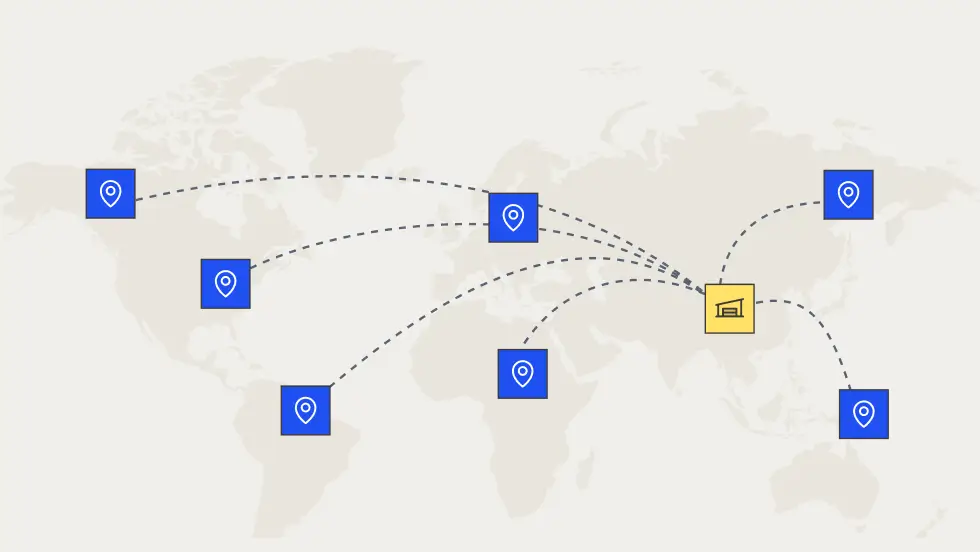
For DTC brands manufacturing in Asia and selling globally, SKUs do more than identify products. They tie your factory's production data to your fulfillment partner's pick lists to your Shopify catalog to your customer's order confirmation. One identifier, six systems, zero room for ambiguity.
What a SKU actually is
A SKU is an internal code created by the seller. That's the key distinction between a SKU and a UPC (Universal Product Code) or EAN (European Article Number), which are standardized identifiers assigned by GS1 for use across retailers globally.
You control your SKU format. You don't control your UPC.
A well-structured SKU encodes useful information at a glance:
- Product category or line
- Size, color, or other variant attributes
- Season, collection, or release year
- Supplier or manufacturing origin
For example, a t-shirt SKU might look like TEE-BLK-M-S25 — a black, medium tee from the Spring 2025 collection. Anyone on your team can read it without looking it up.
Why SKUs matter for inventory and cash flow
SKUs are the unit of measure for everything that touches your inventory. Demand forecasting, reorder points, sell-through rates, dead stock analysis — all of it rolls up at the SKU level.
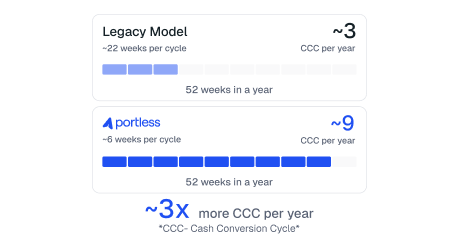
For brands operating on legacy supply chains, this gets painful fast. You're forecasting demand months ahead, committing capital to a specific SKU mix, then watching some variants sell out in two weeks while others sit in a domestic warehouse for a year. The SKU-level mismatch between forecast and reality is where margin goes to die.
This is the same dynamic SHEIN built its model around: micro-batch production at the SKU level, real-time sales feedback, and scaling only the winners. Most brands can't replicate SHEIN's scale, but they can borrow the principle — and the math works. Capital exposure per SKU drops from $5,000–$15,000 in a traditional model to $800–$2,000 in an on-demand one. See our breakdown of how to test products like SHEIN without the baggage for the full framework.
How SKUs flow through the Ecommerce supply chain
A single SKU touches every step of your operation:
- Manufacturing. The factory produces against a SKU and labels cartons accordingly
- Receiving. The fulfillment center scans the SKU on inbound and verifies counts against the purchase order
- Storage. Inventory is shelved and tracked by SKU in the warehouse management system
- Picking. Orders are picked by SKU, with barcode scanning at every step to prevent errors
- Shipping. The carrier label references the order, which references the SKU
- Reporting. Sales, returns, and margin all roll up by SKU for analysis
When &Collar onboarded with Portless before their Father's Day sale, the operation involved coordinating over 1,500 SKUs across two fulfillment nodes. SKU accuracy at every step is what made a 30-day onboarding possible — and what took their hero SKU in-stock ratio from 5% to 100%. The full story is in their case study on saving peak season with direct fulfillment.
SKU structure best practices
A clean SKU system is built once and used forever. A few rules that hold up over time:
- Keep SKUs short but meaningful — 8 to 16 characters is the sweet spot
- Use letters and numbers, never special characters that break in CSV exports
- Front-load the most important attribute (category or product family)
- Never reuse a SKU, even for a discontinued product
- Avoid encoding price in the SKU — prices change, SKUs shouldn't
- Document your SKU logic so new team members can decode it
The biggest mistake brands make is treating SKUs as throwaway codes generated by Shopify on the fly. Six months in, you have 400 SKUs with no consistent structure and no one can answer "how is the black variant performing across all sizes?" without a spreadsheet rebuild.
SKUs in direct fulfillment vs. legacy 3PL models
In a legacy 3PL model, your SKU exists in three or four disconnected systems: the factory's production sheet, the freight forwarder's bill of lading, the 3PL's warehouse management system, and your Ecommerce platform. Each handoff is a chance for a SKU mismatch — wrong barcode, wrong description, wrong quantity — and each mismatch shows up later as a stockout, an oversell, or a customer complaint.
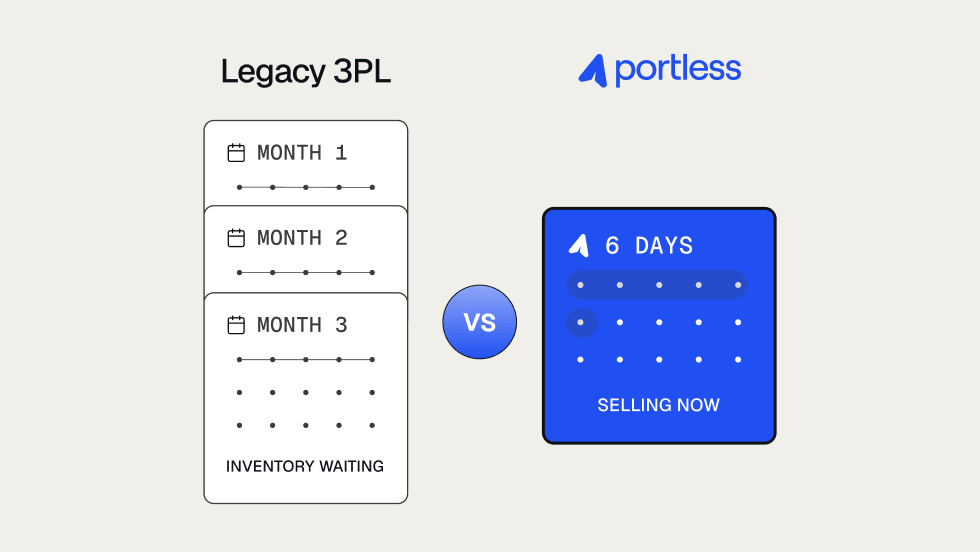
In a direct fulfillment model, the SKU lives in fewer systems and moves faster. Inventory at Portless is received, inspected, and shelved within hours of leaving the factory, with SKU-level scanning at every step. When a defect is caught, the factory is a two-hour drive away, not a six-week ocean voyage. The feedback loop closes in days instead of quarters.
That proximity changes what you can do at the SKU level. You can test 10 new variants in a 100-unit micro-batch, see which ones sell, and reorder the winners within weeks. The full operational walkthrough is in our inside look at how direct fulfillment works.
SKU proliferation is a real risk
More SKUs is not a strategy. It's a tax.
Every new SKU adds complexity to forecasting, photography, listings, packaging, fulfillment, and reporting. Brands that double their SKU count without doubling revenue end up with longer reorder cycles, more dead stock, and less leverage with manufacturers because they're spreading volume across too many variants.
The discipline is to rotate SKUs, not stack them. Discontinue the bottom 20% by sell-through every quarter. Use a lean portfolio model — core sellers, test SKUs, and trend SKUs — and let the data decide which ones graduate.
How Portless turns SKU-level visibility into a cash flow advantage
Direct fulfillment from Asia means every SKU you produce is available for sale within days, not months. Portless gives you real-time SKU-level inventory visibility, factory-adjacent quality control, and the ability to ship globally without committing to a domestic warehouse mix you'll regret a quarter later. If you're tired of cash trapped in slow-moving SKUs sitting in a Utah warehouse, contact us to see how the model works for your brand.
← Back to the Ecommerce supply chain glossary