Demand forecasting
Demand forecasting is the process of predicting future customer demand for products using historical sales data, market signals, seasonality, and trend analysis. It drives purchasing, production, inventory allocation, and cash deployment decisions across the supply chain.
Demand forecasting is how Ecommerce brands decide what to buy, how much to produce, and when to commit capital. The output of a forecast determines almost every downstream decision: purchase orders to factories, freight bookings, warehouse space, ad spend allocation, and cash flow projections. When forecasts are accurate, brands hold the right inventory at the right time. When forecasts miss, the consequences split into two equally damaging outcomes — overstock that traps capital and stockouts that erase revenue.
Most brands treat forecasting as a data problem. Better models, better tools, better historical analysis. But the real constraint is rarely the math. It's the timeline. The further out you have to forecast, the more variables you're guessing on, and the wider your error bars get. According to research published in Supply Chain Management Review, 68% of supply chain executives list inventory optimization as a top priority, yet many respond by increasing safety buffers — which compounds the cash problem rather than solving it.
How demand forecasting actually works
A standard demand forecast pulls from several inputs:
- Historical sales data, typically broken down by SKU, channel, and season
- Year-over-year growth trends and category benchmarks
- Marketing calendar inputs like planned promotions, launches, and ad spend
- External signals including search trends, social sentiment, and competitor activity
- Macro factors like economic conditions, tariff changes, and consumer confidence
Forecasters then apply a method — moving averages, exponential smoothing, regression analysis, or machine learning models — to project demand over a defined horizon. Most legacy Ecommerce brands forecast 90 to 120 days out because that's how long it takes to produce goods overseas, ship them by ocean, clear customs, and stage them in a domestic warehouse.
Why long forecast horizons break accuracy
Forecasting accuracy is a function of time. The shorter the prediction window, the more reliable the output.
- Four months out: high error rate, driven by unstable assumptions across too many variables
- Two months out: clearer patterns emerge as recent demand data accumulates
- Four weeks out: meaningful signals from live sales velocity and trend inflections
- Real time: minimal guesswork, decisions made on confirmed demand
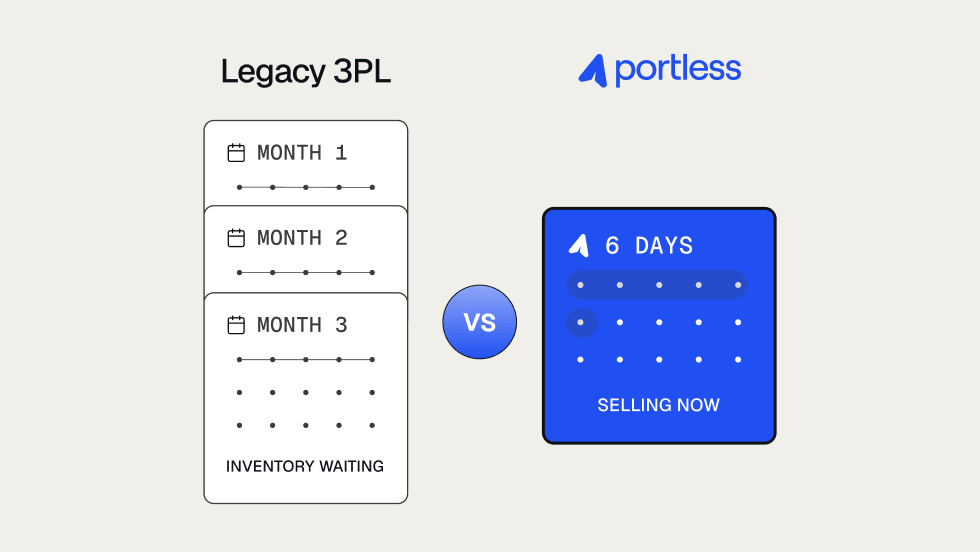
The problem is that legacy supply chains force brands to commit at the four-month mark. Ocean freight takes 45 to 60 days. Customs and drayage add processing time. Warehouses require receiving and staging windows. By the time inventory is sellable, the forecast is months stale. For a deeper breakdown, see why traditional forecasting fails.
The cash flow cost of early forecasting
Early forecasting doesn't just create inventory risk. It traps cash. A typical legacy planning cycle looks like this:
- Factories get paid 60 to 90 days before goods sell
- Ocean freight adds another 45 to 60 days of inventory in transit
- Warehousing fees accrue while inventory waits to be sold
- Domestic fulfillment fees stack on top once orders finally ship
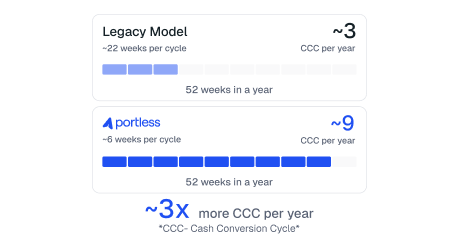
Cash is tied up for 100 to 120 days or more before revenue arrives. For a brand doing $5M in annual revenue, that often means $80,000 to $120,000 committed months before real demand confirms whether the bet was right. That capital can't fund ad spend, new product testing, or rapid replenishment when a SKU breaks out.
Common demand forecasting methods
Most brands use a combination of the following approaches:
- Qualitative forecasting: Expert judgment, market research, and sales team input. Useful for new products with no sales history
- Time series analysis: Projects future demand based on historical patterns, accounting for seasonality and trend
- Causal models: Links demand to specific variables like price, promotions, weather, or ad spend
- Machine learning models: Uses large datasets and pattern recognition to predict demand at SKU or variant level
- Pre-orders and demand validation: Uses real customer purchase intent to validate forecasts before production. Most reliable for first-time launches
According to research from WooCommerce, 32.6% of merchants increase inventory as their top peak-season preparation strategy — even when those commitments are made long before real demand signals are visible.
What better demand forecasting looks like in practice
Forecast accuracy improves when the prediction window shortens. The brands doing this well aren't running better models. They're running faster supply chains. Instead of one large quarterly forecast, they use rolling weekly demand cycles that follow real customer signals.
A weekly forecasting rhythm typically includes:
- Observe: Review sales velocity, SKU health, and contribution margins
- Decide: Identify which SKUs to replenish, pause, or pull back
- Produce: Trigger small-batch production tied to live demand
- Deliver: Move goods from factory to customer in days, not months
This shift turns forecasting from a long-range prediction into short-range decision-making. For the full operational breakdown, see the operational model behind late forecasting.
Demand forecasting for peak season
Peak periods like BFCM and Singles' Day amplify the cost of forecasting errors. Demand concentrates into a tight window, and the brands that win aren't the ones with perfect forecasts — they're the ones that can react. Two peak seasons, two systems breaks this down in detail, but the short version: brands that can restock in days, not quarters, capture demand that other brands lose to stockouts.
For peak season planning specifics, the 2025 BFCM logistics playbook covers historical data analysis, pre-orders, and just-in-time inventory strategies that improve forecast accuracy under pressure.
How Portless changes the demand forecasting equation
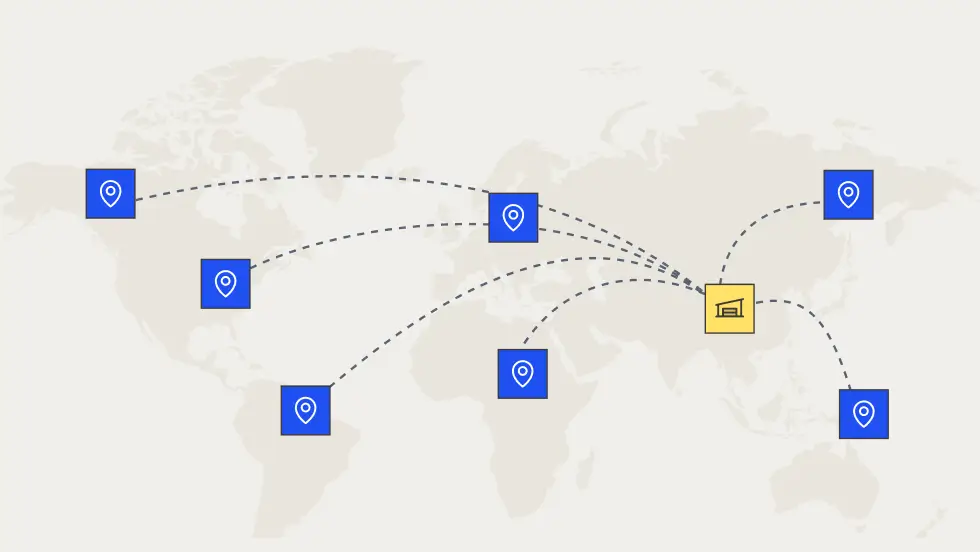
Portless powers direct fulfillment from factories in Asia to customers in 85+ countries, with delivery in five to eight days. By compressing the timeline between production and customer, Portless lets you forecast weekly instead of quarterly, commit smaller batches, and replenish based on live demand data rather than four-month-old assumptions. Forecasting doesn't go away — but the cost of getting it wrong drops dramatically.
Contact us to see what weekly demand cycles could look like for your assortment.
← Back to the Ecommerce supply chain glossary