Last updated: May 2026
If you manufacture in China and sell to customers in North America, here is the reality 2025 revealed:
- TikTok demand can spike in hours, not weeks.
- Your legacy 3PL cannot react fast enough to restock in time. Inbound container queues, receiving delays, and bulk freight cycles add weeks between your purchase order and a sellable unit.
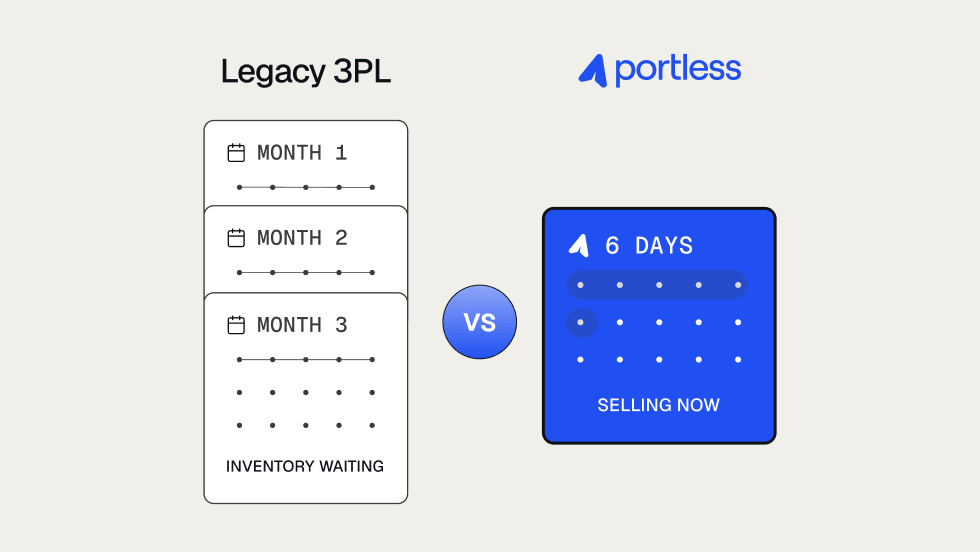
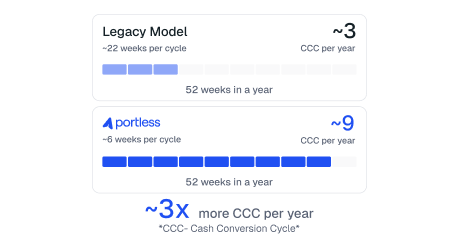
- Your cash is trapped in 90 to 120 day cycles while operators using direct fulfillment run at 45 to 60, and as fast as six to nine days on select lanes, according to Portless customer data.
- North American brands have intelligence. China has proximity and speed.
- The brands that win in 2026 will combine both.
This is a guide to understanding why Singles' Day in China and BFCM in North America now operate on different systems, and what that means for peak season supply chain planning in 2026. For supporting reading on the inventory mechanics behind this shift, see our breakdown of BFCM stocking strategies.
Forecasting vs. reaction time: what changed in peak season 2025
Singles' Day and Black Friday Cyber Monday 2025 showed the same pattern. The brands that held margin weren't the ones with better forecasts. They were the ones that converted demand into revenue while it was still live, instead of losing sales to stockouts or forced markdowns. For the inventory mechanics behind this, see our BFCM stocking strategies breakdown.
The constraint is time. Shopify reported $6.2B in Black Friday sales, with transaction volume peaking at $5.1M per minute. When demand concentrates that fast, delayed response looks identical to missed opportunity.
Reuters noted Amazon, Walmart, and Target captured the bulk of Cyber Week traffic through early deals and broad availability. US online spending from Thanksgiving through Cyber Monday hit $44.2B, up 7.7% year over year. Demand clustered around operators that could absorb volume immediately.
This isn't about livestream tactics or AI discovery. It's about how two retail systems convert demand into revenue, and where each one breaks.
How Singles' Day 2025 ran as continuous execution at scale
Singles' Day 2025 generated RMB 1.695T ($238B) in GMV, up roughly 14-17% year over year. By comparison, total US online spending from Thanksgiving through Cyber Monday reached $44.2B. Singles Day alone is roughly five times the size of the entire US Cyber Week online window.
The scale isn't the point. The operating model is.
Singles' Day doesn't run as a 24-hour event anymore. Promotions extended across five weeks starting in mid-October, forcing continuous execution. Forecasting errors surface immediately. Slow SKUs become cash problems in days.
Livestreaming drives this system. It's not entertainment, it's real-time demand routing. In 2025, livestream commerce generated roughly 25% of Singles Day GMV across more than 180,000 sessions. Conversion signals surface live at the SKU level while campaigns are still active.
Because fulfillment sits close to production, operators act on those signals immediately. Operators reallocate inventory, adjust output, and recover capital before demand fades. Platform concentration reinforces this. Alibaba, JD.com, and Pinduoduo control roughly 90% of China's Ecommerce GMV, according to Reuters reporting on the Singles' Day platform landscape, creating cleaner signals and fewer bottlenecks.
Singles' Day rewards operators who execute continuously under pressure, not those who planned perfectly months ago.
How BFCM 2025 exposed the peak season supply chain gap
BFCM 2025 delivered strong numbers through a different structure. Black Friday online spending hit $11.8B, up 9.1% year over year. Cyber Monday reached $14.25B.
Unlike Singles Day, BFCM unfolded across weeks of micro-cycles shaped by early promotions, loyalty offers, creator drops, and social spikes. Fortune described BFCM as "nearly month-long" rather than a single peak.
AI accelerated discovery but not execution. Brands could see demand forming earlier, but fulfillment speed stayed constrained by long replenishment cycles and warehouse intake delays. Intelligence arrived faster than inventory could move. For a deeper breakdown of the inventory mechanics behind this gap, see our BFCM stocking strategies.
Mobile drove more than 55% of Black Friday revenue, raising expectations around load time and delivery accuracy. Any friction translated to lost conversion.
Fragmentation amplified these constraints. Demand surged quickly. Brands couldn't rebalance inventory with the same speed.
In BFCM 2025, visibility wasn't the advantage. Response time was.
How TikTok Shop drove BFCM 2025
TikTok Shop confirmed its largest BFCM to date, with nearly 50% more shoppers buying year over year. In-feed content and in-app checkout compressed demand into hours.
Brands with fast dispatch and flexible inventory captured incremental revenue during these spikes. Brands dependent on domestic restocking windows didn't.
For tactical details, see our social commerce guide for BFCM and the BFCM logistics playbook.
How premium and impulse SKUs split across channels in peak season 2025
Holiday shoppers bought fewer items at higher prices in 2025. Adobe Analytics tracks holiday ASP trends across major US retailers and reports the season-over-season shift.
At the same time, TikTok Shop skewed toward lower-ticket impulse buys where creator discovery and in-feed checkout compressed decisions into minutes. Higher-priced items converted more reliably through traditional mobile web checkouts where shoppers had more time to evaluate.
The takeaway: SKU type must match the buying context where it converts best.
Why production proximity collapses the lag between demand signal and restock
China's advantage isn't labor cost. It's short decision loops.
When quality control, inventory, and fulfillment sit next to production, operators respond to demand immediately. Operators reallocate inventory, adjust output, and recover capital while demand is active. The lag between insight and execution collapses.
Proximity turns volatility into an advantage.
Why North American brands lose peak season revenue despite better demand intelligence
North American brands excel at discovery. AI merchandising, mobile checkout, and BNPL adoption surface demand earlier than ever.
The constraint is execution. Forecasts run months ahead. Inventory locks in long transits and warehouse queues. Platforms fragment, signals scatter, and restocking lags.
BFCM 2025 made this visible. Brands knew what worked but couldn't restock fast enough to capture it.
North American brands have the best demand signals in the world and the slowest infrastructure to act on them. That gap is the cost.
Three structural issues hold the legacy model in place:
- Ocean transit from China to the US West Coast averages 30 to 40 days port-to-port, with another seven to 14 days for inland transit and 3PL intake during peak: a six to eight week window where capital is committed and inventory is invisible to your storefront. Freightos and Flexport track these baselines weekly.
- Domestic 3PLs queue inbound containers during Q4. Receiving delays of seven to 10 days are routine in November, which means inventory you paid for in September isn't sellable when demand peaks.
- Bulk ordering forces forecast commitments months before the first creator post goes live. By the time TikTok surfaces the winner, the next batch is still on a boat.
The operator math is simple. If your cash conversion cycle is 90 days and a competitor's is 45, they recycle the same dollar twice during peak. They restock winners while you wait on a container. Intelligence without speed is a slower version of guessing.
Why inventory timing determines margin in a peak season supply chain
Inventory timing isn't an ops detail. It's a margin decision.
Legacy planning locks capital by forcing prepayment, long transits, and safety stock to hedge forecast risk. When forecasts miss, brands absorb the cost through stockouts, air freight, or markdowns.
QC timing compounds this. When QC happens after goods reach a US warehouse, defects surface during peak, triggering returns, replacement shipments, support strain, and LTV erosion. Factory-adjacent QC removes that risk before inventory ships.
Slow supply chains turn forecasting into a tax on cash and margin.
Inventory timing is the largest controllable variable in peak season margin. Two numbers tell the story.
Air freight during peak runs five to 10 times the cost of ocean freight per unit, according to Freightos rate data. For a $20 SKU at 50% gross margin, emergency air freight can erase $5 to $8 of margin per unit, cutting net margin to 10% or below. That's the cost of a forecast miss when your only correction tool is air.
The second number is the carrying cost of overordering. According to research summarized by Investopedia, brands often over-order by 30 to 40% for peak. That excess inventory carries storage, handling, and capital costs every month it sits — typically $0.20 to $0.40 per unit per month in a US 3PL, before factoring in the opportunity cost of cash you can't deploy into ad spend, new SKUs, or growth. Markdowns at the end of Q1 are how most brands turn 2025 inventory into 2026 cash flow, at a loss.
QC timing compounds both costs. When inspection happens after goods reach a US warehouse, defects surface during peak, triggering returns, replacement shipments, support strain, and LTV erosion on first-time buyers. Factory-adjacent QC catches defects before inventory ships and before customers see them.
The decision isn't whether to hold inventory. It's how late you can commit and how fast you can restock when the signal confirms.
How hybrid operators will win peak season 2026
The strongest operators in 2026 will combine the strengths from both systems:
From China: factory-adjacent quality control, short restock cycles, real-time inventory visibility, and faster cash conversion.
From North America: AI segmentation, mobile checkout optimization, dynamic pricing, predictive demand models, and social commerce amplification.
Hybrid operators reduce the lag between signal and action while maximizing conversion and cash flow efficiency.
Peak season is no longer a marketing contest. It is a test of operational agility.
The hybrid operator model isn't theory. It's an operating sequence you can build over one quarter.
What it looks like in practice:
- Run smaller initial production batches, 40 to 50% of projected peak volume, staged at factory-adjacent hubs in Asia rather than pre-positioned in a US 3PL.
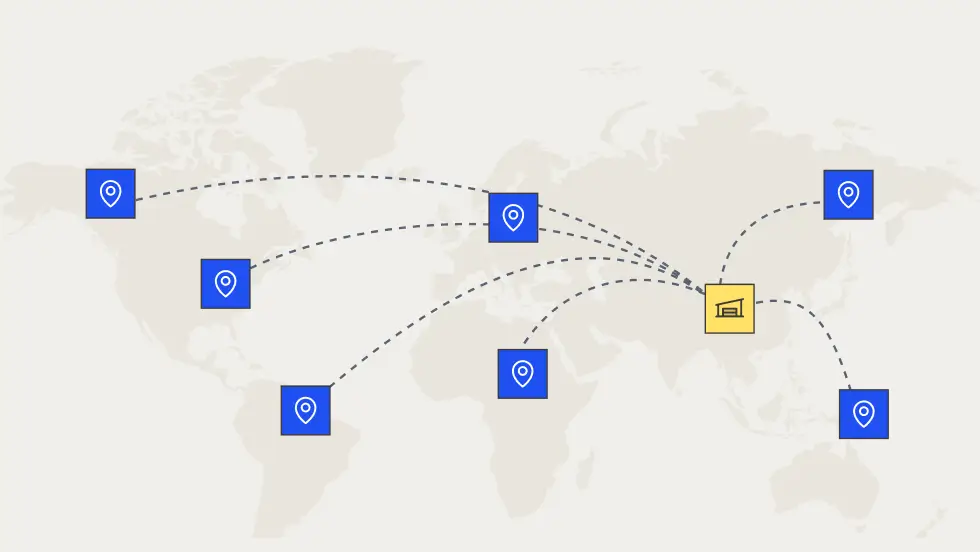
- Use direct fulfillment to ship orders from those hubs to customers in five to eight days, eliminating ocean transit and warehouse intake from the critical path.
- Monitor SKU velocity weekly under rolling demand cycles. Trigger weekly replenishment when week-over-week velocity grows more than 15%, or when consumption runway drops below your reorder threshold.
- Reserve domestic bulk positioning only for SKUs that have proven sustained, predictable velocity, not for new launches or trend bets.
- Hold cash for marketing and creative reinvestment. Operators using this model turn production spend into recoverable cash in six to nine days on select lanes, versus 60 to 90 days under bulk freight.
The hybrid model doesn't replace forecasting. It replaces the part of forecasting that has to be right months in advance. You still plan. You just commit later, with better data, and with a recovery path if a SKU disappoints.
If you want to model what this looks like with your own SKU mix, run the numbers in the Portless Direct Fulfillment ROI calculator.
The 2026 peak season question isn't what to sell, it's how fast you can move
Singles' Day and BFCM 2025 revealed one truth: the distance between production and decision determines peak season supply chain outcomes. The question isn't what to sell or how deep to discount — it's how fast you can see a winning SKU surge, restock in days instead of quarters, catch QC issues before customers do, and test new SKUs without tying up six months of capital. Speed is no longer an operational advantage. It is the operating model, and if you're mapping where the speed gaps sit in your supply chain, you can talk to our team about how other operators closed similar ones.
FAQ
How long does ocean freight from China to the US take during peak season?
Port-to-port transit averages 30 to 40 days, with another seven to 14 days for inland transit and 3PL intake during Q4. That's a six to eight week window where capital is committed and inventory is invisible to your storefront.
What is direct fulfillment and how does it change peak season economics?
Direct fulfillment ships orders from factory-adjacent hubs in Asia directly to customers in five to eight days, removing ocean transit and 3PL intake from the critical path. It shortens the cash conversion cycle from 90+ days to as fast as six to nine days on select lanes.
Should I still hold inventory in a US 3PL?
Yes, but only for SKUs with proven, sustained velocity. Use direct fulfillment for new launches, trend bets, and replenishment of fast movers. Reserve bulk domestic positioning for predictable demand.
When should I commit to peak season production volumes?
Later than you currently do. Run initial batches at 40 to 50% of projected peak volume, then trigger replenishment based on weekly velocity signals. The goal is committing inventory after demand data confirms, not before.
When should brands start planning for peak season?
Most legacy supply chains require operators to commit 90 to 120 days before peak. Brands using direct fulfillment from factory-adjacent hubs can commit later, often 45 to 60 days out, because production-to-customer delivery runs in days, not months. Start the planning conversation in Q2, but commit inventory only when you have a velocity signal.
How do you forecast peak season demand without overordering?
You don't forecast more accurately, you forecast later. Stage smaller initial production runs, monitor weekly velocity, and replenish in rolling batches once signals confirm winners. This replaces one large seasonal bet with several smaller, data-driven commitments.
What is the biggest peak season risk for DTC brands?
The biggest risk is cash trapped in inventory that doesn't sell at full price. Stockouts on winners and markdowns on losers usually come from the same root cause: ordering too much, too early, with no ability to react when demand surfaces.
How does direct fulfillment compare to a legacy 3PL during peak season?
Direct fulfillment ships orders from factory-adjacent hubs in five to eight days, while legacy 3PLs require 60 to 90 days of inventory pre-positioning. Direct fulfillment turns production spend into cash in days. Legacy 3PLs lock cash for months and add receiving delays during peak.
Why did BFCM 2025 reward brands with faster fulfillment?
BFCM 2025 unfolded across weeks of micro-cycles driven by AI discovery, TikTok Shop spikes, and creator drops. Demand surfaced in hours. Brands dependent on domestic restocking windows missed the spike. Brands with flexible inventory captured incremental revenue.








.jpg)
.jpg)
%20(1).jpg)