“We generated $70K in package protection revenue in a single quarter by adding a simple $4 protection option at checkout — plus an additional $12K from cashbacks. Customers get peace of mind, and we're making a profit on every protected order with zero effort."
“We generated $70K in package protection revenue in a single quarter by adding a simple $4 protection option at checkout — plus an additional $12K from cashbacks. Customers get peace of mind, and we're making a profit on every protected order with zero effort."
Here we break down how leading operators replace seasonal forecasting with weekly demand cycles guided by real customer signals. We cover the mechanics behind this shift, including faster production cycles, rapid replenishment, and the direct fulfillment infrastructure that supports agile inventory planning.
From seasonal bets to rolling demand cycles
Legacy supply chains rely on one major order each quarter or season. Agile systems replace this with rolling demand cycles that repeat every seven or 14 days. Once supply chain timelines compress, especially when factory to customer delivery takes five to eight days on most lanes, forecasting becomes a weekly operating system rather than a seasonal bet.
Each cycle includes four steps:
Observe: Review real sales velocity, SKU signals, and contribution margins.
Decide: Identify which SKUs need replenishment, which require caution, and which should slow down.
Produce: Trigger small batch production tied closely to live demand.
Deliver: Move goods directly from factory to customer in days instead of months.
Forecasting improves naturally when decisions refresh weekly instead of once per season.
What signals do high-performing agile inventory teams actually watch?
Agile forecasting relies on a narrow set of real time signals that guide weekly replenishment decisions. The most important include:
Velocity: The rate at which a SKU accelerates or decelerates over the past seven days.
Trend inflections: Slope changes that reveal rising or declining interest before volume confirms it.
Variant behavior: Patterns across sizes, colors, bundles, and regions that highlight hidden winners.
Elasticity response measures how demand shifts when price or promotion changes by even a few percentage points. McKinsey's 2024 consumer research found discretionary buyers have grown more price-sensitive since 2022, which makes elasticity a weekly signal, not a quarterly one.
SKU health score: A daily classification across four zones: healthy, caution, urgent, at risk.
These signals turn forecasting from a long range projection into a real time feedback loop.
How agile brands structure production decisions
Agile operators use structured production cycles that repeat reliably throughout the year. A typical sequence includes:
Cycle 0: Initial launch batch
A modest starter order based on directional expectations, often 40 to 50 percent of projected volume.
Cycle 1: First replenishment
Triggered by week one velocity and early trend inflections.
Cycle 2: Validation cycle
Confirms strength in SKUs showing consistent lift across multiple days.
Cycle 3: Expansion cycle
Ramps production for breakout products that show clear upward momentum.
Cycle 4: Correction cycle
Reduces replenishment for slow movers and reallocates toward emerging winners.
Instead of relying on one large seasonal forecast, brands make several smaller decisions that follow the behavior of real customers.
Replenishment rules that support later forecasting
Agile replenishment is deliberate and structured. Clear decision rules remove guesswork and protect margins as demand evolves. The weekly rhythm only works when the decision speed inside the team matches the speed of the supply chain. This is where how decision latency drains DTC margins becomes the operating constraint, not forecast accuracy.
Replenish when:
Week over week velocity grows more than 15 percent
SKU health score moves into the caution zone
Consumption runway drops below threshold
Contribution margin remains strong under air shipment
Early social or creator signals appear
Pause replenishment when:
Velocity plateaus
A newer variant shows rising traction
Price sensitivity increases unexpectedly
Pull back when:
Sell through falls below expectation
Inventory outpaces realistic runway
Competitor movements materially shift demand
These rules turn forecasting into a controlled weekly rhythm. For a deeper look at why speed of decision matters as much as accuracy, see how decision latency drains DTC margins.
Why direct fulfillment is the foundation of agile inventory planning
Late forecasting only works when production and delivery are fast enough to support it. Direct fulfillment creates this foundation by reducing total supply chain time.
Factory adjacency: Small batches can be produced and packed within days.
Air first routing: Goods travel from factory to customer in five to eight days on most lanes.
Continuous inbound flow: Eliminates port congestion, container dwell time, and warehouse receiving delays.
Smaller batch viability: Replenishment works at 200, 500, or 1,000 units without efficiency loss.
Variant level flexibility: Inventory mix adjusts weekly rather than quarterly.
Late forecasting is impossible without short lead times. The math is unforgiving: if your supply chain takes 60 to 90 days from production to selling shelf, your forecasts are 60 to 90 days early. Every week of compression buys you a week of better data.
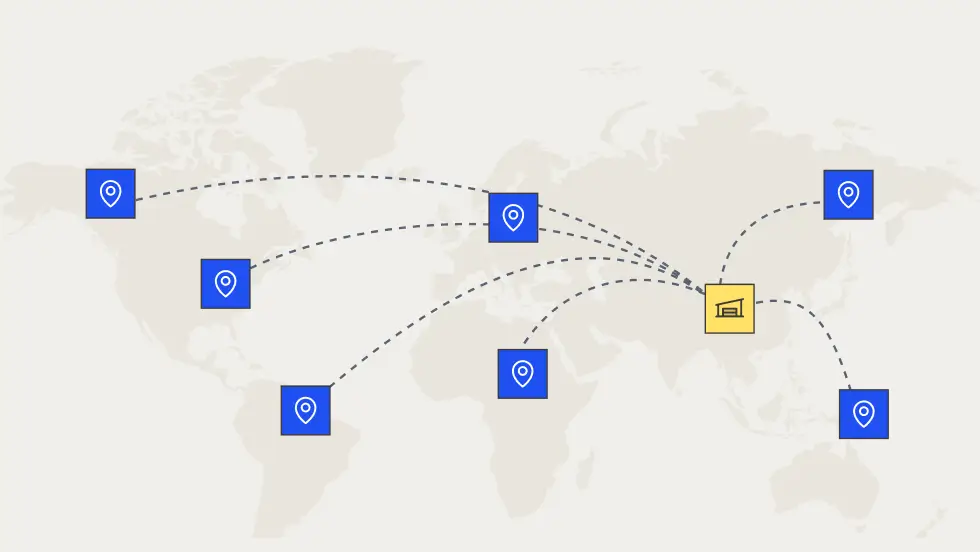
Direct fulfillment from manufacturers in China and Vietnam removes the steps that force early commitment. There is no ocean leg, no port dwell, no domestic 3PL receiving window, no inter-warehouse transfer. Goods move from the factory to a Portless-operated hub within hours, then air-ship direct to the customer.
What this changes in practical terms:
Small batches at 200, 500, or 1,000 units stay economical because there is no container minimum and no domestic warehouse receiving fee per pallet
Replenishment triggers in days, not weeks. A velocity spike on Monday can produce restock units in the customer's hands the following week
Variant mix shifts weekly: if mediums are selling 3x faster than larges, the next batch reflects that without restructuring a container plan
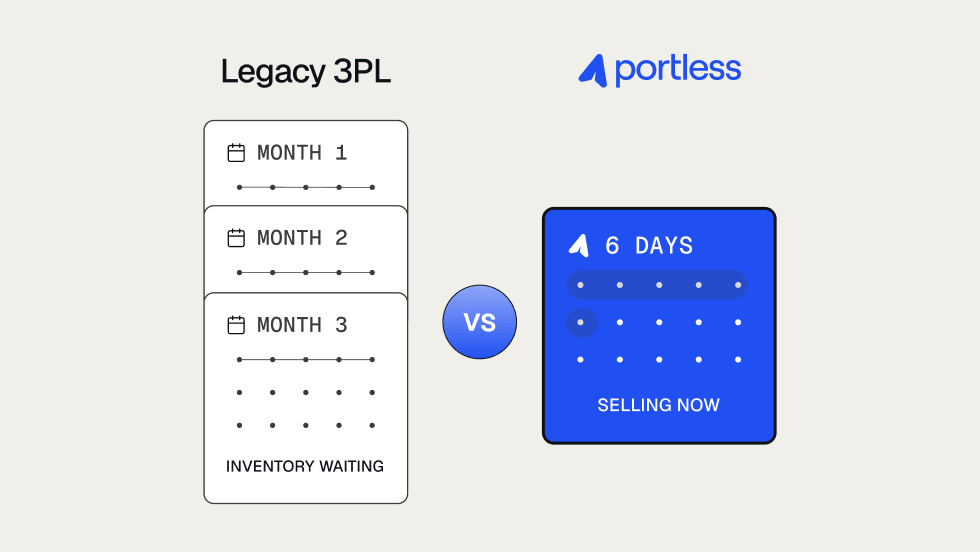
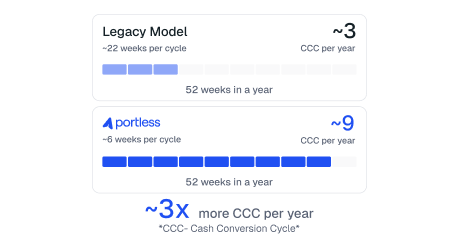
Cash conversion compresses from 100-plus days to under 45 because production spend turns into delivered revenue in days, not months, closing the cash flow trap that kills most DTC brands
Shein and Temu built their entire commercial advantage on this model — small-batch production tied directly to real-time demand, with fulfillment compressed to days. The infrastructure that supports it is not exotic anymore. It's available to any DTC brand doing 1,000-plus orders per month.
Direct fulfillment does not eliminate forecasting. It eliminates the need to forecast months in advance.
How Craft Club uses late forecasting to stay in stock and scale faster
Craft Club, a fast-growing craft kit brand, ran into a ceiling that has nothing to do with marketing or product-market fit. They had demand. They couldn't replenish fast enough to capture it.
Their legacy setup forced them to commit to large seasonal orders months in advance, shipped by ocean, received into a domestic 3PL. By the time inventory was sellable, the demand signal that drove the order was already three months stale. Bestsellers stocked out. Slower SKUs sat. Cash sat with them.
After switching to Portless, the operating model changed:
Production shifted from large seasonal orders to small weekly replenishment cycles tied to live Shopify velocity
Cash conversion cycle dropped 3x because inventory spent less time in transit and storage
In-stock rates on bestsellers stayed consistently high through replenishment in days, not months
Revenue grew 3x as the team stopped planning around container cycles and started planning around campaigns
"We just create a campaign and turn it on. One upstream inventory pool serves multiple regions." — Nikos Maniaty, Founder, Craft Club
What tools agile inventory teams use for weekly replenishment decisions
Agile systems rely on a compact set of tools that turn real data into clear action.
Agile inventory planning runs on a small stack of data inputs, not a dashboard buffet. The point is to give the operator running Monday morning's replenishment meeting a clear, repeatable read on what to do next.
The five inputs that matter:
SKU clustering groups your catalog by velocity profile so a hero SKU is reviewed on a different cadence than a long-tail variant. Most teams cluster into three to five tiers.
Consumption runway shows days of inventory remaining at current velocity, calculated per SKU. When runway drops below your replenishment lead time plus a buffer, you reorder. With direct fulfillment, that threshold is days, not weeks.
Trend detection flags week-over-week velocity changes greater than 15 percent before volume confirms them. This is what lets you act on early creator-driven or social-driven demand.
Air viability calculator confirms that contribution margin holds when product moves by air. For most lightweight DTC products under 3.5 lbs, the math works.
Contribution margin per kilogram ranks SKUs by which generate the most margin per unit of air freight cost. This guides which SKUs get the fastest replenishment cadence.
A working setup pulls velocity data from Shopify, ties it to factory production capacity through your fulfillment partner's system, and surfaces replenishment triggers in a single weekly view. The technology is not the bottleneck. The bottleneck is having a fulfillment model fast enough to act on what the tools tell you.
These tools create the planning structure needed for late forecasting.
Can your supply chain support later forecasting?
You can forecast later if:
Production partners can flex weekly
Inventory can move factory to customer in 7 to 10 days
Small, frequent batches are possible
SKU health updates daily
Velocity is reviewed weekly
Replenishment does not require monthly meetings
If any of these conditions fail, forecasting must remain early by necessity. Before committing to a planning cadence, it's worth understanding which fulfillment decisions are hard to reverse, because the supply chain you choose sets the floor for how late you can responsibly forecast.
What agile inventory planning means for margins, cash flow, and inventory risk
Forecast accuracy does not improve by looking further into the future. It improves by shortening the distance between decision and data, and agile systems make this possible through weekly rhythms powered by real signals instead of assumptions.
With shorter timelines, brands commit later, adjust faster, and operate with less risk. This is how operators improve accuracy, reduce inventory exposure, and strengthen cash conversion without needing perfect prediction.
Agile inventory planning isn't a planning trick. It's an operating model that only works when your supply chain is short enough to act on weekly signals. If you want to see what weekly demand cycles could look like for your assortment, talk to our team about the operational model behind it.
FAQ
What is agile inventory planning?
Agile inventory planning is a system that replaces large seasonal forecasts with weekly or biweekly replenishment cycles driven by live sales data. It works only when supply chain timelines are short enough, typically five to eight days from factory to customer, to let brands commit to small batches based on real demand.
How is agile inventory management different from traditional inventory management?
Legacy inventory management relies on large quarterly or seasonal orders placed three to four months before peak demand. Agile inventory management uses smaller, more frequent production runs triggered by weekly velocity signals. The trade-off is not cost per unit, it is risk exposure and cash conversion speed.
What are the four dimensions of an agile supply chain?
The four dimensions are market sensitivity (reading real-time demand), virtual integration (sharing data across factory, fulfillment, and storefront), process integration (coordinated production and replenishment), and network integration (factory-adjacent fulfillment that compresses lead times to days, not months).
How do you reduce stockouts without overstocking?
Hold a smaller initial batch — 40 to 50 percent of projected volume — then trigger fast replenishment when week-over-week velocity grows more than 15 percent or consumption runway drops below threshold. This requires a fulfillment model that can deliver factory-to-customer in five to eight days.
What does a weekly replenishment cycle look like?
A weekly replenishment cycle has four steps: observe sales velocity and SKU signals, decide which SKUs need replenishment, produce small batches at the factory, and deliver direct to customers in days. Each cycle refreshes decisions with the previous week's actual demand data.
Frequently asked questions
Heading
Lorem ipsum dolor sit amet, consectetur adipiscing elit. Suspendisse varius enim in eros elementum tristique. Duis cursus, mi quis viverra ornare, eros dolor interdum nulla, ut commodo diam libero vitae erat. Aenean faucibus nibh et justo cursus id rutrum lorem imperdiet. Nunc ut sem vitae risus tristique posuere.
Get operator-level supply chain insights
Thank you! Your submission has been received!
Oops! Something went wrong while submitting the form.









.jpg)

.avif)