Stockout
A stockout is an event in which a product is fully depleted from available inventory and can no longer be sold or shipped to fulfill customer demand. For Ecommerce brands, stockouts directly translate into lost revenue, eroded customer trust, and weaker performance on marketplaces that reward in-stock rates.
Every founder has felt it. A SKU goes viral, ad spend is converting, and then inventory hits zero. The product page flips to "sold out," the marketing engine keeps spending against a dead listing, and you watch demand walk away in real time. That's a stockout, and it's one of the most expensive failures in Ecommerce because it punishes you on both sides of the P&L: lost sales today, lower lifetime value tomorrow.
Stockouts aren't bad luck. They're the predictable output of a legacy supply chain that asks you to forecast demand six months in advance, lock cash into ocean containers, and hope the plan still works by the time the inventory clears a domestic 3PL. When any link in that chain slips — production, freight, customs, receiving — the result is the same. Empty shelves, on a product you already paid to make.
What causes stockouts in Ecommerce
Stockouts rarely come from a single failure. They're the compounding result of long lead times, fragile forecasts, and decisions made too far ahead of real demand signal.
- Inaccurate demand forecasting. Bulk ordering forces you to commit months in advance, so any miss on velocity, seasonality, or a viral moment shows up as empty shelves.
- Long replenishment lead times.Ocean freight plus domestic 3PL receiving can stretch 60 to 90 days. By the time you spot a winner, the next container is still on the water.
- Inventory inaccuracy across channels. When Shopify, Amazon, and your 3PL don't share a single source of truth, you oversell on one channel while sitting on stock you can't see.
- Capital constraints. Cash tied up in slow-moving SKUs leaves nothing to reorder the fast-movers. You stock out of winners while pallets of losers sit untouched.
- Supplier or QC delays. A failed inspection, a missed production slot, or a customs hold turns a planned restock into a four-week gap.
The real cost of a stockout
The visible cost of a stockout is the sale you didn't make. The hidden costs are usually bigger.
According to IHL Group research, inventory distortion — the combined cost of overstocks and stockouts — costs retailers roughly $1.7T globally each year, about 1% of global GDP. For a DTC brand, that shows up as:
- Lost revenue per stockout event. Direct sales you can't fulfill, often during your highest-velocity window.
- Wasted ad spend. Paid traffic continues to land on an out-of-stock page, burning CAC with zero return.
- Marketplace ranking penalties. Amazon, TikTok Shop, and other platforms downrank listings that go out of stock, and recovery can take weeks.
- Customer trust erosion. A buyer who hits "sold out" on your top SKU often doesn't come back. Your LTV takes a hit you'll feel for quarters.
- Emergency air freight. When you scramble to restock, ocean economics disappear. Air freight can cost five to 10 times more than ocean, wiping out margin on the units you finally ship.
This is why "play it safe and order more" doesn't fix the problem. Overstocking just moves the bleed from lost sales to trapped capital and markdowns.
Why the legacy supply chain almost guarantees stockouts
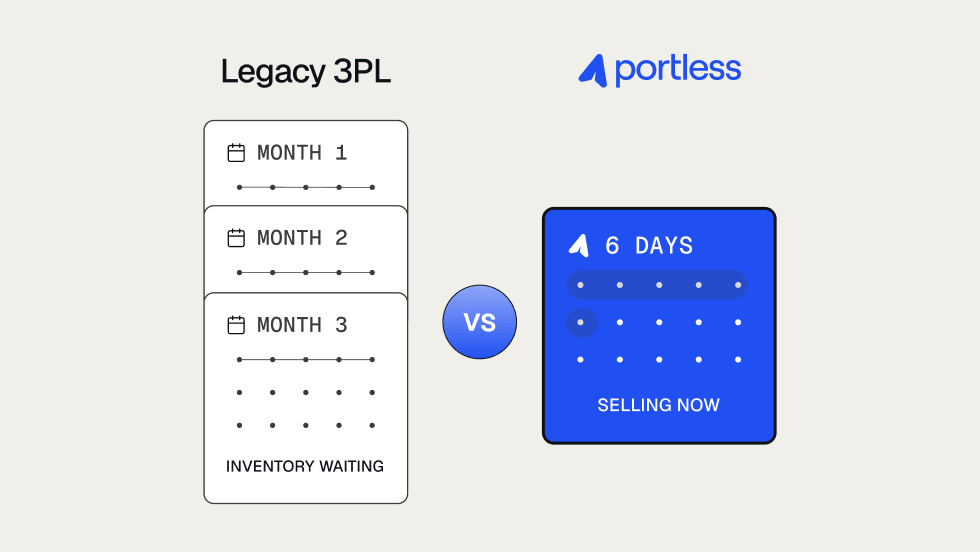
The bulk-ocean-freight-plus-domestic-3PL model was built for a slower internet. It assumes you can predict demand 90 days out, commit to a full container, wait 30 to 45 days for it to cross the ocean, then absorb another week or two of receiving and put-away before any unit becomes sellable.
Inside that window, you can't react. If a TikTok creator drives 10x traffic to a single SKU, the inventory to serve that spike is either already on a boat or already in a warehouse — usually in the wrong proportion. The system was never designed for the velocity at which modern Ecommerce demand actually moves.
Worse, the legacy model creates a binary choice every quarter: over-order and trap cash, or under-order and stock out. There's no third option, because the cycle time is too long to course-correct mid-season. Brands like Shein and Temu sidestep this entirely by shipping direct from manufacturing in small, continuous batches — proving the bulk model isn't the only way to operate.
How direct fulfillment reduces stockout risk
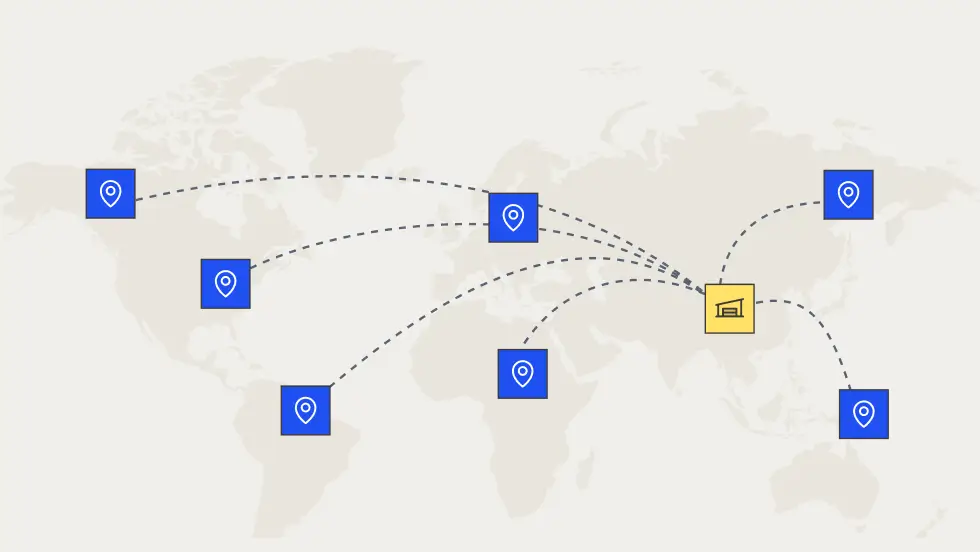
Direct fulfillment from the point of manufacture changes the math. Instead of committing capital to a container, you produce in smaller batches, hold inventory adjacent to your factory, and ship orders to customers in five to eight days as they come in.
That shift does three things for stockout prevention:
- Compresses replenishment from months to days. Inventory becomes sellable five to eight days after production, not 60 to 90. You can reorder in response to actual sales velocity instead of a forecast.
- Removes domestic warehouse receiving delays. No 3PL inbound queue, no put-away lag during peak season. The unit is live the moment it's produced and labeled.
- Frees cash to reorder winners. With less capital trapped in long-haul inventory, you have working capital to scale the SKUs that are actually selling.
&Collar saw this play out in real time. Two weeks before Father's Day, inventory on their top SKUs had dropped to 5% and they were days away from losing thousands of orders. Instead of paying for emergency air freight, they rerouted 40,000 units through Portless directly from the factory to customers. The result: a 20x improvement in in-stock ratio, 99.8% pick-and-pack accuracy, and a 35% year-over-year revenue lift.
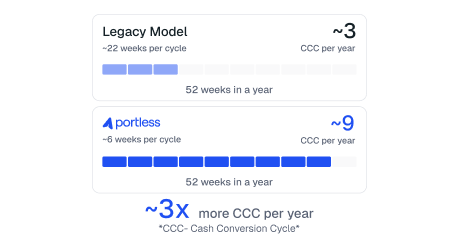
Craft Club hit the same wall from a different angle. Long lead times turned inventory into a growth ceiling — frequent stockouts on winners, wrong stock in the wrong region. After moving to a direct fulfillment model, they unlocked 3x growth tied to faster replenishment and a 3x drop in cash conversion cycle.
How to prevent stockouts: a practical checklist
You can't eliminate demand volatility, but you can build a system that absorbs it.
- Segment SKUs by velocity. Identify the 20% of SKUs that drive 80% of revenue and protect their in-stock rate aggressively.
- Shorten your replenishment cycle. Move from quarterly bulk orders to rolling smaller batches that match actual sell-through.
- Hold inventory closer to production. Staging stock near the factory keeps your options open until orders actually arrive.
- Unify your inventory data. One source of truth across Shopify, marketplaces, and fulfillment — no more weekly reconciliation calls.
- Set a real reorder point. Build it on lead time plus daily velocity plus a safety stock buffer, not gut feel.
- Track in-stock ratio as a KPI. Top performers maintain 95%+ availability on best sellers during peak periods.
Stockouts are a symptom of a broken supply chain — fix the system, not the symptom
Stockouts aren't a forecasting problem. They're a supply chain design problem. As long as your model requires you to commit to inventory 60 to 90 days before demand arrives, you'll keep choosing between running out and tying up cash. Portless eliminates that trade-off by shipping orders directly from manufacturers in Asia to customers in 85+ countries — turning production into sellable inventory in days, not months, so you can reorder against real demand instead of a forecast that's already stale.
Contact us to see how direct fulfillment can protect your in-stock rate and free up the cash you need to scale the SKUs that are actually working.
← Back to the Ecommerce supply chain glossary