CAC
CAC (Customer Acquisition Cost) is the total amount a brand spends to acquire one paying customer, calculated by dividing total sales and marketing spend by the number of new customers acquired over the same period. For DTC Ecommerce brands, CAC is the single most-watched profitability metric — and the one most directly squeezed by rising ad costs, longer payback periods, and supply chain inefficiency.
CAC sounds simple. Take what you spent on acquiring customers, divide by how many you got, and you have your number. But the way most DTC brands calculate it hides more than it reveals. A clean CAC figure tells you what a customer costs to acquire today. It says nothing about whether your business can afford that cost, how long it takes to earn it back, or what's actually driving it up quarter over quarter.
For brands doing $1–15M in revenue, CAC is rarely the root problem. It's the symptom. Rising CAC usually points to one of three structural issues: paid channels saturating, margin compression that forces you to spend more per customer to stay profitable, or a cash conversion cycle so long that you can't reinvest fast enough to compound your wins. This page breaks down how to calculate CAC properly, what to benchmark against, and where the real levers sit.
For DTC Ecommerce brands, CAC is the number that decides whether your next dollar of ad spend builds a business or drains the bank account. It sounds simple — divide acquisition spend by new customers — but the inputs are where most brands get it wrong, and the structure of your supply chain quietly determines how much CAC your margins can actually absorb.
Note: in the supply chain world, CAC also sometimes refers to the China-ASEAN Free Trade Area, but for DTC Ecommerce operators reading this, CAC almost always means Customer Acquisition Cost. That's what we'll focus on here.
How to calculate CAC
The basic formula:
CAC = Total acquisition spend ÷ Number of new customers acquired
A clean calculation includes:
- Paid media spend across Meta, Google, TikTok, and any other channels
- Creative production costs, including agency fees and content
- Affiliate, influencer, and partnership payouts
- Marketing team salaries allocated to acquisition
- Software and platform fees tied to acquisition activity
What CAC should not include: retention marketing, customer service, or fulfillment costs. Those belong in different parts of your P&L. Mixing them inflates CAC artificially and makes your unit economics harder to read.
For a deeper view of how all your costs roll up, the Federal Trade Commission's guide to retail pricing is a useful reference for keeping cost categorization clean.
Blended CAC vs. paid CAC
Two CAC numbers matter, and most operators only track one.
Blended CAC divides total marketing spend by total new customers, including organic and word-of-mouth. It tells you the average cost across all channels.
Paid CAC divides paid acquisition spend by new customers acquired through paid channels. It tells you what each paid dollar is actually buying.
Track both. Blended CAC tells you the health of the overall business. Paid CAC tells you whether your ad accounts are working.
Why CAC keeps rising — and what to do about it
iOS privacy changes, rising CPMs, and increased platform competition have pushed CAC up across nearly every DTC category over the past few years. Brands that built their model on cheap Facebook traffic in 2018 are now paying multiples of that for the same customer.
The instinct is to optimize ad creative or test new channels. Those help. But the structural fix sits further upstream: if your margins are compressed by bulk freight, domestic warehousing, and duties paid on unsold inventory, you have very little room to absorb a CAC increase without going underwater on every order.
CAC and LTV: the only ratio that matters
CAC in isolation doesn't tell you anything. You have to pair it with Lifetime Value (LTV) — the total revenue or gross profit a customer generates over their relationship with your brand.
The standard benchmark in DTC is an LTV-to-CAC ratio of at least 3:1. Below that, you're paying too much to acquire customers who don't stick around. Above 5:1, you may be underspending on growth.
A 3:1 ratio on a $30 CAC means you need $90 in lifetime gross profit per customer. If your gross margin is 40% on a $50 product, you need an average customer to buy 4.5 times. That math has to work, or the business doesn't.
CAC payback period: the cash flow question
LTV-to-CAC tells you if a customer is profitable eventually. CAC payback period tells you how long "eventually" takes.
CAC payback is the number of months it takes to recover the cost of acquiring a customer through the gross profit from their purchases. A 12-month payback means you're funding 12 months of growth before that customer pays you back.
For brands with constrained working capital, payback period is often more important than ratio. A 5:1 LTV-to-CAC with an 18-month payback can be harder to operate than a 3:1 ratio with a three-month payback, because the second model recycles capital faster.
How supply chain structure changes the CAC math
Most brands treat CAC as a marketing problem. It's also a supply chain problem.
Here's why: your CAC is only sustainable if your contribution margin per order can absorb it. Contribution margin is what's left after COGS, shipping, fulfillment, and transaction fees come out of revenue. The lower your contribution margin, the lower the CAC ceiling you can afford.
Legacy supply chains compress contribution margin in three ways:
- Duties paid upfront on bulk imports tie up cash before any of that inventory generates revenue, and force you to bake duty cost into landed cost whether or not units sell.
- Domestic warehousing and 3PL carrying costs add 20–30% per year on inventory value, eroding margin on slow-moving SKUs.
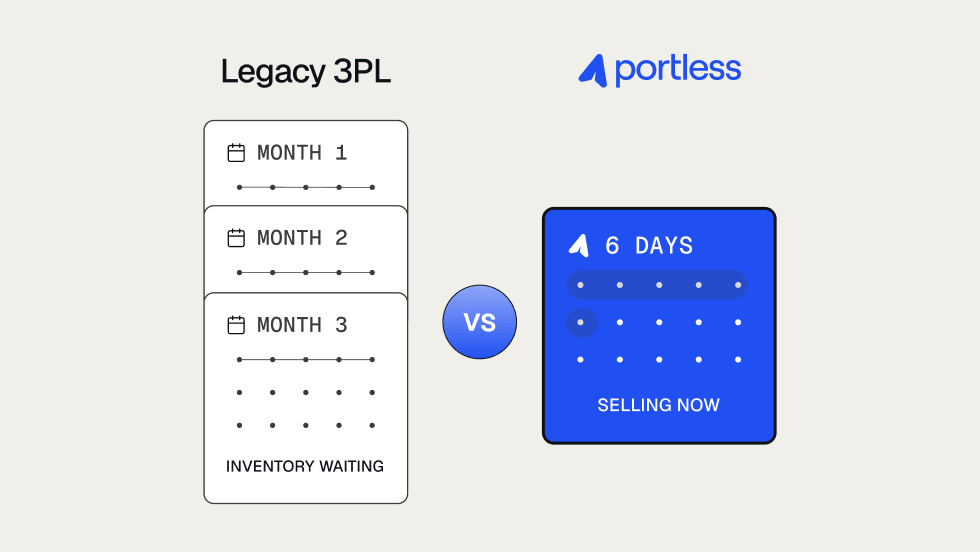
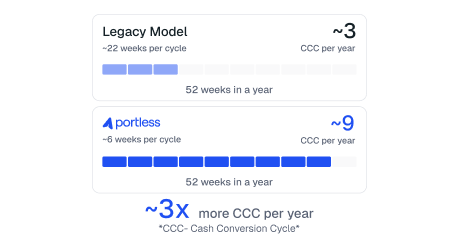
- Long cash conversion cycles mean every dollar of CAC is funded by cash that won't return for 60–90 days.
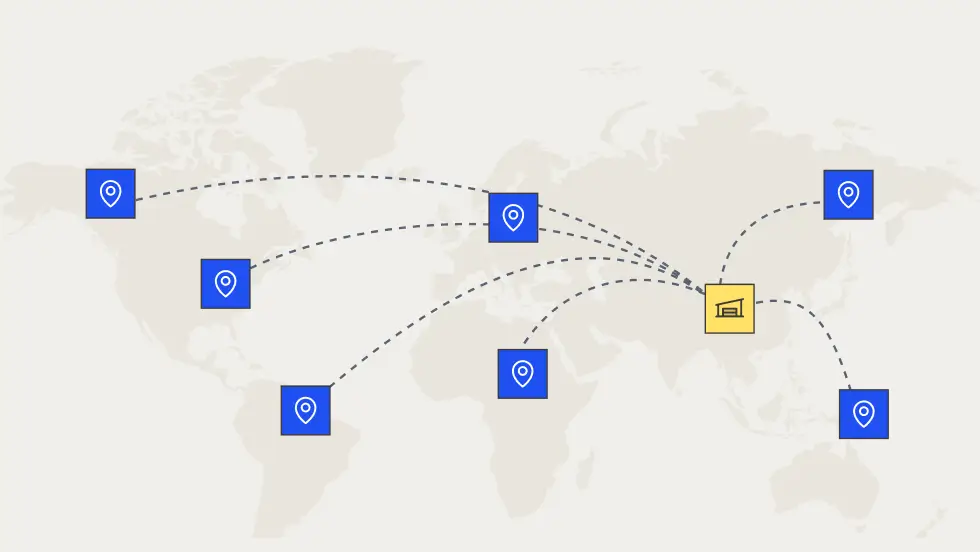
Brands running direct fulfillment from the point of manufacture flip this. Duty is paid per order against actual revenue. There's no domestic warehouse carry. Cash recycles in days, not months. That doesn't lower your CAC — but it raises the CAC ceiling your margins can absorb, which is functionally the same thing.
How to lower CAC (and what to stop doing)
The conventional advice — better creative, better targeting, more channels — is fine but limited. The bigger levers:
- Raise AOV. A higher average order value spreads CAC across more revenue, improving the ratio without lowering the actual cost.
- Improve repeat rate. LTV does the heavy lifting if you can get customers to buy a second and third time.
- Test post-purchase upsells. Every dollar added at checkout or in the first 30 days lowers effective CAC.
- Cut reverse logistics costs. Returns silently destroy contribution margin and inflate your real CAC per retained customer.
What to stop doing: optimizing CAC at the expense of growth. If you only chase the lowest-CAC channels, you'll scale into a ceiling. Some channels with higher CAC drive better LTV. Track both.
See how Portless protects your CAC math
Portless ships directly from manufacturers in China and Vietnam to customers in 85+ countries, removing the cash flow drag of bulk freight, domestic warehousing, and upfront duties on unsold inventory. The result: better margins, faster payback periods, and CAC economics that hold up when ad costs rise. Contact us to see what your unit economics look like on a direct fulfillment model.
← Back to the Ecommerce supply chain glossary