Working capital
Working capital is the cash and short-term assets a business has available to fund daily operations, calculated as current assets minus current liabilities. For Ecommerce brands, it's the money you can actually deploy into inventory, ads, payroll, and growth, after covering near-term obligations.
Working capital is the financial oxygen of an Ecommerce business. On a balance sheet, it's a clean formula: current assets minus current liabilities. In practice, it's the cash you can deploy this quarter to buy inventory, run ads, pay your team, and keep the lights on. The problem most DTC brands face isn't a lack of revenue. It's that revenue and cash don't arrive at the same time, and the legacy supply chain model makes that gap worse than it needs to be.
If you manufacture in China or Vietnam and sell into the US, EU, or UK, your working capital is structurally tied up in three places: pre-paid production, ocean freight in transit, and inventory sitting in a domestic 3PL. According to JPMorgan Chase Institute research, the median small business holds fewer than 15 days of cash buffer. One bad forecast or a delayed container can drain that buffer fast.
How working capital is calculated
The standard formula:
Working capital = current assets − current liabilities
For an Ecommerce brand, current assets typically include:
- Cash and cash equivalents
- Accounts receivable (less critical for DTC, more relevant for wholesale)
- Inventory on hand, in transit, and at fulfillment centers
- Prepaid expenses
Current liabilities typically include:
- Accounts payable to suppliers
- Short-term debt and credit lines
- Accrued expenses (payroll, taxes)
- Customer deposits or unfulfilled order obligations
Positive working capital means you can cover short-term obligations. Negative working capital means you're leaning on credit, supplier terms, or future revenue to operate — a fragile position when demand shifts or a shipment delays.
The supply chain trap: working capital locked in inventory
The single largest drag on working capital for DTC brands is the legacy import-and-warehouse model. Here's what it actually looks like:
- Day 1: Pay supplier 100% upfront or with a 30% deposit
- Day 30–45: Production completes
- Day 45–75: Ocean freight to destination port
- Day 75–80: Customs, drayage, and 3PL receiving
- Day 80+: First units available to sell
- Day 110+: Cash from those units finally hits your account
That's 90 to 110 days where your cash is frozen in product that hasn't generated a dollar. The Hackett Group's 2025 Working Capital Survey found roughly $1.7 trillion in excess working capital sitting in inventory and receivables across the 1,000 largest US public companies. The problem isn't unique to DTC — it's structural across the industry.
Every additional day in your cash conversion cycle is a day of working capital you don't have access to. Every container you buy "just in case" is cash you can't deploy to acquisition, product development, or new market expansion.
How direct fulfillment frees up working capital
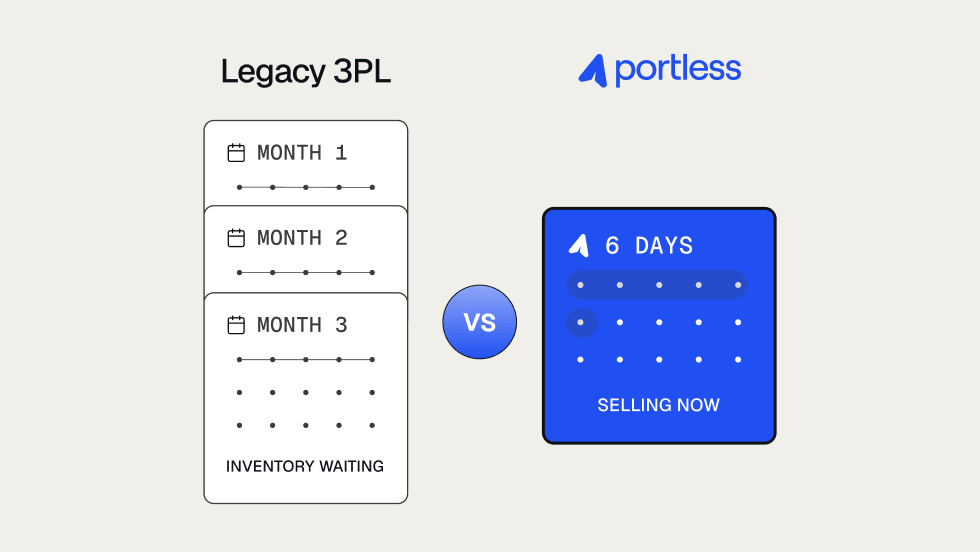
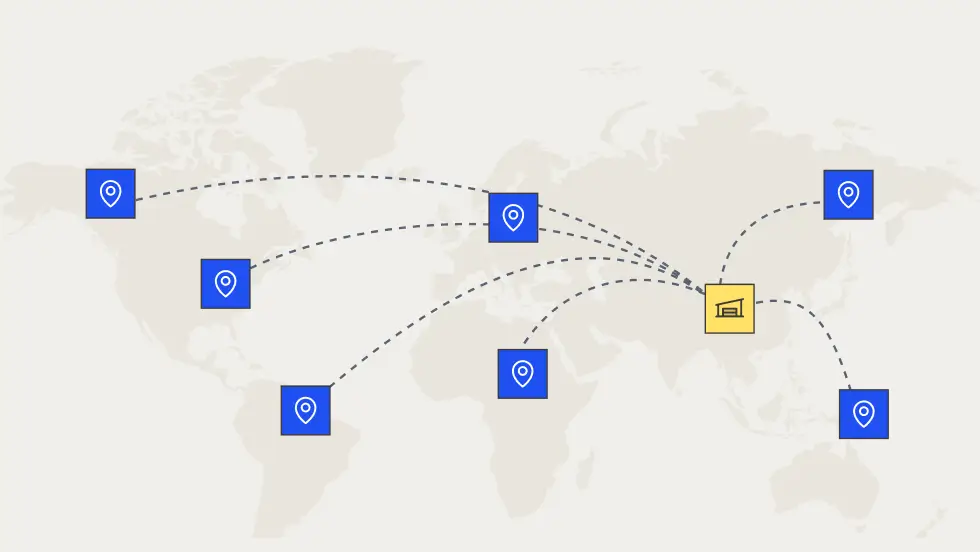
Direct fulfillment from the point of manufacture eliminates the longest stretches of the legacy timeline. Instead of waiting for ocean freight and domestic 3PL receiving, inventory ships directly from factory-adjacent hubs to customers within five to eight days of order placement.
Here's the same timeline under a direct fulfillment model:
- Day 1: Pay supplier
- Day 3: Inventory arrives at factory-adjacent fulfillment center
- Day 5: First orders ship
- Day 12–13: Orders delivered to customers
- Day 26: Cash received
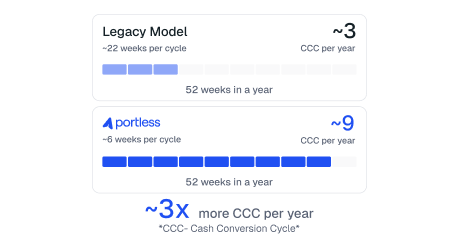
That's a 50+ day improvement in your cash conversion cycle. With the same $200,000 in working capital, a brand operating on a legacy 79-day cycle turns inventory roughly four times per year. The same brand on a 26-day cycle turns it 14 times — a 3.5x increase in annual throughput without raising a dollar of new capital.
You can model the impact on your own numbers with the direct fulfillment ROI calculator.
Other levers that improve working capital
Restructuring your supply chain is the biggest lever, but it's not the only one. Brands also free up working capital by:
- Staging commitments instead of single large bets. Run smaller initial production batches and scale once velocity data confirms demand. Covered in detail in our guide on turning 2025 inventory into 2026 cash flow wins.
- Using just-in-time inventory practices. Tie production cycles to real sales data rather than forecasts from six months ago. See why DTC brands fail in the cash flow trap for how JIT works in practice.
- Deferring duties and VAT. Bonded warehouses, postponed VAT accounting, and DDP structures can shift the timing of tax payments. Our guide on leveraging your VAT number for cash flow breaks this down.
- Negotiating supplier payment terms. Net-30 or net-60 terms extend your payables and reduce the gap between paying for goods and collecting on them.
- Dual-sourcing without doubling inventory. Maintain resilience without doubling your working capital bill. See dual-sourcing without the cash drag.
How to measure working capital health
Two metrics matter most:
Working capital ratio = current assets ÷ current liabilities. A ratio between 1.5 and 2.0 is generally considered healthy. Below 1.0 means you can't cover short-term obligations. Above 2.0 can indicate inefficient use of capital.
Cash conversion cycle = days inventory outstanding + days sales outstanding − days payable outstanding. The shorter, the better. For Ecommerce brands, days inventory outstanding is usually the biggest lever — and the one most directly affected by your fulfillment model.
← Back to the Ecommerce supply chain glossary