Last updated: May 2026
For most DTC brands, "add backup suppliers" sounds like the responsible move. Then the quotes come back, MOQs climb, and suddenly dual sourcing looks like a fast way to park more cash in inventory, straight into the DTC cash flow trap.
The good news: you can get the resilience benefits of dual sourcing without doubling your risk or your working capital bill. You just need to treat it as a cash flow design problem, not a procurement checklist.
This guide walks through a practical way to set up dual sourcing for 2026 that protects you from disruptions and keeps your cash conversion cycle lean.
What is dual sourcing in a DTC supply chain?
Dual sourcing means qualifying more than one factory for the same product, component, or material, then running one as your primary and keeping the other warm as a backup. For DTC brands manufacturing in China or Vietnam, it usually looks like 70–80% of volume going to a main factory and 20–30% going to a qualified second source that can absorb a quality issue, a capacity squeeze, or a tariff swing without taking your bestseller offline.
The reason this matters more for DTC than for legacy CPG is concentration. A typical $1–15M DTC brand has 10–30 SKUs, and three to five of them usually drive the majority of revenue. If one of those hero SKUs sits with a single factory in a single province, one policy shift or one production line failure can take down a quarter of your top line. The 2024 McKinsey Global Supply Chain Pulse Survey found that 73% of supply chain leaders now run a multi-sourcing strategy, up from 60% in 2022 — the shift is happening because single-supplier risk is now priced into how investors evaluate Ecommerce brands, not just how operators run them. (McKinsey Global Supply Chain Leader Survey 2024) This is the core of any strategic supplier diversification playbook.
The trap most brands fall into is treating dual sourcing as a procurement decision when it's actually a cash flow decision. Adding a backup factory is cheap. Funding two production cycles instead of one is not. The rest of this guide is about how to get the resilience without the working capital hit.
Dual sourcing's real problem: legacy models drag cash
When dual sourcing gets bolted onto a legacy import model (bulk ocean freight, domestic 3PL, duties paid upfront), three things usually happen:
- Inventory doubles faster than revenue. You book bigger MOQs with both suppliers "just to be safe."
- Your cash conversion cycle stretches. You pay factories months before goods are sold, now across two or more production runs instead of one.
- Complexity hides the real cost. You spread containers, SKUs, and forecasts across multiple suppliers and maybe multiple 3PLs. Finance sees the invoice, not the frozen cash behind it.
That is dangerous in the current environment. The same dynamics are why building a tariff-resilient supply chain requires rethinking the fulfillment model, not just the supplier list.
The Hackett Group's 2025 Working Capital Survey identified roughly $1.7 trillion in excess working capital tied up across the 1,000 largest US public companies, with inventory and receivables as the largest contributors. The same report found that top-quartile performers turn their cash conversion cycle 41% faster than the median, and that gap widens every year as more brands restructure around faster turns instead of bigger buffers. (The Hackett Group, 2025 Working Capital Survey)
If your dual sourcing plan requires you to prepay both factories for large production runs, you are adding resilience by taking on more of the same working capital problem your finance team is already trying to reduce.
Step 1: Decide where you actually need redundancy
Dual sourcing is not "add a second supplier for every SKU." That is how you end up with a bloated supplier list and scattered focus.
Start by asking three questions for your top products:
- Revenue reliance: If this SKU goes out of stock for 30 days, what happens to revenue and repeat purchase behavior?
- Production risk: How fragile is the current supply? Think single region, capacity constraints, complex materials, or heavy manual steps.
- Switching friction: How hard would it be to qualify another factory on this product?
The products that score high on revenue reliance and production risk are where dual sourcing delivers real value. For many brands, that is the 20% of SKUs that drive the majority of margin, not the entire catalog. Before you start qualifying second factories, audit where capital is stuck across your current SKU base. The answer usually narrows the list further.
Step 2: Separate "qualification" from "full production"
Most of the cash drag comes from treating a new backup supplier as if they need full-volume orders to be useful. They do not. What they need is qualification and a clear path to more volume when the time comes.
This is one of the hard-to-reverse fulfillment decisions brands get wrong early, committing real PO volume to a backup before the relationship is proven, then being stuck with the inventory when demand shifts.
A more cash-efficient approach looks like this.
Pilot runs to qualify backup factories
- Run small batches to test quality, communication, and timelines.
- Agree upfront that pilots are for qualification, not long-term pricing leverage.
- Document test results so you can compare factories objectively.
This mirrors how dual sourcing is described in primary guides like TechTarget's dual sourcing definition and NetSuite's article on dual sourcing, where one supplier typically carries more volume and the other stays active enough to be reliable when called on.
Before you run the first pilot, audit where capital is stuck in your current supply chain. Qualifying a second factory only pays off if you have the cash flexibility to actually use it. Otherwise the backup becomes a line item you fund but never activate.
Keep allocations skewed, not even
You do not need a 50/50 split to be considered dual-sourced. In practice, most DTC brands we work with settle on a 70/30 or 80/20 allocation between primary and backup, which keeps unit pricing sharp at the main factory while keeping the backup warm enough to be useful. That way:
- The main factory still gets enough volume for sharp pricing.
- The backup factory stays warm, with smaller but recurring orders.
- You can ramp the backup quickly if the primary has an issue or demand spikes.
The goal is to keep options alive, not to redistribute all volume out of habit.
Step 3: Design dual sourcing around cash flow, not containers
Where dual sourcing either works or fails is how your inventory actually moves.
If your model requires every supplier to ship full containers into a single domestic 3PL, you are locked into the same long timelines and cash commitments, just multiplied. You still pay factories months before you recover cash. You still commit to container-level MOQs for tests. This is why rethinking your 3PL location matters before you add a second supplier: the warehouse footprint dictates how much flexibility you actually get.
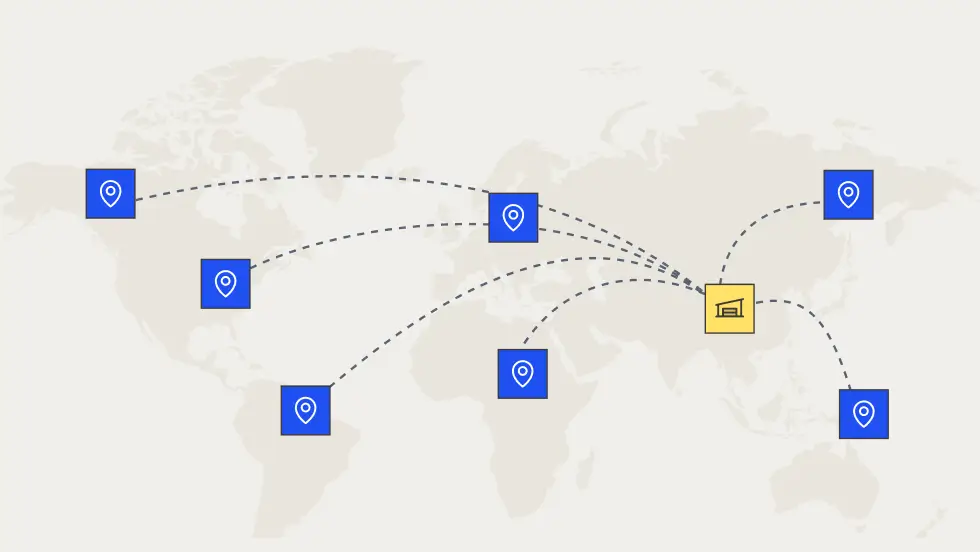
That is where direct fulfillment changes the math. When inventory flows through a factory-adjacent center instead of going straight into a distant warehouse, you can:
- Run smaller, more frequent batches from each supplier, which gives you inventory agility.
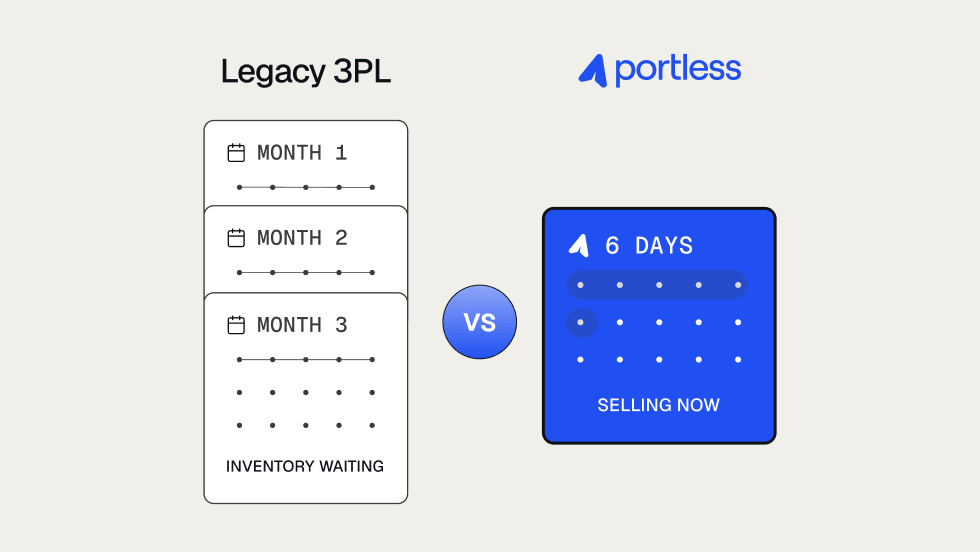
- Start selling within days instead of waiting for ocean freight and domestic receiving.
- Use live sales data to adjust allocation between your primary and backup factories.
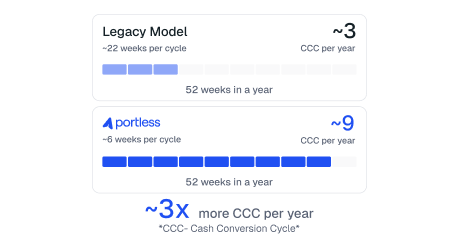
Portless' Direct Fulfillment ROI Calculator lets you model how different inventory strategies change your cash conversion cycle. When you shorten the time between production and cash collection, dual sourcing becomes easier to fund because each production run ties up less capital for less time.
Dual sourcing decisions: when to shift volume between primary and backup suppliers
Once you have qualified suppliers and a logistics setup that supports smaller batches, the last piece is knowing when to actually move volume to your backup. At minimum, track four metrics with concrete thresholds:
- Lead time variance. Healthy is within ±5 days of plan. If three consecutive POs miss by 10+ days, that's a structural problem, not noise.
- Defect rates. Most DTC operators target under 2% on apparel and beauty, under 1% on electronics. If you cross those for two batches running, pause new POs.
- On-time delivery. Below 90% is a yellow flag. Below 80% is a trigger to shift 10–20% of volume to the backup.
- Landed cost per unit. Model this with our landed cost calculator and re-run it quarterly. A 5%+ swing between primary and backup is meaningful; 1–2% is inside the noise band.
Decision rules can stay simple. If lead times miss for three consecutive POs, shift 10–20% more volume to the backup until stability returns. If defect rates cross your threshold, pause new orders at the primary and lean on the backup while you resolve the issue. If landed cost at the backup improves by 5% or more across two production runs, test a higher allocation instead of negotiating on anecdotes.
The Hackett Group's 2025 Working Capital Survey found that companies in the top quartile of working capital efficiency turn their cash conversion cycle 41% faster than the median, and the gap is almost entirely driven by how they manage supplier performance data. (The Hackett Group, 2025 Working Capital Survey)
Dual sourcing should feel like adjusting dials, not flipping a panic switch when something breaks.
How Portless helps you dual source without the cash drag
Portless was built for DTC brands manufacturing in China or Vietnam and selling to customers outside those markets. Instead of shipping containers from each factory into a domestic 3PL, you stage inventory at a factory-adjacent fulfillment center and ship orders direct to customers once they sell. That changes three things for dual sourcing specifically:
- Smaller, more frequent production runs at both factories. You're not forced into container-level MOQs to make the freight economics work, so qualifying a backup factory doesn't require committing to a quarter of demand upfront.
- Live allocation adjustment. Because inventory turns in five to eight days instead of 60–90, you're shifting volume based on this week's sell-through, not last quarter's forecast.
- A cash conversion cycle that funds the second supplier. Brands moving to direct fulfillment typically cut their CCC by 60–80%, which is what makes running two factories financially viable in the first place.
This is the part most "add a backup supplier" advice skips: resilience costs money you don't have if your supply chain is locked in legacy bulk-and-warehouse mode. The structural change has to come first. For a closer look at how the economics shift as you scale, see our breakdown of fulfillment model ROI by growth stage.
If you want to see how the math works on your numbers, the Direct Fulfillment ROI Calculator will model your current CCC against a direct fulfillment scenario.
Dual sourcing is a cash flow decision, not a procurement one
Adding a backup supplier is the easy part. Funding two production cycles, holding inventory at two factories, and absorbing two sets of MOQs without choking your cash conversion cycle is where most dual sourcing plans break. The brands that get this right design the fulfillment model first and the supplier list second, which is exactly the conversation worth having with our team if your current setup is forcing you to choose between resilience and working capital.
FAQ
What is dual sourcing in a DTC supply chain?
Dual sourcing means qualifying more than one factory for the same product, component, or material, then running one as your primary and keeping the other warm as a backup. For DTC brands manufacturing in China or Vietnam, it usually looks like 70–80% of volume going to a main factory and 20–30% going to a qualified second source that can absorb a quality issue, a capacity squeeze, or a tariff swing without taking your bestseller offline.
The reason this matters more for DTC than for legacy CPG is concentration. A typical $1–15M DTC brand has 10–30 SKUs, and three to five of them usually drive the majority of revenue. If one of those hero SKUs sits with a single factory in a single province, one policy shift or one production line failure can take down a quarter of your top line. The 2024 McKinsey Global Supply Chain Pulse Survey found that 73% of supply chain leaders now run a multi-sourcing strategy, up from 60% in 2022 — the shift is happening because single-supplier risk is now priced into how investors evaluate Ecommerce brands, not just how operators run them.
The trap most brands fall into is treating dual sourcing as a procurement decision when it's actually a cash flow decision. Adding a backup factory is cheap. Funding two production cycles instead of one is not. The rest of this guide is about how to get the resilience without the working capital hit.
Does dual-sourcing always increase costs?
Dual sourcing adds complexity in three places: supplier management overhead, split forecasting, and the cash drag from paying two factories on overlapping production runs. The risk is real when allocations are even (50/50) and both suppliers are pushed to container-level MOQs. It shrinks when allocations stay skewed (70/30 or 80/20) and inventory flows through a model that lets you run smaller, more frequent batches at each factory.
How many backup suppliers do I really need?
Dual sourcing uses two qualified suppliers for the same item, with one running as the primary and the other kept warm as a backup. Single sourcing optimizes for unit price and simplicity. Dual sourcing trades a small amount of unit cost for resilience against capacity issues, quality problems, and tariff or policy shocks tied to one country.
How is dual sourcing different when I use direct fulfillment?
Skip dual sourcing when the product is built around a unique spec, a patent, or proprietary tooling that a second supplier can't legally or technically replicate. Also skip it for low-revenue SKUs where a 30-day stockout wouldn't materially affect the business. Dual sourcing earns its keep on the 20% of SKUs that drive the majority of margin, not the entire catalog.
When is the right time for my brand to add a backup supplier?
Skip dual sourcing when the product is built around a unique spec, a patent, or proprietary tooling that a second supplier can't legally or technically replicate. Also skip it for low-revenue SKUs where a 30-day stockout wouldn't materially affect the business. Dual sourcing earns its keep on the 20% of SKUs that drive the majority of margin, not the entire catalog.







.jpg)