“We generated $70K in package protection revenue in a single quarter by adding a simple $4 protection option at checkout — plus an additional $12K from cashbacks. Customers get peace of mind, and we're making a profit on every protected order with zero effort."
“We generated $70K in package protection revenue in a single quarter by adding a simple $4 protection option at checkout — plus an additional $12K from cashbacks. Customers get peace of mind, and we're making a profit on every protected order with zero effort."
Your 3PL sends a clean monthly invoice. Storage fees. Pick and pack charges. Shipping costs. Everything looks predictable.
But that invoice rarely shows what you are actually paying.
Most DTC brands choose fulfillment based on visible costs: warehouse location, per-unit fees, and storage rates. These matter, but they miss the operational dynamics that shape your overall cost structure.
If you manufacture in Asia and sell in North America, the legacy model forces you to optimize for the wrong variables. These variables made sense when ocean freight and domestic warehousing were the only options.
Today, they introduce hidden costs that compound as you grow.
The hidden 3PL costs draining your margin
On paper, you see three clean numbers: storage per cubic foot, pick and pack fees, and domestic shipping rates. These give the illusion that you can model your unit economics by plugging numbers into a spreadsheet.
The real costs live elsewhere.
Zone premiums grow as your customer base spreads across the country. Capital stays locked for 60 to 90 days before a single order ships. Quality issues surface weeks after production, when your inventory is already thousands of miles from the factory. Every new product test requires container scale, which forces you into decisions that are expensive to reverse.
These costs never appear on your invoice because the structure of your supply chain creates them, not the warehouse itself. Brands that scale efficiently understand that the second group, not the line items, determines margin and cash flow.
What appears on invoices:
Storage per cubic foot
Pick and pack fees
Domestic shipping rates
What never appears:
Zone-based shipping premiums
Capital locked for 60 to 90 days
Delayed quality discovery
High MOQ requirements for every new test
Brands that scale efficiently optimize for the second group, not the first.
Hidden cost 1: the zone premium
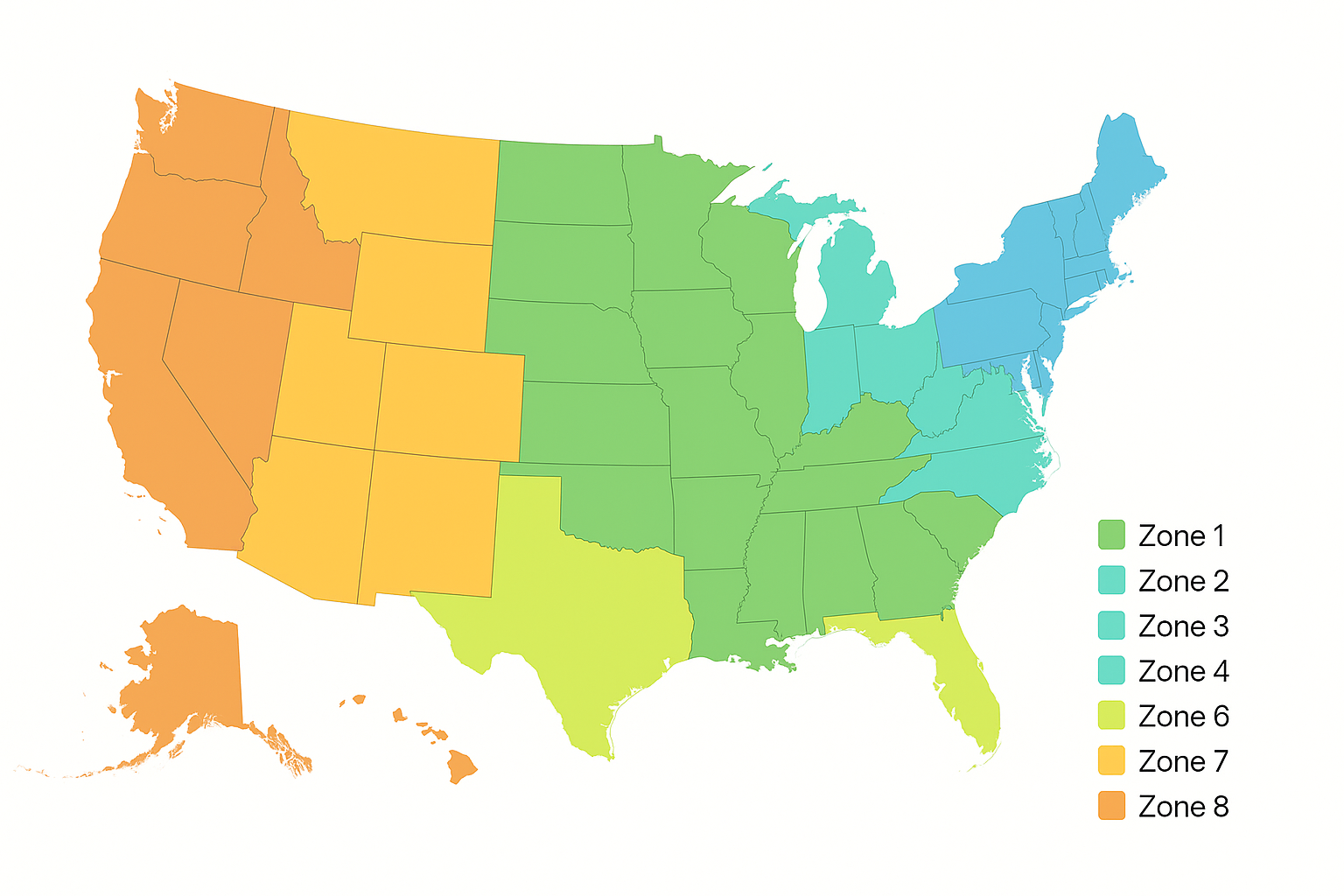
Carriers price by zones. The farther a package travels from your warehouse, the more you pay.
Example: USPS zones for a California based fulfillment center
When your 3PL sits on the west coast, every east coast customer becomes a far-zone delivery.
A two-pound USPS Priority Mail package costs roughly $9.35 in Zone 2 and $14.25 in Zone 8 under USPS's published commercial rates, a 52% premium for the same package. (USPS Priority Mail Retail Prices)
If your 3PL sits in Kentucky, every California customer pays that premium. Many brands try to solve this by splitting inventory across several warehouses, but this creates new problems.
Forecasting across locations
Multiple storage fees
Inventory trapped in the wrong region
Capital required to stock each facility
For a brand shipping 10,000 orders per month with 40% landing in far zones, the annual zone premium alone can exceed $20,000.
The same pattern holds for UPS and FedEx Ground. UPS Ground rates for a 2-pound package can run roughly 40% to 60% higher from Zone 2 to Zone 8 depending on dimensional weight and service level, based on UPS's published 2026 rate tables. (UPS Daily Rates)
Brands try to solve this two ways. Both have costs:
Split inventory across two or three regional warehouses. You eliminate some zone premium, but you take on duplicated storage fees, inventory imbalances between regions, and the working capital required to stock every facility.
Negotiate carrier rates harder. This caps your loss but doesn't eliminate it. Zones are baked into carrier pricing structures.
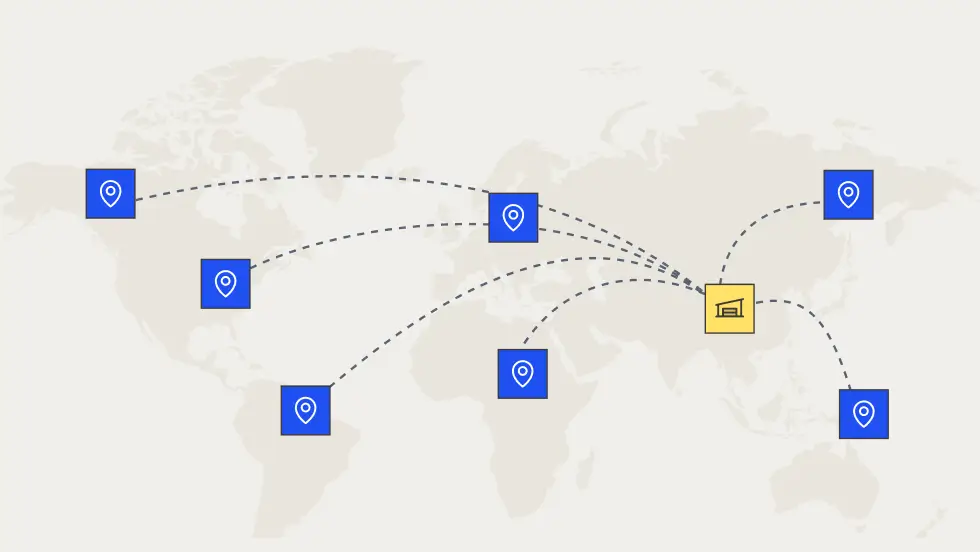
Direct fulfillment removes the anchor entirely. Packages enter the destination country's last-mile network after customs, so a customer in Miami and a customer in Vancouver can route through entirely different carriers from the same shipment day. Carrier choice becomes the optimization layer, not warehouse geography.
Hidden cost 2: capital locked for months
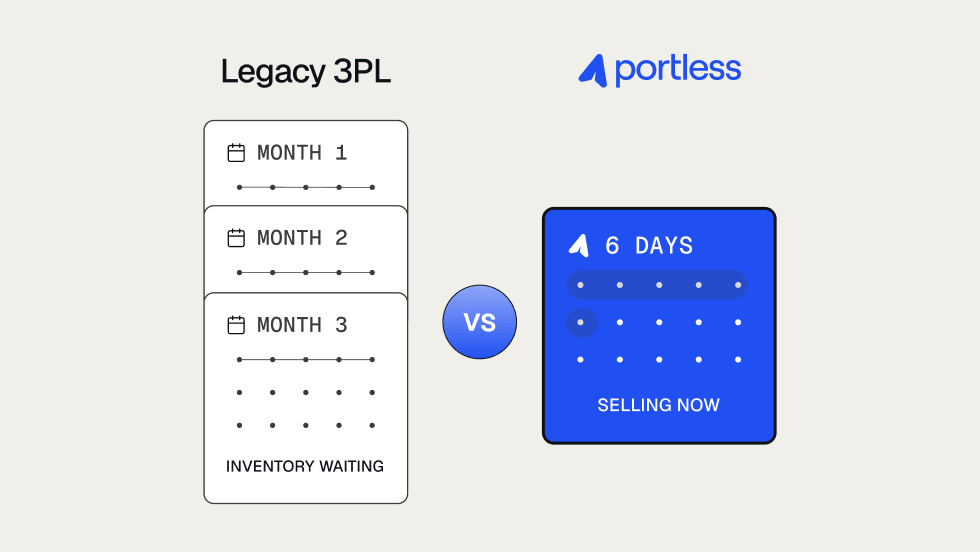
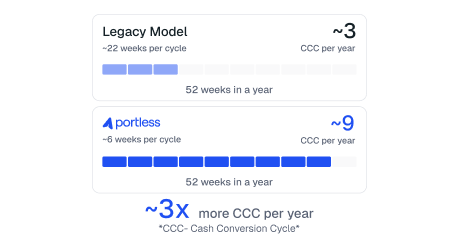
The cash conversion cycle tracks how long your capital sits idle between paying suppliers and receiving cash from customers. This is the cash flow trap that kills otherwise healthy DTC brands.
Legacy import timeline for a $50,000 order
Day 1: Pay supplier
Day 45-60: Ocean freight
Day 65: Arrives at domestic 3PL
Day 70: First sales
Day 79: Cash received
Total time: 79 days
Direct fulfillment timeline
Day 1: Pay supplier
Day 3: Arrives at factory-adjacent center
Day 5: First sales
Day 12: Orders delivered
Day 26: Cash received
Total time: 26 days
That is a 53-day improvement.
Turns are calculated using the 79-day legacy cycle and 26-day direct fulfillment cycle shown above. Your actual turn count depends on payment terms and ship-to revenue lag.
Faster cycles free cash, improve planning accuracy, and allow brands to respond to real demand signals rather than three-month-old forecasts.
Products arrive within hours. Inspection happens immediately. Defective units can be returned to the factory the same day and corrected the next day.
Legacy cost: at least $5,000 or a likely write-off
Factory-adjacent cost: local transport plus repair
This is the 1-10-100 rule, originally formalized in quality management research, applied to supply chains. (Labovitz & Chang, Total Quality Management framework) Fixing issues at the source costs one dollar. Fixing issues during fulfillment costs ten. Fixing issues after delivery costs one hundred.
Hidden cost 4: testing new products costs 10 times more
Ocean freight only works at volume. A 20-foot container holds 2,000-3,000 units. Anything smaller carries a disproportionately high unit cost.
That economics forces every new SKU to be tested at container scale, which means fewer tests, slower learning, and bigger losses when a product misses.
A brand wants to test a new $8 unit cost product that sells at $32
Legacy model:
MOQ aligned to container scale: 2,500 units
Total commitment: about $25,800
Failed test: $16,200 loss
Direct fulfillment:
Test run: 250 units
Total commitment: about $2,750
Failed test: $1,790 loss
You test with 10% of the capital and a fraction of the downside.
More tests lead to better data. Better data leads to better inventory decisions.
How to evaluate whether direct fulfillment fits your business
Run the math on four questions before assuming your current 3PL is the cheapest option:
What percentage of your orders land in far zones? If more than 30% travel to Zone 5 or higher, your shipping cost line is structurally inflated
How many days of working capital are locked between paying suppliers and collecting revenue? If the answer is more than 45, you're financing inventory that isn't generating cash
What's the dollar value of inventory you wrote off, liquidated, or shipped despite known defects in the last 12 months? Late quality discovery has a number, find it
What MOQ does your supplier require, and how often does that MOQ stop you from testing new SKUs? Container-scale testing means you launch fewer products per quarter than your team is capable of building
Why leaner inventory models win when capital is expensive
Lean inventory beats heavy inventory when borrowing is expensive and demand shifts quickly. As of late 2025, the US federal funds rate sat between 3.75% and 4.00% after the FOMC's October cut, which means working capital still costs more than it did pre-2022. (Federal Reserve)
Every dollar locked in a container or a domestic warehouse is a dollar you're financing at that rate, not deploying into acquisition.
Three structural shifts compound that pressure:
Tariff volatility makes front-loaded inventory a bet on rates staying flat between order and arrival
Cultural moments now drive demand spikes faster than a 45-day ocean container can respond
Carrying costs on slow movers compound at 20% to 30% of inventory value per year, before any markdown (CSCMP State of Logistics Report)
The brands compounding through this environment carry less stock, react faster to real demand signals, and recover cash before the next production cycle starts. Direct fulfillment makes that operating model possible: production becomes available for sale within five to eight days, duties apply per parcel against matched revenue, and inventory decisions are made against real orders rather than three-month-old forecasts.
The invoice isn't the cost
Direct fulfillment isn't simply cheaper or faster. It's a different operating model. If zone premiums, locked capital, late defect discovery, or container-scale MOQs are draining your margin, it's worth talking to our team about what direct fulfillment would change for your specific cost structure.
FAQ
What are the hidden costs of a 3PL that don't appear on the invoice?
The four costs that never appear as line items: zone-based shipping premiums on far-zone orders, capital locked for 60 to 90 days between paying suppliers and collecting revenue, defects discovered weeks after production when the inventory is already overseas, and high minimum order quantities that make product testing expensive.
How much does a 3PL's location actually cost your brand?
For a brand shipping 10,000 orders per month with 40% landing in far zones, zone premiums alone can exceed $20,000 per year. A single-warehouse 3PL forces every customer outside its region into a far-zone delivery, and splitting inventory across multiple warehouses introduces new forecasting, storage, and capital costs.
What is the cash conversion cycle for DTC brands using a domestic 3PL?
A typical bulk import cycle runs 79 days from paying the supplier to collecting cash from customers. Direct fulfillment compresses that cycle to around 26 days. With $200,000 in working capital, that shift moves a brand from four inventory turns per year to fourteen.
What's the difference between a 3PL and direct fulfillment?
A 3PL warehouses your inventory domestically after ocean freight and ships orders from that warehouse. Direct fulfillment ships individual confirmed orders from a fulfillment center near your manufacturer, bypassing domestic warehousing entirely. Duties apply per parcel rather than per container.
Frequently asked questions
Heading
Lorem ipsum dolor sit amet, consectetur adipiscing elit. Suspendisse varius enim in eros elementum tristique. Duis cursus, mi quis viverra ornare, eros dolor interdum nulla, ut commodo diam libero vitae erat. Aenean faucibus nibh et justo cursus id rutrum lorem imperdiet. Nunc ut sem vitae risus tristique posuere.
Get operator-level supply chain insights
Thank you! Your submission has been received!
Oops! Something went wrong while submitting the form.







.jpg)
%20(1).jpg)