Last updated: May 2026
Peak season revenue may look great on a bar chart. But if you are staring at a strong top line and a shrinking cash balance, your dashboard is not telling the full story. You don't just have a "marketing problem" or a "warehouse problem."
You have an inventory problem.
Inventory distortion, the combined cost of overstocks, stockouts, and shrinkage, costs global retailers an estimated $1.77 trillion per year, according to IHL Group's research.
For a DTC brand, that number shows up as:
- Cash trapped in slow moving SKUs
- Storage and handling fees for products that are not earning their keep
- Margin evaporating in markdowns and promo "cleanups"
- Missed upside when you stock out of winners while pallets of other SKUs sit untouched
And underneath all of that is the same pattern: you are being forced to make container sized decisions with partial information, in a supply chain that moves slower than your customers. That lag is where decision latency drains margins — every week capital sits in transit is a week you cannot reallocate against what is actually selling.
The goal for your brand is simple. Turn the leftover 2025 inventory into a clean plan where you: see where your capital is actually stuck, redesign 2026 decisions around cash, and understand where a direct fulfillment model can change the equation.
Step 1: Audit the real cost of holding unsold stock
Before you start drastically reducing leftover inventory, you need a detailed overview of your working capital. Stop staring at "total units." Start looking at cash velocity.
Segment inventory by strategic role
Do not treat every SKU the same. Break your catalog into three buckets:
- Core heroes: high margin, predictable, evergreen or long life cycle
- Seasonal and trend bets: short window, higher risk, often tied to specific campaigns or cultural moments
- Tests: new SKUs with little or no historical data
Within each bucket, tag SKUs as: fast movers, slow movers, and true deadstock. This takes you from "we have too much inventory" to "we have too much of this type of inventory, in this role, moving at this speed." That is actionable.
Run a carrying cost audit
This is not about a complex financial model. It is a carrying cost audit, focused on storage, handling, and time.
A simple way to frame it:
(Landed cost per unit + monthly storage per unit) x months to sell through = the true drain on cash
If 3,000 units of a $9 SKU sit for six months at $0.30 per unit per month in storage, you are not just sitting on $27,000 in cost of goods. You also pay about $5,400 in storage and handling for the privilege. That is roughly $32,400 in capital and cost tied up in one decision.
Multiply that across categories and you understand why the bank balance feels tight even when revenue looks strong. Shopify's breakdown of inventory costs notes that holding costs alone can run 20% to 30% of total inventory value annually once storage, handling, insurance, and obsolescence are included, not just the unit cost of the goods themselves. That is why this audit matters. Once you see the real cost of doing nothing, "we will just let it sell over time" stops being a neutral choice.
The formula above is the floor, not the ceiling. A full carrying cost audit accounts for four buckets: capital cost (what you could earn deploying that cash elsewhere), storage and handling, inventory services (insurance, taxes, IT), and inventory risk (obsolescence, shrinkage, markdowns).
Industry benchmarks put total annual carrying costs at 20% to 30% of inventory value. For a DTC brand sitting on $500,000 in stock, that is $100,000 to $150,000 a year leaving the business before a single markdown.
Run the audit by category, not by total inventory. The $9 SKU sitting six months at $0.30 per month in storage is the visible drain. The less visible drain is the gross margin you give up when that same capital can't fund paid acquisition, a new SKU launch, or supplier deposits for a category that is actually moving. Once you price opportunity cost into the audit, the "let it sell over time" option stops looking neutral and starts looking expensive.
Step 2: Design inventory cash flow for capital efficiency, not just unit cost
The goal for a brand is not to guess better.
It is to reduce the amount of cash you commit before demand is proven, and to shorten the time between spending and earning that cash back.
Inventory cash flow lever 1: staged commitments instead of single big bets
Stop placing 10,000 unit bets that live or die on a forecast from six months ago. Move to a test and scale physical model. Use smaller initial production runs, air freight samples, or direct fulfillment to test the SKU in the real world. The goal is to get a clean read on velocity, not to maximize early margin. Once a SKU clears your target velocity and margin thresholds, commit deeper. Until then, treat it as a test, not a full season anchor.
One practical way brands apply this is by keeping only a small fraction of inventory local while staging the majority upstream. This builds reversibility into your supply chain — every commitment up to the final scale stage can be adjusted, paused, or redirected without writing off containers of dead stock.
Staged commitments only work if you define the stages. Use three:
- Test stage: 200 to 500 units. The goal is a clean velocity read, not margin. Ship direct from production, skip domestic warehousing, and let the SKU prove itself against your target sell-through rate over a defined window (typically 30 to 45 days).
- Validation stage: 1,000 to 3,000 units, only after the test SKU clears your velocity and contribution margin thresholds. Continue fulfilling from a factory-adjacent hub so capital cycles fast and you can read demand across a second wave.
- Scale stage: bulk commitments make sense only after two consecutive validation cycles confirm the SKU is a core hero, not a trend bet. At this point, a hybrid model (bulk into domestic for the core SKUs, direct fulfillment for the long tail) protects cash flow without sacrificing speed on proven winners.
The point is to make the decision to commit capital reversible at every stage except the last. Most brands invert this: they commit at scale on day one, then spend the next two quarters trying to undo it through markdowns.
AI-driven forecasting can reduce error and support these decisions when it is used well. McKinsey's analysis of AI in supply chain found that AI-driven forecasting can reduce forecasting errors by 20% to 50% and cut lost sales due to stockouts by up to 65%. The point is not that AI will magically fix inventory. The point is that a staged physical model gives you more chances to act on the signal it surfaces.
Inventory cash flow lever 2: structure your model for agility, not just lower freight
The "ocean gap" is the time your products spend on a boat or in a containerized pipeline. For many brands, that is 30 to 45 days where you have fully paid for product, you are paying for transport, and you have zero ability to react to a TikTok spike or a demand drop. That window is exactly where decision latency drains margins — capital is locked, the market is moving, and your options are not.
During that gap, the market moves, but your options do not. A model designed for cash changes the sequence:
- You keep more inventory near production in a flexible position
- You use direct fulfillment to ship orders from factory adjacent hubs once they sell, not months before they sell
- You bring in bulk domestically in a more targeted way, once you are confident in the SKU's role
You still care about landed cost and freight efficiency. You just stop optimizing for a lower cost per pallet at the expense of locking up working capital for 90 days.
Step 3: Inventory cash flow under a direct fulfillment model
You cannot fix this year's inventory problem with a legacy logistics model: bulk container into a domestic 3PL, then hope the forecast was right. That structure bakes in high risk and low cash visibility from the day you place the PO.
Portless exists to change that structure. For a deeper look at how direct fulfillment from China actually works, the mechanics are worth understanding before you model the cash impact.
Instead of prepaying production in large batches, putting those batches in containers, and paying duties, freight, and storage before you know what really sells…
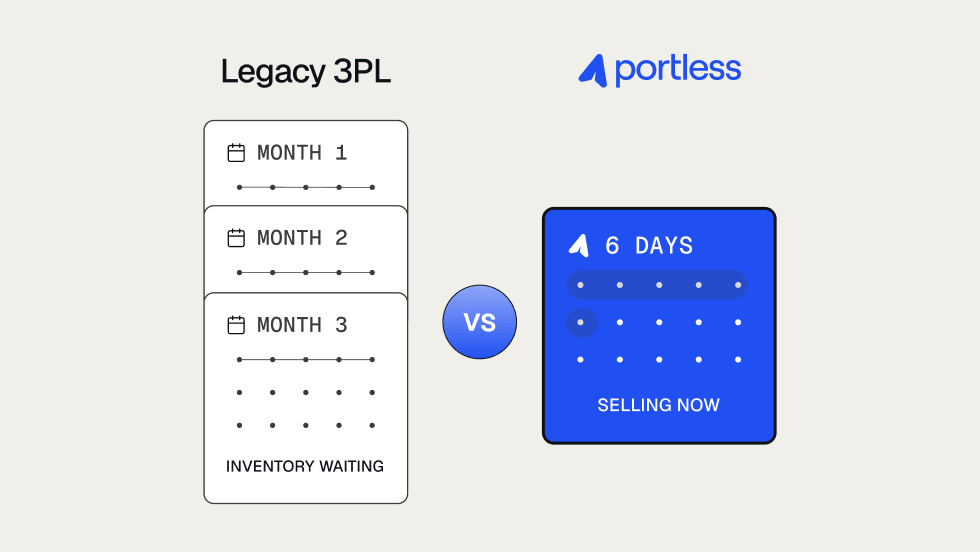
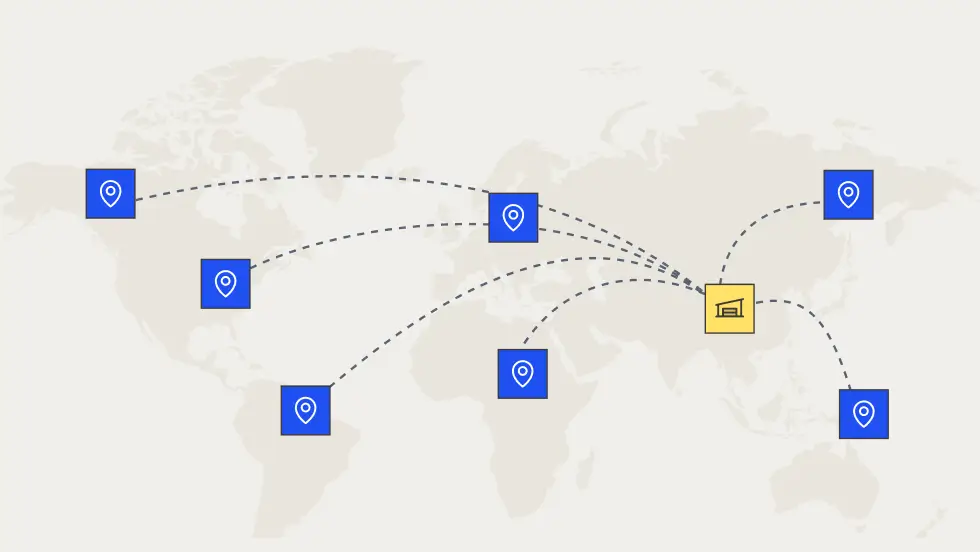
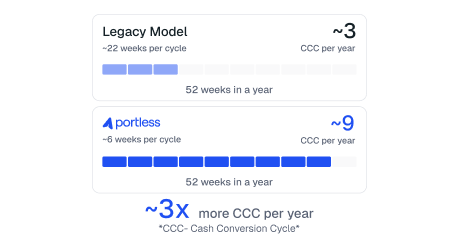
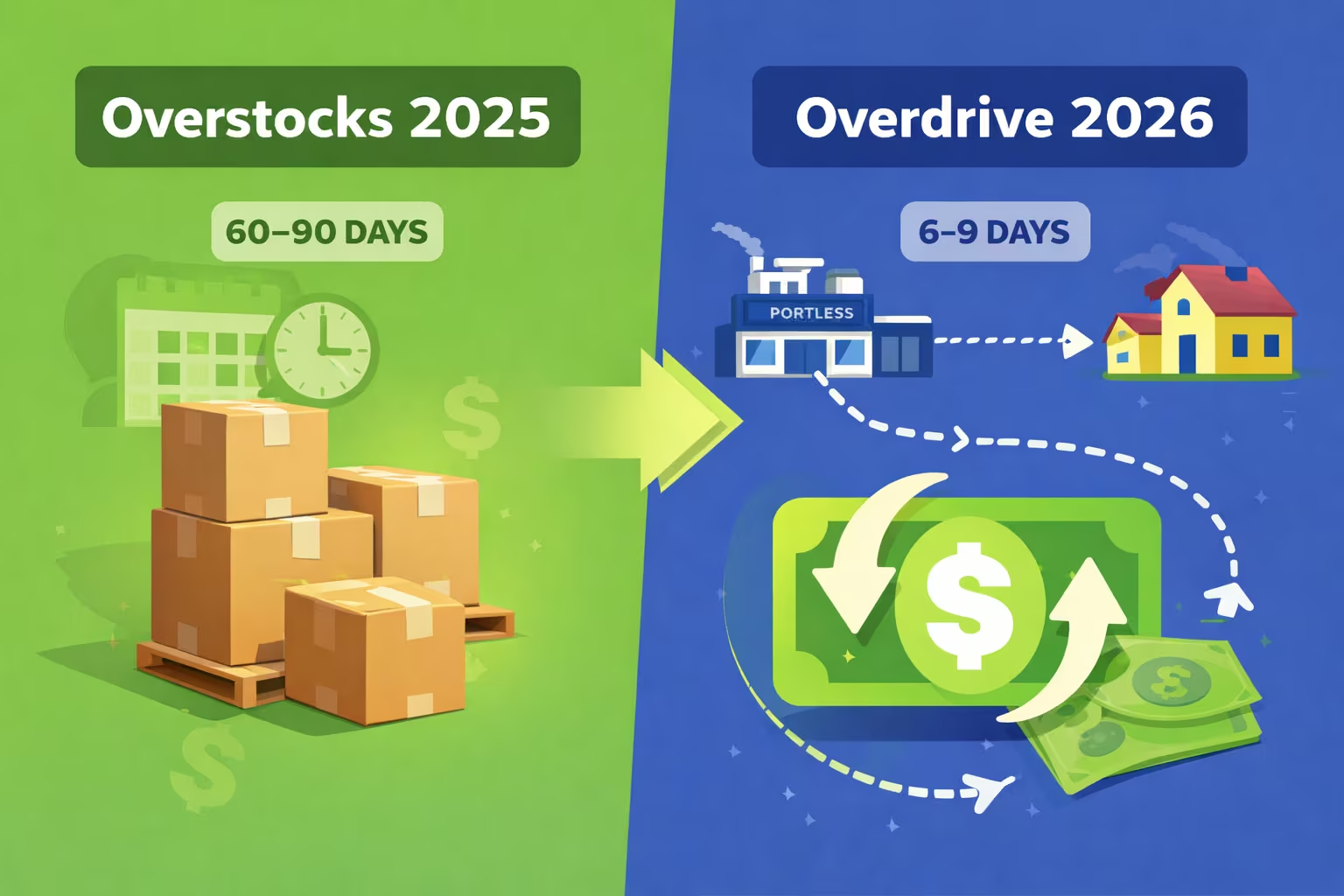
Portless lets you stage inventory near your factories in our hubs, ship orders, not pallets, directly from those hubs to your customers, and turn production spend into cash in as little as five to eight days in many key markets, instead of 60 to 90 days under the legacy bulk freight model.
What that looks like in practice:
- You commit later: you do not have to lock in container sized orders as far in advance. You can run smaller initial batches and scale when the data supports it.
- You see risk earlier: slow movers show up in the data while they are still near production, not months later in a warehouse report.
- You put cash back to work faster: high velocity SKUs generate cash within days, which can fund the next batch or the next creative push.
Foreign Resource, a premium streetwear brand manufacturing in China, ran the standard model for years: ocean freight, domestic 3PL, six inventory turns per year, and air freight whenever a launch slipped. Founder Matias Belete describes the math as "your unit economics get cooked."
After moving to direct fulfillment with Portless, the manufacturing-to-shipping window dropped from 21+ days to two days. The cash conversion cycle went near-negative: revenue from one production run lands before the next production run needs to be paid for. That is the structural difference between a supply chain designed for cash and one designed for unit cost.
"Now instead of having to pay all these tariffs, taxes, duties and shipping fees upfront I can pay them as sales are made. So I recoup all that cash." — Matias Belete, Founder, Foreign Resource
Read the full case study or model your own cash cycle improvement with the direct fulfillment ROI calculator.
Stop letting capital sit on shelves
Inventory cash flow problems are structural, not seasonal. If your capital is stuck in slow SKUs, container-scale MOQs, and 60-to-90-day cash cycles, the audit will tell you the cost, but only a different operating model changes the math. If you want to see what direct fulfillment would change for your specific cost structure, talk to our team.
FAQ
How does inventory affect cash flow?
Inventory ties up working capital from the moment you pay your supplier until the moment a customer pays for the unit. The longer stock sits, the more carrying costs (storage, handling, insurance, capital cost) accumulate against revenue that hasn't arrived yet. High inventory levels reduce operating cash flow even when sales look healthy.
What is the inventory turnover ratio and why does it matter for cash flow?
Inventory turnover ratio measures how many times you sell through and replace stock in a period. A higher ratio means cash is moving, not sitting on shelves. For DTC brands, low turnover is the clearest signal that capital is trapped in the wrong SKUs.
How do you turn slow-moving inventory into cash?
Segment SKUs by velocity and role, isolate true deadstock, and choose between markdown, bundling, liquidation, or returning to a direct fulfillment model that lets future production scale based on actual demand rather than container minimums.
How is inventory reflected on a cash flow statement?
Inventory changes appear in the operating activities section. An increase in inventory reduces operating cash flow because cash left the business to buy stock. A decrease in inventory increases operating cash flow because stock converted into revenue.
What inventory management tips improve cash flow for DTC brands?
Shorten the cash conversion cycle by committing to smaller production runs, holding stock closer to manufacturing rather than in domestic warehouses, and shipping individual orders against confirmed demand instead of pre-positioning bulk inventory months in advance.







.jpg)