Lead time
Lead time is the total elapsed time from placing a purchase order to receiving finished goods ready to sell. In Ecommerce, it spans manufacturing, quality inspection, inland transport, international freight, customs clearance, and warehouse receiving.
Lead time is one of the most underestimated variables in Ecommerce operations. Most founders think of it as a single number their factory quotes them — "30 days" — and plan around that. The reality is that production lead time is only one slice. The full lead time from PO to sellable inventory in your fulfillment center routinely runs 60 to 120 days when you account for ocean freight, drayage, customs, and 3PL receiving. Every additional day extends how far in advance you have to forecast demand, how much cash sits locked in transit, and how exposed you are when a trend shifts or a tariff changes.
What lead time actually includes
The number your supplier quotes is rarely the full picture. A complete lead time calculation covers six distinct stages:
- Production: the days from PO confirmation to finished goods leaving the factory floor
- Quality control: inspection time at the factory or via a third-party QC firm
- Inland transport: trucking from the factory to the origin port or airport
- International freight: ocean (typically 14 to 45 days) or air (3 to 8 days)
- Customs clearance: 1 to 5 days at the port of entry, longer if documentation issues arise
- Receiving and putaway: the time your 3PL needs to log inventory before it's available to sell
Each stage has its own variability. According to the U.S. Bureau of Transportation Statistics, container dwell times at major U.S. ports have fluctuated between 3 and 10 days over recent years, which alone can shift a forecast by a full week.
Why lead time decides your cash flow
Long lead time is a cash flow problem before it's a logistics problem. You pay your supplier at production, then pay for freight, then pay for warehousing — all before a single unit sells. For a brand making $5M a year, this can mean $80,000 to $120,000 committed months before demand is known.
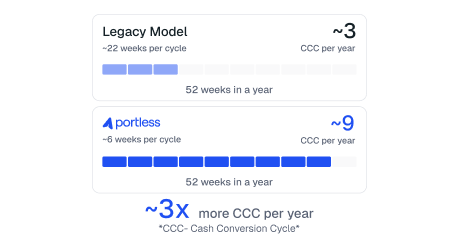
The math is simple: the longer your lead time, the more inventory you carry, the more capital you lock, and the fewer turns you get per year. A brand operating on a 90-day lead time with $200,000 in working capital gets roughly four inventory turns annually. Compress that lead time and turns multiply — which means the same capital generates significantly more throughput.
How lead time forces early forecasting
If your supply chain takes 90 days to move goods from factory to customer, your forecasts have to be 90 days early. That's the structural problem. Brands aren't bad at forecasting — they're forced to forecast at a horizon where accuracy is impossible.
Forecasting accuracy improves dramatically as the prediction window shortens:
- Four months out: high error rate, mostly assumptions
- Two months out: clearer patterns emerge
- Four weeks out: meaningful demand signals
- Real time: minimal guesswork
Brands stuck with long lead times overstock to protect against stockouts, which traps capital and inflates carrying costs. Or they understock and lose sales. Both outcomes trace back to the same root cause.
How direct fulfillment compresses lead time
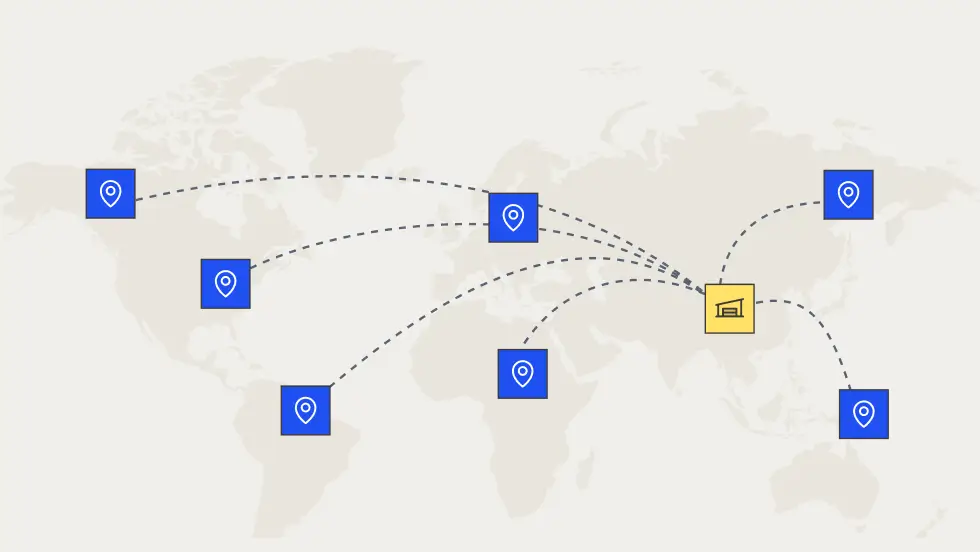
The legacy model — bulk production, ocean freight, domestic 3PL — was built for an era when air freight was prohibitively expensive and customs was manual. Neither is true anymore. Direct fulfillment from the point of manufacture cuts lead time in two ways:
- It removes the 30 to 45 days of ocean transit by flying goods to the end customer
- It removes the warehouse-receiving step entirely, since inventory ships from a fulfillment center adjacent to the factory
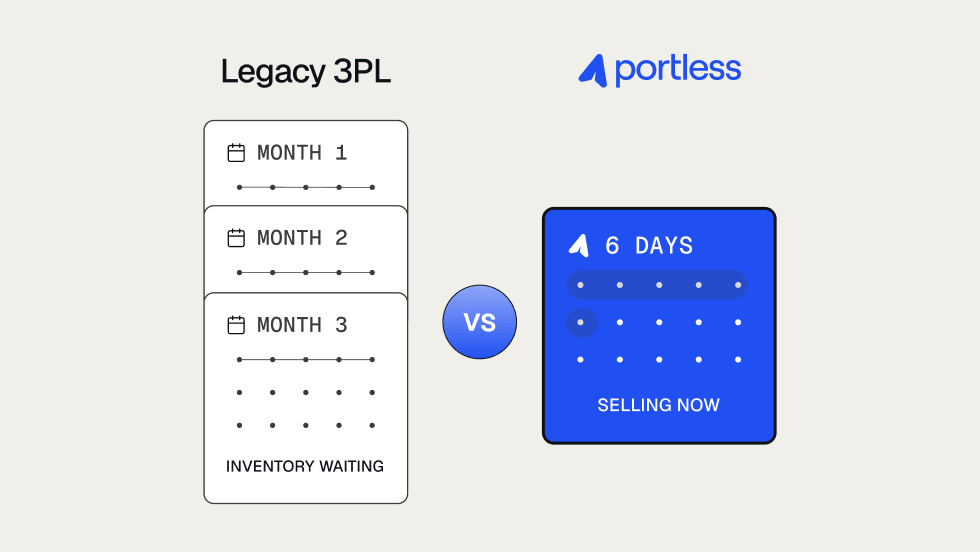
The result: inventory becomes available to sell within days of production rather than months. Portless customers see total production-to-customer timelines compress from 90 days to under 20, with delivery windows of five to eight days to most major markets. Shein and Temu built their entire business models around this principle — the difference now is that DTC brands can access the same infrastructure without operating at their scale.
How to calculate your true lead time
Most brands undercount their lead time by 20 to 40 days because they only track what's on the supplier invoice. To get an accurate number:
- Log the date you confirmed the PO, not the date production "started"
- Track every handoff: factory exit, port arrival, vessel departure, port of arrival, customs release, 3PL receipt, SKU live in your system
- Measure variability across at least five recent shipments, not your best-case scenario
- Add buffer for known volatility: peak season port congestion, Lunar New Year factory shutdowns, customs inspections
The gap between what you assume and what's actually happening is usually where margin is leaking.
Lead time and inventory risk
Long lead time amplifies every other operational problem. A QC issue caught at the 3PL after a 45-day ocean voyage costs 10 to 100 times more to fix than the same issue caught at the factory. A trend shift that happens mid-transit means inventory arrives already obsolete. A tariff change announced while goods are on the water can wipe out the margin on an entire shipment.
This is the 1-10-100 rule applied to supply chains: fixing issues at the source costs one dollar, fixing them at fulfillment costs ten, fixing them after delivery costs a hundred. Shorter lead time means faster discovery and cheaper correction.
Reducing lead time is the highest-leverage operational change you can make
Most brands try to fix margin and cash flow by negotiating freight rates, optimizing pick-and-pack costs, or renegotiating 3PL contracts. Those changes move single-digit percentages. Compressing lead time from 90 days to 20 changes the entire economic model of the business — how much capital you need, how accurately you can forecast, how much risk you carry, and how fast you can respond to demand. Portless eliminates the warehousing and ocean freight legs of legacy fulfillment, which is where most lead time gets spent. If shortening your lead time is on your 2026 operating plan, contact us to see how direct fulfillment fits your product line.
← Back to the Ecommerce supply chain glossary