Fulfillment center
Most Ecommerce founders interact with fulfillment centers without ever stepping inside one. You send inventory in, orders flow out, and a monthly invoice tells you what it cost. But the structure of that operation — where it sits, how it's priced, and how much capital it ties up — shapes your margins, your cash flow, and your ability to grow into new markets.
A fulfillment center is the physical layer of your supply chain where individual orders get assembled and shipped. The term became common in the mid-1990s as Ecommerce volume forced warehouses to specialize. A bulk storage warehouse holds pallets for retailers. A fulfillment center processes thousands of single-unit orders per day, often with dedicated zones for receiving, shelving, picking, packing, and carrier handoff.
How a fulfillment center works
A standard fulfillment center runs on a repeatable workflow:
- Receiving: inventory arrives by truck or container, gets inspected, scanned, and assigned to storage locations
- Storage: SKUs are organized by velocity, with fast movers placed closer to packing stations
- Picking: workers or robotic systems pull items from shelves based on incoming orders
- Packing: items are boxed or bagged, often with brand-specific packaging requirements
- Shipping: packages are sorted by carrier and zone, then handed off for last-mile delivery
Most domestic 3PLs operate fulfillment centers under this model. Some are general-purpose; others specialize in cold storage, hazmat, oversized goods, or specific verticals like beauty or apparel. For more on how the operational model works inside a factory-adjacent facility, see Inside Portless Operations: How Direct Fulfillment from China Actually Works.
Fulfillment center vs warehouse vs distribution center
These terms get used interchangeably, but they mean different things:
- Warehouse: long-term storage of bulk inventory, minimal handling, low throughput
- Distribution center: stages inventory for outbound shipment to retailers or other facilities, typically pallet-level
- Fulfillment center: processes individual consumer orders at high velocity, with pick-pack-ship as the core function
The cost structures differ too. Warehouses charge primarily for storage. Fulfillment centers charge for storage plus per-order fees, receiving fees, and surcharges for things like kitting, returns, and peak season volume.
What a fulfillment center actually costs
The pricing model at a typical domestic 3PL fulfillment center includes:
- Storage: $15–$40 per pallet per month, or per cubic foot
- Receiving: $25–$50 per pallet inbound, with per-unit fees for case-picking
- Pick and pack: $2–$5 per order, with additional fees per item beyond the first
- Shipping: carrier rates marked up, plus zone-based pricing
- Returns: $3–$8 per return processed
- Peak surcharges: 15–30% increases during Q4 and other high-volume windows
A growth-stage brand doing $3M in annual revenue often spends 12–18% of revenue on fulfillment alone. According to McKinsey's analysis of working capital, inventory is one of the largest sources of trapped cash on most balance sheets — and a domestic fulfillment center is where most of that inventory sits.
For a deeper breakdown of how these costs compare across models, see Which Fulfillment Model Maximizes Your Profit Margins?.
Why the legacy fulfillment center model is broken for DTC brands
The standard playbook — manufacture in Asia, ocean freight to a domestic fulfillment center, store inventory for 60–120 days, ship to customers — was designed for a slower, less capital-constrained era. For a DTC brand doing 1,000 to 15,000 orders per month, it creates three structural problems:
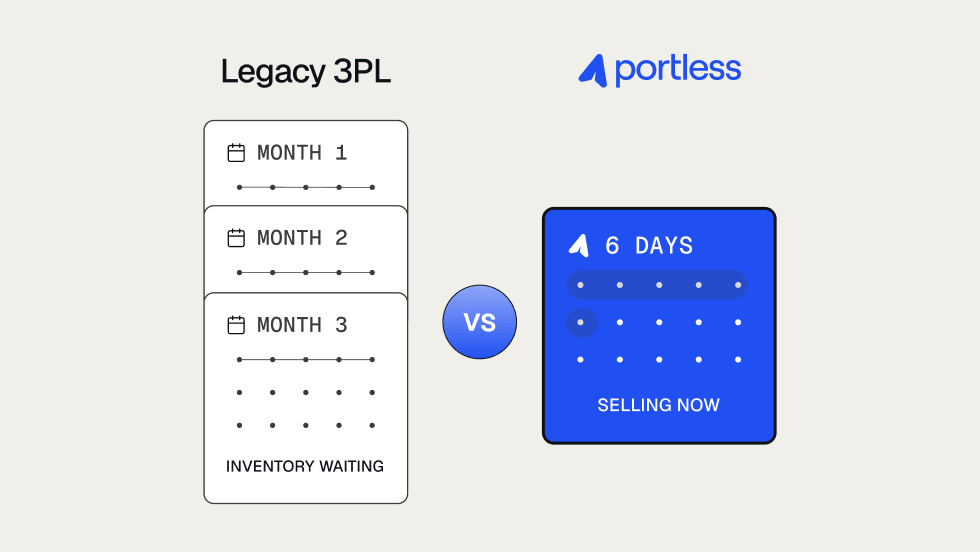
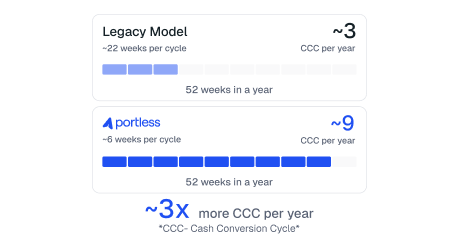
- Capital lock-up. You pay for inventory at the factory, pay duties at the port, and pay storage at the fulfillment center — all before a single unit sells. Your cash conversion cycle stretches to 90+ days.
- Forecasting risk. You're betting on demand four to six months out. If you over-order, you sit on dead stock. If you under-order, you stock out and lose ranking on Amazon and ad efficiency on Meta.
- Slow quality feedback. Defects discovered at a domestic fulfillment center are six weeks old by the time you find them. Shipping bad inventory back to the factory rarely pencils out, so brands liquidate or eat the loss.
The 2025 OECD Supply Chain Resilience Review found that agility — not reshoring — is the key to resilience. Holding inventory in a single domestic node, far from the source, is the opposite of agile.
What a factory-adjacent fulfillment center changes
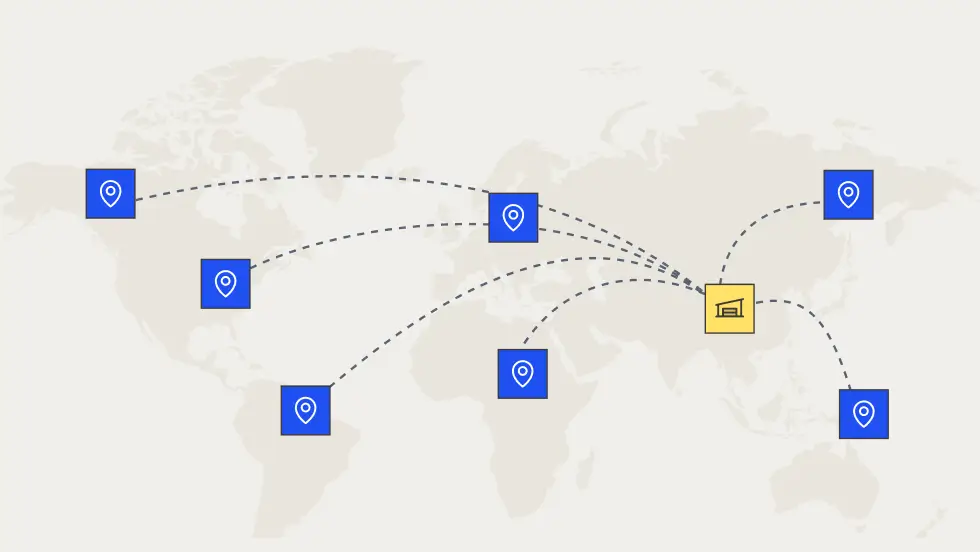
Portless operates fulfillment centers in China. Inventory lands at the facility within days of production, not weeks. Orders ship directly to customers in 85+ countries through more than 20 last-mile carriers, with typical delivery in five to eight days.
The math works differently:
- No domestic warehousing fees
- Inventory available for sale within days of production
- Duty paid via Delivered Duty Paid (DDP) only on units that actually ship
- Quality issues caught at receiving, with same-day correction at the factory
- One inventory pool serves multiple markets, removing the need to forecast country-by-country
For Craft Club, moving from a legacy fulfillment center to direct fulfillment correlated with 3x growth and a 3x drop in cash conversion cycle, as their team described in detail in Ecommerce Fulfillment Risk: Hard-to-Reverse Decisions for Growing Brands.
When a domestic fulfillment center still makes sense
Direct fulfillment isn't right for every product. A domestic fulfillment center remains the better fit when:
- Your product is heavy or oversized (over 3.5 lbs), where air freight per unit becomes uneconomical
- Your customers expect one to two day delivery and won't accept five to eight days
- Your category requires complex returns processing or refurbishment near the customer
- You're selling primarily through retail or wholesale channels that require pallet-level distribution
Most $1–15M DTC brands shipping lightweight goods in apparel, beauty, electronics, home, or toys fall outside those constraints — which is why the direct fulfillment model has scaled fastest in those categories.
Rethink where your fulfillment center sits
A fulfillment center isn't a strategy. It's a location decision — and where you put it determines how much capital you tie up, how fast you can respond to demand, and how much margin you keep. The legacy model puts that location far from your factory and close to your customer, which made sense when ocean freight was cheap and tariffs were stable. Neither is true anymore.
If you manufacture in Asia and ship lightweight goods to customers outside China, a factory-adjacent fulfillment center will almost always outperform a domestic one on cash flow, lead time, and inventory risk. Contact us to walk through what direct fulfillment would look like for your specific SKU mix and order volume.
← Back to the Ecommerce supply chain glossary