Safety stock
Safety stock is the extra inventory a brand holds beyond expected demand to protect against stockouts caused by demand spikes, supplier delays, or forecasting errors. It functions as a buffer between unpredictable customer demand and slow, rigid supply chains.
Every Ecommerce brand running on bulk freight and domestic warehousing carries safety stock. You have to. When your lead time from China is 60 to 90 days and your forecast is a guess, you need a cushion — units sitting in a warehouse that may never sell but exist to prevent the worst-case scenario: a viral product going out of stock right when demand peaks.
The problem is that safety stock is expensive insurance. It ties up working capital, racks up carrying cost, and absorbs warehouse space that could be earning revenue. According to IHL Group research cited by RIS News, inventory distortion — the combined cost of overstocks and stockouts — costs retailers roughly $1.7 trillion globally each year. Safety stock sits at the center of that math.
Why brands hold safety stock
Safety stock exists because the legacy supply chain is slow and unpredictable. Three variables drive how much you carry:
- Demand variability — how much your sales fluctuate week to week
- Supply variability — how reliable your supplier's lead time actually is
- Service level target — the probability you're willing to accept that you won't stock out
The longer your lead time and the more volatile your demand, the more safety stock you need. A brand importing from China via ocean freight with 75-day replenishment cycles needs significantly more buffer than a brand replenishing weekly from a domestic supplier.
How to calculate safety stock
The most common formula uses a service level multiplier, demand standard deviation, and lead time:
Safety stock = Z × σ × √L
Where:
- Z is the service level factor (1.65 for 95% service level, 2.33 for 99%)
- σ is the standard deviation of daily demand
- L is the lead time in days
A simpler rule of thumb used by many operators: maintain 15 to 20 days of safety stock for high-velocity SKUs based on projected daily sales. The Association for Supply Chain Management notes a common guideline of safety stock equal to 10 to 20% of cycle stock — though that range varies widely by category and supplier reliability.
The hidden cost of safety stock
Safety stock is not free. Every unit sitting as a buffer carries four costs:
- Capital cost — cash locked in inventory that can't fund marketing, product development, or new SKUs
- Storage cost — warehouse rent, handling fees, and insurance
- Obsolescence risk — units that become deadstock if demand shifts or seasons change
- Opportunity cost — the SKUs you didn't order because your cash was tied up in buffer stock
For a $9 SKU sitting in a 3PL at $0.30 per unit per month, six months of safety stock on 3,000 units equals roughly $32,400 in tied-up capital and storage. Multiply that across a catalog and you understand why brands with strong top-line revenue still feel cash-poor.
Why legacy supply chains force you to overstock
The standard sea freight model creates a structural problem: you have to commit to inventory months before you know what will sell. Most brands respond by ordering 30 to 40% more than forecasted demand, according to coverage in Investopedia's inventory turnover analysis. That over-ordering is safety stock by another name — a hedge against being wrong.
The deeper issue isn't the math. It's that legacy infrastructure forces container-sized decisions based on partial information. You're betting on demand 90 days out and paying for it in cash today.
How direct fulfillment changes the safety stock equation
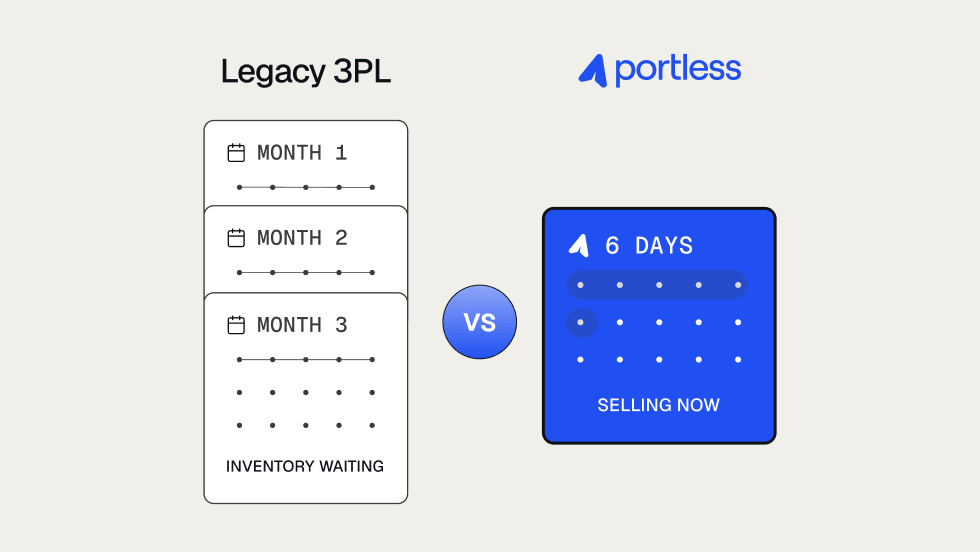
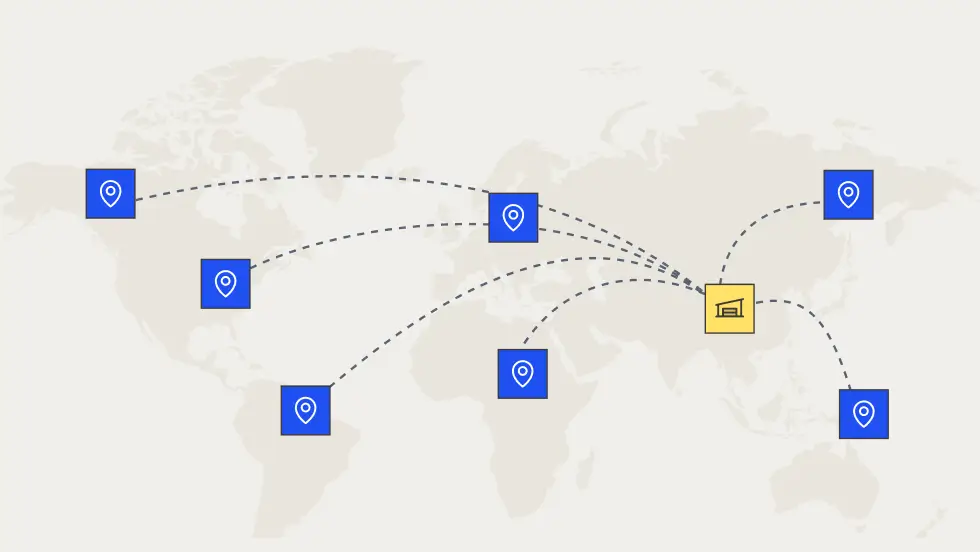
When orders ship directly from manufacturers in Asia to customers in five to eight days, the entire premise of safety stock changes. You no longer need 60 days of buffer inventory sitting in a Los Angeles warehouse to protect against a 75-day ocean freight cycle. You need enough production capacity to replenish in days, not months.
This is what brands like &Collar discovered when they switched to direct fulfillment — their in-stock ratio went from 5% to 95%+ while cutting inventory investment nearly in half. The buffer didn't disappear. It moved upstream, closer to production, where it costs less and stays flexible.
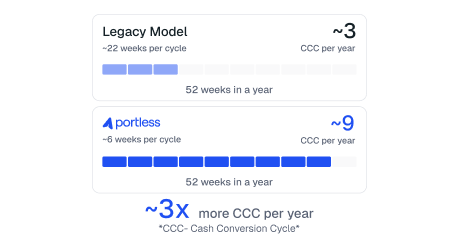
Some safety stock will always be necessary. Demand variability doesn't go away. But when replenishment cycles compress from 90 days to under 15, the size of the buffer you need shrinks dramatically.
Cut your safety stock by cutting your lead time
Safety stock is a symptom, not a strategy. The real lever is lead time — and brands fulfilling directly from Asia are operating with a fraction of the buffer their legacy peers carry. If you want to see what your business looks like with shorter cycles and less cash tied up in warehouses, contact Portless to walk through your numbers.
← Back to the Ecommerce supply chain glossary