LTV
LTV (Lifetime Value) is the total revenue or gross profit a business expects to earn from a single customer over the full duration of their relationship. For DTC brands, LTV is the metric that determines whether your customer acquisition spend is sustainable.
LTV — also written as CLV or CLTV (Customer Lifetime Value) — is one of the few metrics that ties marketing, product, and operations into a single number. It tells you how much a customer is worth to your business across every order they'll ever place, not just the first one. When paired with CAC (Customer Acquisition Cost), LTV becomes the foundation of every growth decision: how much you can spend to acquire a customer, which channels are profitable, and whether your business model actually works at scale.
Most brands treat LTV as a marketing metric. That's a mistake. LTV is a supply chain metric too — because delivery speed, packaging quality, stockout frequency, and shipping cost all shape whether a customer comes back. The legacy bulk-freight model quietly suppresses LTV in ways most operators never measure.
How to calculate LTV
The standard LTV formula has two common variations.
Simple LTV:
LTV = Average Order Value (AOV) × Purchase Frequency × Customer Lifespan
Gross profit LTV (more accurate for DTC):
LTV = AOV × Gross Margin × Purchase Frequency × Customer Lifespan
The second version is what most serious operators use, because revenue LTV without margin is misleading. A $200 AOV customer at 20% margin is worth less than a $100 AOV customer at 60% margin.
For subscription brands, LTV is often calculated as:
LTV = Average Revenue Per User (ARPU) ÷ Churn Rate
Why LTV matters for DTC brands
LTV determines three things:
- How much you can spend to acquire a customer (your CAC ceiling)
- How quickly you recover that spend (your CAC payback period)
- Whether your unit economics support growth without burning capital
The benchmark most operators use is a 3:1 LTV-to-CAC ratio. Below 3:1, you're not generating enough margin per customer to fund acquisition and overhead. Above 5:1, you're likely under-investing in growth.
But the number itself isn't the point. The point is what drives it.
What actually drives LTV (and what most brands miss)
Marketing teams obsess over email flows, loyalty programs, and personalization. Those matter. But the operational side of LTV gets ignored.
Research from a Convey study cited by McKinsey shows 84% of consumers won't return to a brand after a single poor delivery experience. That's not a marketing problem — that's a supply chain problem hitting your LTV directly.
The factors that quietly compound or destroy LTV:
- Delivery speed. Slow shipping suppresses repeat purchase rate. Brands shipping from China via legacy ocean freight can't compete on speed without holding domestic inventory.
- Stockout frequency. A customer who can't buy your bestseller when they want it often doesn't come back.
- Packaging and unboxing. The first physical touchpoint sets the tone for every future order.
- Tracking transparency. "Where is my order?" (WISMO) tickets erode trust and inflate support costs.
- International availability. Brands that can't ship to a customer's country lose that LTV entirely.
How supply chain choices change your LTV math
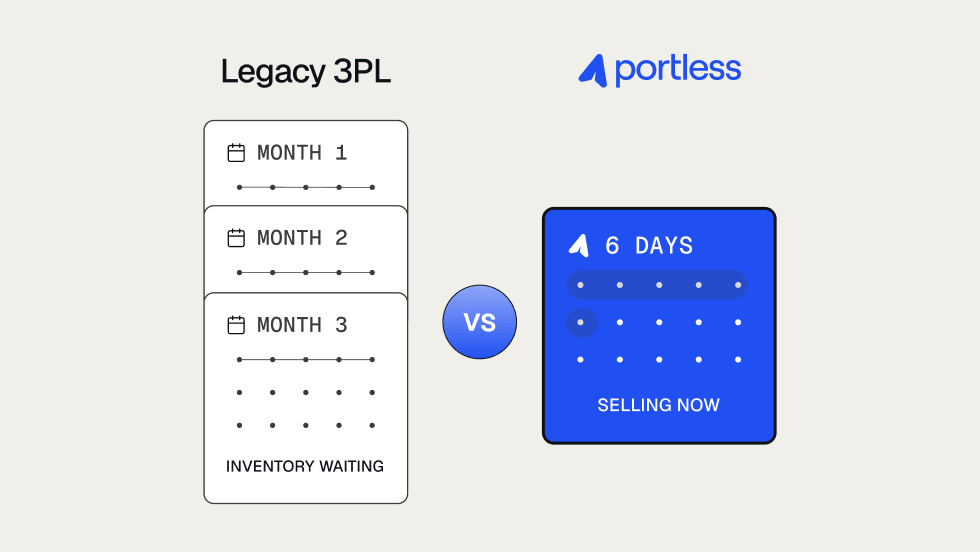
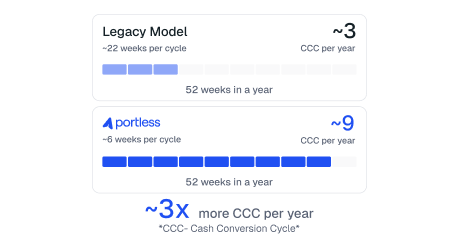
Here's where the legacy 3PL model breaks down. The bulk-freight-plus-domestic-warehouse model forces brands into a tradeoff: hold enough inventory to ship fast (and tie up cash), or run lean and accept stockouts. Either way, LTV suffers.
Direct fulfillment from the point of manufacture changes the equation. When you ship directly from Asia to customers in five to eight days, you:
- Eliminate stockout risk on slow-moving SKUs
- Free up working capital for marketing and retention
- Expand into 85+ countries without warehouse overhead, expanding your addressable LTV
- Reduce dead stock that drags down gross margin and therefore LTV
Shein and Temu have built their entire models around this. They don't forecast demand six months ahead — they respond to it in real time. The result is faster product testing, less waste, and more cash recycled into customer acquisition.
Common mistakes when measuring LTV
Most LTV calculations are wrong in one of three ways:
- Using revenue instead of gross profit. Revenue LTV ignores the cost of fulfilling each order. A high-AOV brand with thin margins can have a worse LTV than a low-AOV brand with strong margins.
- Treating LTV as static. LTV changes with every operational decision. A new fulfillment partner, a packaging change, or a delivery delay all move the number.
- Ignoring cohort variation. Customers acquired through paid social often have lower LTV than organic or referral customers. Blended LTV hides this.
For Ecommerce brands, the most rigorous approach is cohort-based LTV: track each monthly acquisition cohort separately and measure their cumulative gross profit over 12, 24, and 36 months.
LTV benchmarks for DTC brands
Benchmarks vary by category, but general ranges from Shopify's commerce data suggest:
- Apparel and accessories: $100–$300 LTV
- Beauty and personal care: $150–$400 LTV
- Home goods: $200–$500 LTV
- Subscription brands: $300–$1,000+ LTV
These are revenue figures. Your gross profit LTV will be 40–70% of these numbers depending on your margin structure.
Build LTV through better supply chain economics
LTV isn't just a marketing number — it's a reflection of how well your entire operation serves customers across their full relationship with your brand. The brands winning on LTV aren't running better email flows. They're running better supply chains: faster delivery, fewer stockouts, lower fulfillment costs, and the capital flexibility to keep investing in retention.
Portless helps DTC brands compress lead times, free up working capital, and deliver a domestic-quality experience to customers in 85+ countries — all of which compound into higher LTV. See how Portless can improve your unit economics.
← Back to the Ecommerce supply chain glossary