Average order value (AOV)
Average order value (AOV) is the average dollar amount a customer spends per transaction, calculated by dividing total revenue by total number of orders over a defined period. It's a core Ecommerce metric for evaluating customer purchasing behavior, pricing strategy, and the profitability of acquisition spend.
AOV tells you how much money the average customer hands over each time they check out. It's one of the three levers — alongside traffic and conversion rate — that determine Ecommerce revenue. Raise AOV without raising customer acquisition cost (CAC), and your unit economics improve immediately. Drop AOV while CAC stays flat, and the math stops working.
For DTC brands operating on thin margins, AOV is more than a vanity number. It directly shapes how much you can spend to acquire a customer, how quickly you recover that spend, and whether shipping and fulfillment costs eat your margin alive. A $25 AOV with $8 fulfillment costs leaves very little room. A $75 AOV with the same fulfillment cost is a different business entirely.
How to calculate average order value (AOV)
The formula is simple:
AOV = Total revenue ÷ Number of orders
If you generated $150,000 in revenue across 3,000 orders last month, your AOV is $50. Most Ecommerce platforms, including Shopify and WooCommerce, calculate this automatically in their analytics dashboards.
A few things to watch when calculating AOV:
- Use net revenue (after discounts and returns), not gross
- Calculate per channel — your Meta-acquired AOV and email-acquired AOV are rarely the same
- Track AOV by customer segment: new vs. returning customers behave differently
- Exclude shipping fees if you want a clean view of product revenue
Why AOV matters for DTC Ecommerce brands
AOV is one of the few metrics you can actively influence without spending more on ads. Every dollar added to AOV flows through your unit economics in a way that paid acquisition can't match.
Higher AOV gives you:
- More room to absorb shipping, duties, and fulfillment costs per order
- Faster CAC payback periods, freeing capital for reinvestment
- Better margins on the same traffic and conversion rate
- A larger pool to fund retention and loyalty programs
The connection to fulfillment is direct. Fixed per-order costs — pick-and-pack, last-mile shipping, packaging, processing fees — don't scale with order size. A $30 order and a $120 order cost roughly the same to fulfill. Higher AOV means a smaller percentage of revenue goes to logistics overhead.
How AOV connects to landed cost and margin
Landed cost is the total cost of getting a product from manufacturer to customer — product cost, freight, duties, fulfillment, and shipping combined. AOV determines how much of that landed cost you can absorb before your contribution margin disappears.
Consider two brands selling the same $40 product:
- Brand A has an AOV of $40 (one unit per order). Fixed fulfillment of $10 = 25% of revenue.
- Brand B has an AOV of $120 (three units per order). Fixed fulfillment of $10 = 8.3% of revenue.
Same product, same margin per unit, dramatically different unit economics. This is why bundling, free shipping thresholds, and upsells aren't just merchandising tactics — they're margin strategy.
For brands shipping internationally, AOV becomes even more critical. As covered in our breakdown of EU de minimis exemption changes, processing fees and per-parcel duties scale poorly against low-AOV orders. Brands selling €30 products into the EU after 2026 will feel the squeeze; brands with €100+ AOVs have more breathing room.
Proven ways to increase AOV
There are four mechanical ways to raise AOV: get customers to buy more units, buy more expensive units, add complementary products, or both. Most effective tactics fall into one of these buckets.
Product bundling. Group complementary SKUs into a single offer. A skincare brand selling cleanser, toner, and moisturizer as a routine bundle moves three units per order instead of one. Bundling also helps distribute fixed customs and shipping costs across more revenue.
Free shipping thresholds. Set the threshold 15–25% above your current AOV. Customers will add items to qualify, lifting AOV without discounting product price.
Upsells and cross-sells. Recommend a higher-tier product on the product page or a complementary item at checkout. Triggering this at the right moment matters more than the offer itself.
Volume discounts. "Buy 2, save 10%" or "Buy 3, save 20%" works particularly well for consumables and gifting categories.
Subscription options. Subscriptions raise effective AOV by locking in repeat purchases at predictable intervals, improving lifetime value alongside order size.
For more on connecting these tactics to long-term customer behavior, see our guide to increasing customer lifetime value.
AOV benchmarks across Ecommerce categories
AOV varies widely by category, and benchmarking against your own historical performance matters more than comparing to industry averages. That said, rough ranges look like this:
- Apparel and accessories: $60–$120
- Beauty and skincare: $40–$90
- Electronics and accessories: $80–$200+
- Home goods: $70–$150
- Toys and gifts: $30–$80
Higher-AOV categories generally have more flexibility to absorb fulfillment costs and tariff exposure. Lower-AOV categories rely more heavily on bundling, repeat purchase rate, and operational efficiency to make the math work.
How direct fulfillment changes the AOV equation
Most conversations about AOV focus on the demand side — pricing, merchandising, upsells. The supply side gets ignored. But fulfillment costs are a percentage of every order, and the legacy model of bulk ocean freight plus domestic 3PL warehousing inflates those costs in ways that punish low-AOV brands hardest.
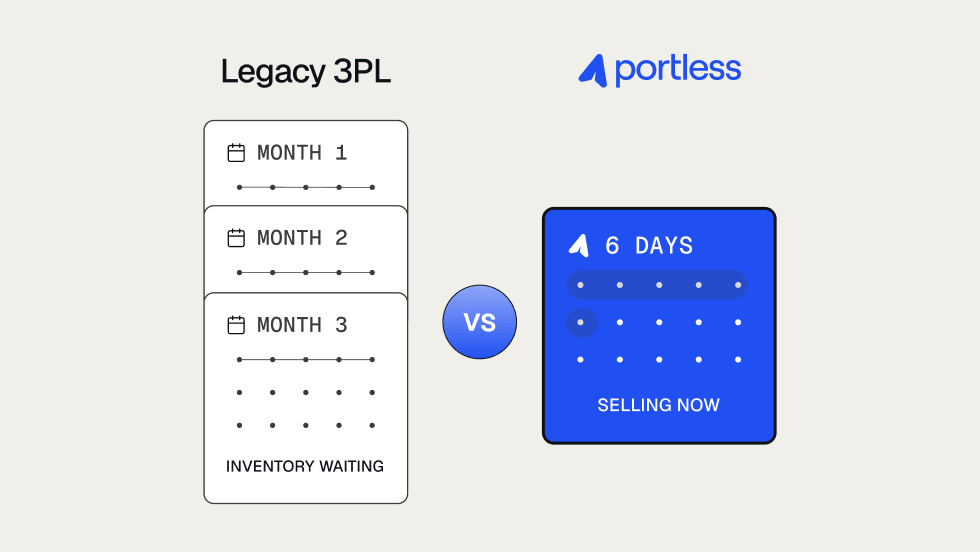
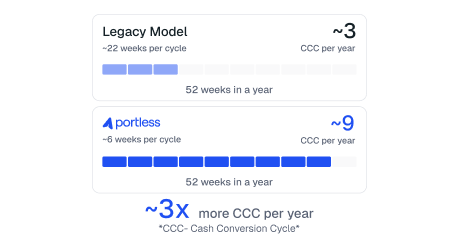
Direct fulfillment from the point of manufacture cuts out the middle steps. Inventory becomes available for sale days after production instead of months. Duties get paid only on units that actually sell, not on bulk inventory sitting in a warehouse. The cash conversion cycle shrinks from 120–180 days to 7–10 days.
For brands with lower AOVs, this matters even more. When every dollar of fulfillment cost represents a larger share of order revenue, eliminating warehouse holding fees, inventory financing, and duty exposure on unsold units directly protects margin. Brands like &Collar used this approach to go from 5% in-stock to 100% during peak season while delivering 35% YoY revenue growth.
Make AOV work harder with Portless
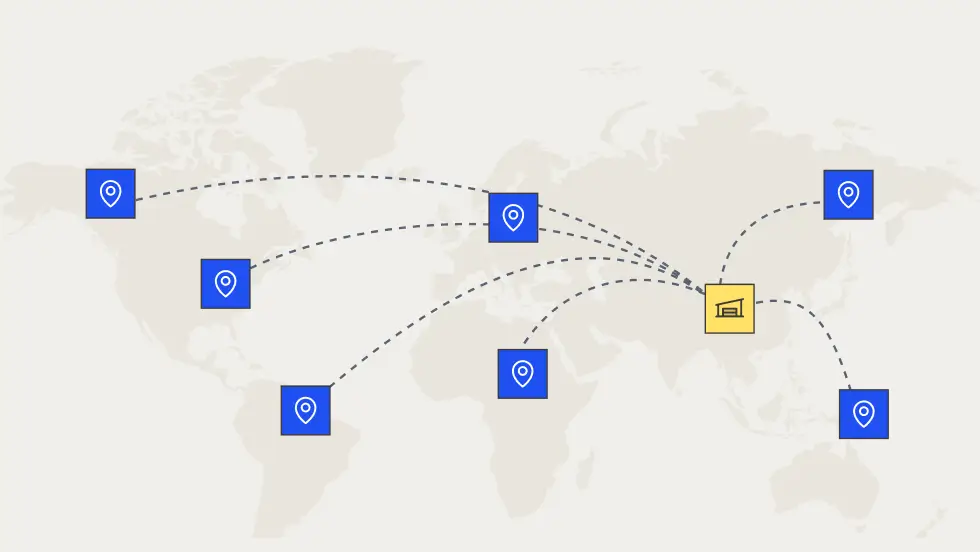
AOV is only half the picture. The other half is what it costs you to fulfill each order — and that's where most brands leave margin on the table. Portless powers direct fulfillment from manufacturers in Asia to customers in 85+ countries, cutting lead times by up to 90% and aligning duty payments with actual sales. That means fewer fixed costs eating into low-AOV orders, and more room to scale acquisition without losing margin.
Contact us to see how direct fulfillment changes the unit economics behind your AOV.
← Back to the Ecommerce supply chain glossary