Importer of record (IOR)
An importer of record (IOR) is the legal entity responsible for ensuring imported goods comply with the destination country's customs laws and for paying any duties, taxes, and fees owed at the time of import. For Ecommerce brands shipping cross-border, the IOR is the party Customs holds accountable if anything is wrong with the declared value, classification, or documentation.
Every shipment that crosses a border has an IOR — whether the brand realizes it or not. In legacy bulk freight, the IOR is usually the brand itself, named on the commercial invoice and bond. In direct fulfillment models, the IOR can be the brand, a customs broker acting on the brand's behalf, or a third-party service designated to take on that responsibility.
The role matters because it determines who CBP (or the equivalent agency in another country) treats as the legally accountable party for duty payment, valuation accuracy, HS code classification, and compliance with partner government agency requirements. Get the IOR wrong, and you can end up overpaying duties, facing shipment holds, or worse — being held liable for misdeclared shipments you didn't directly file.
What an importer of record actually does
The IOR is responsible for the full compliance picture, not just paying the bill. That includes:
- Filing the correct entry documents with the customs authority of the destination country
- Declaring the accurate transaction value of the imported goods
- Classifying products under the correct Harmonized Tariff Schedule (HTS) code
- Paying applicable duties, tariffs, and import taxes
- Maintaining import records for at least five years (per CBP requirements)
- Ensuring goods comply with any partner government agency (PGA) rules, such as FDA, CPSC, or USDA
If something is misdeclared or undervalued, the IOR is the entity Customs comes after — not the manufacturer, not the freight forwarder, and not the end customer.
Who can be the importer of record
In the US, CBP allows three parties to serve as the IOR: the owner of the goods, the purchaser of the goods, or a licensed customs broker designated by either of those parties. For most DTC brands shipping from manufacturers in Asia, the brand itself is named as the IOR, with a licensed customs broker handling the actual filing.
There are also third-party IOR services that act on behalf of brands without a legal presence in the destination country. This is more common in B2B and enterprise shipping than in DTC Ecommerce, but it's a structure worth knowing about if you're expanding into markets where you don't have a registered entity.
Why the IOR matters for customs valuation
The IOR designation directly affects how your goods are appraised for duty purposes. CBP's preferred valuation method is transaction value — the price actually paid or payable for the goods when sold for export to the US. There's a legal presumption that the price the IOR paid for the goods is the transaction value.
This is critical in direct fulfillment models, where the brand sells the product to the end customer before it's imported. As long as the brand (or an entity acting on its behalf) is listed as the IOR, CBP cares about the price paid to the factory — not the retail price at checkout. Get this wrong, and you could end up paying duties on the retail price instead of the factory cost, which is often a 5-10x overpayment.
For a deeper breakdown of how this works, see customs valuation after de minimis.
IOR responsibilities under the new tariff environment
When the US eliminated the $800 de minimis threshold in 2025, the IOR role became more consequential for DTC brands. Every shipment now triggers a formal customs entry. Every entry requires accurate valuation, classification, and documentation. And every error — even a small one — sits with the IOR.
Cross-border duty strategies like bonded warehousing, duty deferral, and country-of-origin optimization all depend on the IOR being correctly designated and the documentation being airtight. If your IOR setup is sloppy, none of the downstream strategies work cleanly.
This is also why Type 86 entries require the IOR number when goods are subject to PGA reporting. CBP needs to know who's accountable for compliance, not just who paid the duty.
How IOR fits into the direct fulfillment model
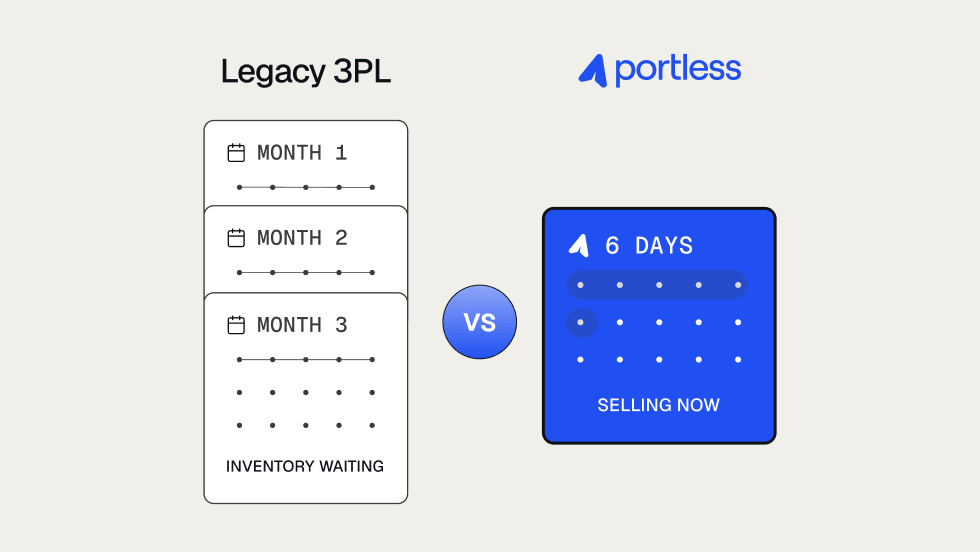
In a legacy supply chain, the brand pays duty on a full container the moment it enters the US — regardless of whether the goods sell. In a direct fulfillment model like Portless's, duty is paid per order at the time of sale. The brand remains the IOR on each shipment, but the duty obligation aligns with revenue rather than with bulk import timing.
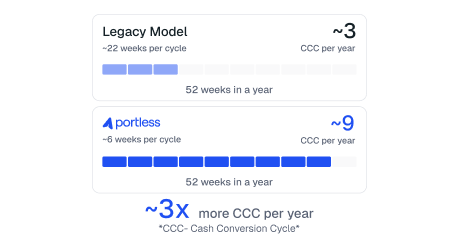
That shift cuts the cash conversion cycle from 120-180 days to roughly seven to 10 days and eliminates duty exposure on unsold inventory. The IOR responsibility doesn't go away — it just gets distributed across thousands of small parcels instead of concentrated on a handful of containers.
Get your IOR setup right with Portless
Portless operates a direct fulfillment model where the merchant is the importer of record on every shipment, with duty calculated on the factory transaction value and paid only when the order ships. That structure preserves your cash flow, keeps valuation defensible, and removes the duty exposure on unsold units that comes with legacy importing.
If you want to align duty payment with actual sales and tighten your import compliance, contact the Portless team.
← Back to the Ecommerce supply chain glossary