“We generated $70K in package protection revenue in a single quarter by adding a simple $4 protection option at checkout — plus an additional $12K from cashbacks. Customers get peace of mind, and we're making a profit on every protected order with zero effort."
“We generated $70K in package protection revenue in a single quarter by adding a simple $4 protection option at checkout — plus an additional $12K from cashbacks. Customers get peace of mind, and we're making a profit on every protected order with zero effort."
Disclaimer: this post is informational, not legal advice. Confirm any tariff or customs strategy with your counsel before acting on it.
If you import a 40-foot container of goods today, you owe US tariffs on every unit inside the moment it clears customs, even on the units that won't sell for six months, the units that never sell, and the units you eventually mark down to clear. With effective duty rates on Chinese-origin goods now reaching 50%+ depending on the HTS code, that's a five- to six-figure cash bill on inventory that hasn't generated a dollar of revenue. For the latest landscape, see current US tariff and import rules and how the new China tariffs impact Ecommerce.
There are two legal ways to fix this:
Tariff deferment: restructure your fulfillment so duty is owed per order, not per container
First Sale rule: lower the dutiable value itself by basing it on the factory's price to a middleman, not the price you paid
This post walks through both, who they apply to, and how direct fulfillment from China and Vietnam bakes deferment in by default.
Legacy vs. direct supply chain: when tariffs hit your cash
With US tariffs on Chinese-origin goods now stacked across Section 301, IEEPA, and reciprocal duties, and with rates changing on a near-quarterly basis, Ecommerce brands are looking for durable ways to reduce both the rate and the timing of duty payments.
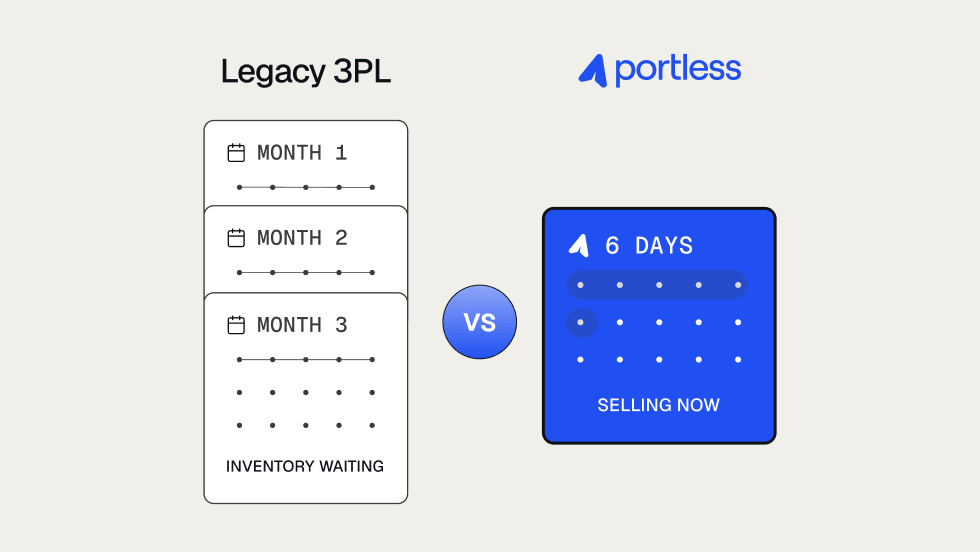
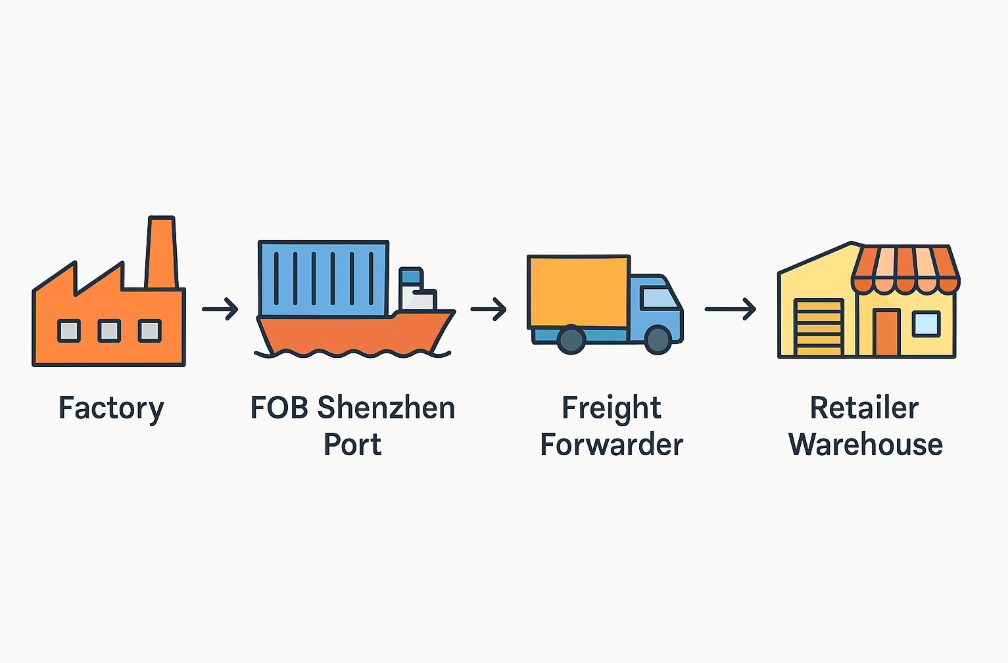
In a legacy supply chain model, a retailer buys merchandise from a factory overseas. The retailer typically buys the merchandise "FOB [Port City X]" (for example, FOB Shenzhen Port), meaning the factory is responsible for delivering the goods in a shipping container "Free on Board" to the Shenzhen Port. The retailer then works with a freight forwarding company to import the shipping container into the US. Six to eight weeks later, the container arrives at the retailer's warehouse or 3PL and the goods become available for sale.
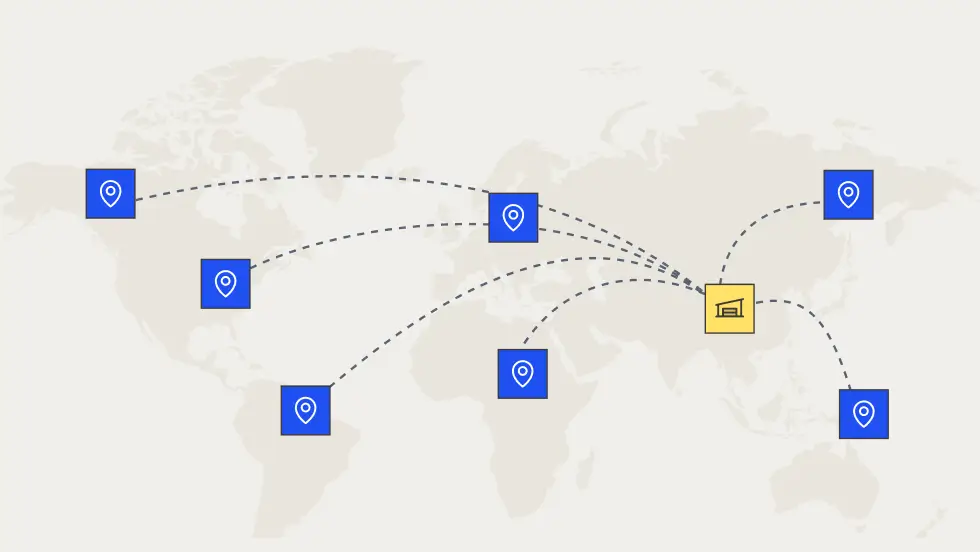
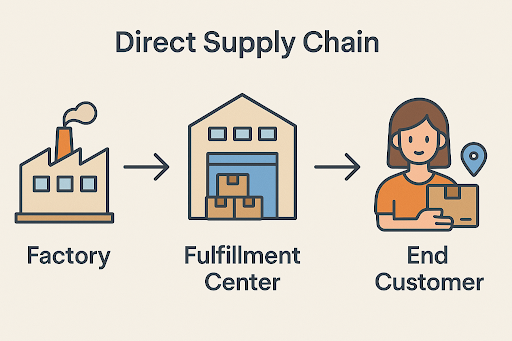
In a direct fulfillment model — the same structural approach used by Shein and Temu, and now by hundreds of US DTC brands using Portless — the goods ship from a fulfillment center near the factory, not from a domestic 3PL after a six to eight week ocean voyage. Direct fulfillment is independent of de minimis; the cash flow and tariff timing advantages survive the de minimis is closing change (see also: de minimis exemption).
The goods are inbounded at a fulfillment center near the factory and immediately made available for sale on the Ecommerce merchant's website. When the Ecommerce merchant sells an item to an end customer, the fulfillment center picks, packs, and ships that item directly to the end customer in the US (and if they're using Portless, that shipment is done with a completely domestic shipping experience and a five to eight day average delivery time). The reason it is called direct supply chain is because it cuts out all the middle steps, allowing brands to shorten the time between production and sale from months to just a few days.
How to appraise goods for US tariffs under direct fulfillment
In a legacy supply chain model, the importer uses the "transaction value" (the amount actually paid to the factory for the goods) as the appraisal price.
What about in a direct supply chain model, where the Ecommerce merchant has already sold the goods to an end consumer prior to the importation?
Here's the great news: the merchant can still use the transaction value, i.e. the amount they paid the factory for the goods.
Why?
All merchandise imported into the United States must be appraised in accordance with Section 402 of the Tariff Act of 1930, as amended (19 U.S.C. § 1401a). The preferred method of appraisement is transaction value, defined as: "the price actually paid or payable for merchandise when sold for exportation to the United States," plus certain specific additions.
And here is the key: CBP presumes that "transaction value" is the price actually paid by the importer for the imported merchandise.
Therefore, as long as the Ecommerce merchant or an entity acting on their behalf is listed as the importer of record, the fact that there is an additional sale to an ultimate consignee (the end customer) is irrelevant; CBP cares about the value the importer paid for the goods, not the price at which they ultimately sold the goods.
Please note that it is important to use a reputable fulfillment center that understands these rules, as there are some additional complexities (like ensuring that the original sale was "for exportation to the United States") that can trip you up if you are not careful. In particular, using the correct Importer of Record is critical to getting this right.
For additional clarity, here is a clip of Portless CEO Izzy Rosenzweig and Lenny Feldman discussing this on our recent tariffs-focused webinar. Lenny is a Principal at Sandler, Travis & Rosenberg and one of the nation's leading experts on import and export compliance, having served on the Commercial Customs Operations Advisory Committee (COAC) for U.S. Customs and Border Protection, appointed by three different Secretaries of the Treasury.
The First Sale rule: what it is and when it applies
For almost all merchants, using transaction value is sufficient; this allows them to use the price they actually paid their factory for their goods as the appraised value for US tariffs.
However, in certain unique instances, merchants can take advantage of the First Sale methodology to pay tariffs on a value even lower than the standard transaction value.
How?
In 1988, the U.S. Court of Appeals for the Federal Circuit decided the case of E.C. McAfee Co. v. United States, 842 F.2d 314 (Fed. Cir. 1988), which established the First Sale rule in U.S. import law. This rule allows importers to base the dutiable value of merchandise on the price paid in the initial sale, typically between the manufacturer and a middleman, rather than the price paid by the importer to the middleman. This can result in significant duty savings. The middleman can sometimes be a third party but is often a secondary entity (such as a Hong Kong corporation) set up by the factory itself for expressly this purpose.
Len Rosenberg, a senior attorney at Sandler, Travis & Rosenberg, P.A. (the same firm as Lenny Feldman from our webinar), represented E.C. McAfee Co. in this landmark case. The court held that the price paid by the middleman to the manufacturer was the proper basis for transaction value, provided that the transaction was conducted at arm's length and involved goods clearly destined for export to the United States.
In other words, if there are multiple sales between the factory and the importer, the importer is allowed to use the value of the first sale. This enables the importer to shift ~10-20% of the costs of the item (typically costs unrelated to manufacturing, like marketing, finance, etc.) to a middleman, and reduces their dutiable rate accordingly.
Importantly, this is generally only relevant for larger merchants that buy significant quantities of goods from a single factory. Setting up a proper First Sale methodology requires expert guidance from tax professionals. The 10-20% savings on tariffs would generally not pay for the overhead of running a proper First Sale program unless a merchant is buying $1-2M of goods from a single factory annually.
Should you actually pursue First Sale? A decision framework
First Sale is real, legal, and durable, but it isn't free to set up. Use this checklist before you spend on it:
You buy $1M+ annually from a single factory or factory group
That factory already has, or will set up, a qualifying middleman entity (often a Hong Kong or Singapore corporation)
You can document the middleman sale as arm's-length and the goods as clearly destined for the US at the time of the first sale
You can afford legal and customs counsel to set the structure up and defend it on audit
If you check all four, expect 10–20% savings on dutiable value, which at current China rates translates to meaningful margin recovery.
If you check fewer than four, your better play is tariff deferment through direct fulfillment: same cash-flow benefit, no middleman setup, no audit exposure. The two strategies stack: large brands run First Sale and direct fulfillment. A third strategy worth evaluating in parallel is tariff engineering, restructuring the product itself to qualify for a lower HTS classification.
What documents prove First Sale to CBP?
To use First Sale, the burden of proof sits entirely with you, the importer. CBP presumes your dutiable value is the price you paid. You declare First Sale at the time of entry, not as a retroactive election, and you come ready to prove it.
Courts set the bar in Nissho Iwai American Corp. v. United States, 982 F.2d 505 (Fed. Cir. 1992), and CBP formalized it in General Notice T.D. 96-87. Three conditions apply: a bona fide sale, goods clearly destined for export to the US at the time of the first sale, and a manufacturer and middleman dealing at arm's length, free of non-market influences.
CBP does not publish a fixed checklist. It looks for records that establish each condition:
::table
Condition;Documents CBP looks for
Bona fide sale;Contracts, distribution agreements, invoices, purchase orders, bills of lading, proof of payment, correspondence between the parties, and company reports or brochures
Clearly destined for the US;Invoices, sales contracts, purchase orders, proof of payment, and shipping documents for each tier with consistent prices, dates, parties, and merchandise; plus US-specific evidence like labels, logos, unique stock or bar codes, and US regulatory markings or certifications
Arm's length;Disclosure of any relationship between the parties; if related, evidence the relationship did not influence price, or that the value approximates a test value
:table
Two structural requirements run across every submission. Include a written description of each party's role. Provide a complete paper trail covering every tier of the transaction. You also report any statutory additions — packing costs, selling commissions, assists, royalties, or proceeds of resale — or confirm none apply.
A stack of documents is not enough on its own. In ruling HQ H337689 (October 2025), CBP reaffirmed that the records must collectively establish title transfer, risk of loss, pricing, and each party's role. Declare a First Sale value without that support, and CBP can treat it as a failure of "reasonable care," which exposes you to penalties.
First Sale remains valid US law as of 2026, and CBP applied the same framework in HQ H337689. A bill to end it, the Last Sale Valuation Act, was introduced in the Senate in February 2026 but has not been enacted.
The takeaway is simple: First Sale rewards brands that can produce a clean, consistent paper trail across every tier.
How Portless defers tariffs until each order ships
Merchants using Portless have a major advantage over other Ecommerce merchants when it comes to tariffs:
In a legacy supply chain, the merchant pays tariffs on the entire container the minute it enters the US, even if they don't sell the goods for weeks, months, or ever. With the current tariffs, that can easily be tens of thousands of dollars paid upfront.
CBP owes duty at the time of import. Direct fulfillment changes when each import event happens, so duty timing aligns with when each customer order ships. The legal duty obligation doesn't change; the cash timing does. This way, you effectively defer tariffs until there is revenue to pay for them, and never pay duty on slow or unsold inventory.
The cash timing is the strategy
Tariffs aren't going down, and the cash you pay upfront on a container is cash you don't have for inventory, ads, or payroll. Whether you qualify for First Sale or simply shift to per-order duty timing through direct fulfillment, the goal is the same: stop financing duty on inventory that hasn't sold. If that math matters to your business, it's worth talking to our team about what direct fulfillment would change for your specific cost structure.
FAQ
How can Ecommerce brands legally delay paying import tariffs?
You delay tariffs by switching from bulk container imports to direct fulfillment. Tariffs are owed when goods enter the US, so if you import per order instead of per container, you only pay duty on items that have already sold and been paid for.
What is tariff deferment?
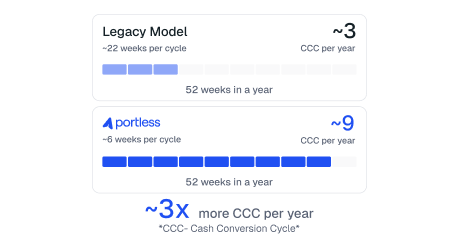
Tariff deferment is paying import duties after a customer buys your product, not when inventory enters the US. It frees up working capital, removes duty cost on unsold inventory, and shortens the cash cycle from 90+ days to days.
Does the First Sale rule still apply under current US tariffs?
Yes. The First Sale rule established in E.C. McAfee Co. v. United States remains valid US import law. CBP continues to accept first sale valuations when the manufacturer-to-middleman sale is at arm's length and the goods are clearly destined for US export.
Who qualifies for the First Sale rule?
First Sale typically only makes financial sense for brands buying $1–2M+ annually from a single factory. The compliance and legal overhead of setting up a qualifying middleman structure outweighs the 10–20% duty savings below that threshold.
What is the difference between transaction value and First Sale value?
Transaction value is what you paid your factory or middleman. First Sale value is the earlier price the middleman paid the manufacturer, which excludes 10–20% of non-manufacturing costs like marketing and finance, lowering your dutiable base.
Frequently asked questions
Heading
Lorem ipsum dolor sit amet, consectetur adipiscing elit. Suspendisse varius enim in eros elementum tristique. Duis cursus, mi quis viverra ornare, eros dolor interdum nulla, ut commodo diam libero vitae erat. Aenean faucibus nibh et justo cursus id rutrum lorem imperdiet. Nunc ut sem vitae risus tristique posuere.
Get operator-level supply chain insights
Thank you! Your submission has been received!
Oops! Something went wrong while submitting the form.








%20(1)%20(1).avif)
%20(1).avif)
.jpg)