Last updated: May 2026
Disclaimer: this blog post is not legal advice and is for informational purposes only. Please seek guidance from your own legal counsel before utilizing any information you see here.
With the recent announcement of increased tariffs on goods imported into the United States, many DTC and Ecommerce business owners are searching for ways to mitigate the financial impact.
One term that's been gaining attention is tariff deferment. But what does it actually mean? And how can your Ecommerce or DTC business take advantage of it?
Let's break it down.
What is tariff deferment?
Tariff deferment allows businesses to delay paying import duties and taxes until after their goods are sold, rather than upfront at the time of import. Instead of tying up capital in customs payments before products even reach customers, brands can use this strategy to improve cash flow, reduce financial risk, and scale operations faster. By deferring tariffs until goods ship, businesses can reinvest working capital into growth while maintaining compliance. It's a powerful financial tool for Ecommerce brands, especially in high-tariff times.
Tariff deferment delays when an importer pays customs duties — from the moment goods enter the US to the moment they ship to the end customer. The US importer of record still owes the duty to US Customs and Border Protection (CBP), but the timing shifts.
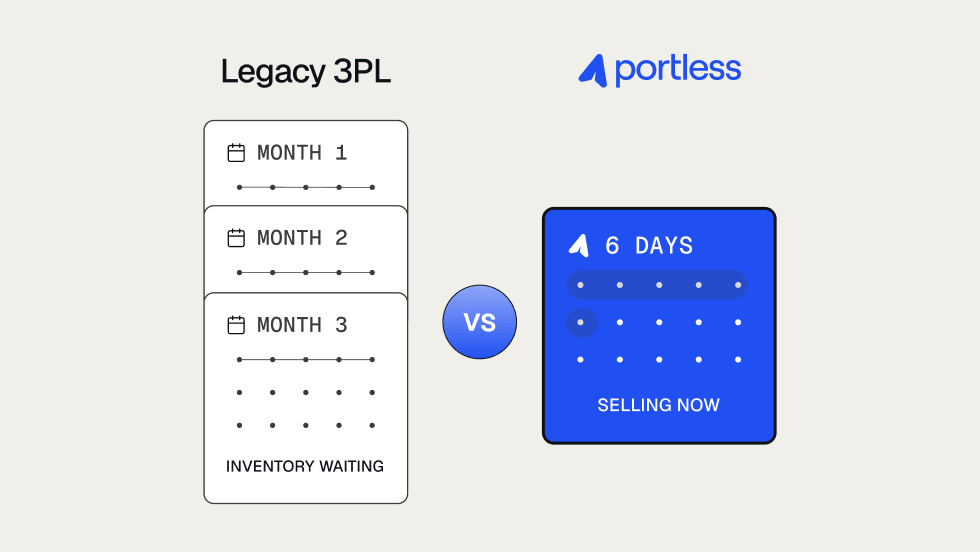
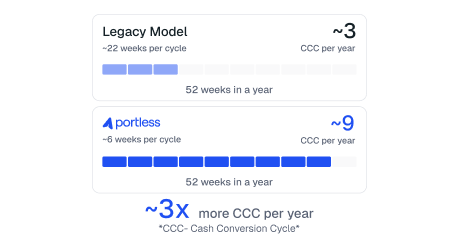
Under a legacy model, you wire duties to CBP when a container clears the port. Your inventory then sits in a warehouse for 60 to 90 days before it sells. You financed the government for three months on stock that may or may not move.
Under a direct fulfillment model, every parcel clears customs on the day it ships to a customer who has already paid you. You collect revenue first, then pay duty. The duty cost still exists, but it never leaves your business before the cash does.
A few things to know:
- Tariff deferment is not duty avoidance. You owe the same amount; you just pay it later.
- It is not the same as duty drawback, which refunds duties on re-exported goods.
- It is not the same as a bonded warehouse, which defers duty for goods stored in CBP-supervised facilities but still requires a warehousing operation in the US.
- For larger merchants, it is also distinct from First Sale valuation, a separate strategy that reduces the dutiable value itself. Defer tariffs for your Ecommerce brand using First Sale covers that approach.
Direct fulfillment from Chin gives you deferment as a structural feature, not as a program you apply for.
This matters more in 2026 than it did two years ago. The de minimis exemption that previously allowed sub-$800 parcels to enter the US duty-free was suspended globally by Executive Order in August 2025. Every parcel now clears customs with duty owed. The question for DTC brands is no longer whether to pay, it is when. For further reading on what changed and what still works, see de minimis is closing, but tax deferment strategies aren't dead and Where US tariffs stand: de minimis, postal changes, and Section 321 Type-86.
Legacy vs. direct fulfillment models
To understand tariff deferment, we first need to examine the differences between legacy and direct fulfillment models.
Legacy fulfillment model
In a legacy model, a retailer purchases merchandise from an overseas factory, typically under FOB (Free on Board) terms (e.g., "FOB Shenzhen Port"). The factory delivers the goods to the port, and the retailer works with a freight forwarder to import the container into the US.
- Six to eight weeks later, the container arrives at the retailer's warehouse or 3PL.
- The retailer then makes the goods available for sale.
This model requires brands to pay tariffs upfront on all inventory in the container, regardless of whether the items sell. With combined Section 301, IEEPA, and reciprocal tariffs on Chinese-origin goods now stacking well above 50% for many HTS codes, the capital tied up in upfront duty payments has grown significantly. For a current breakdown, see Where US tariffs stand: de minimis, postal changes, and Section 321 Type-86. This can tie up significant capital in unsold inventory for 90+ days, straining cash flow.
Direct fulfillment model (the playbook Shein and Temu pioneered, now available to DTC brands via Portless)
A direct supply chain model eliminates many of these inefficiencies. Here's how it works:
- The merchant buys goods from an overseas factory.
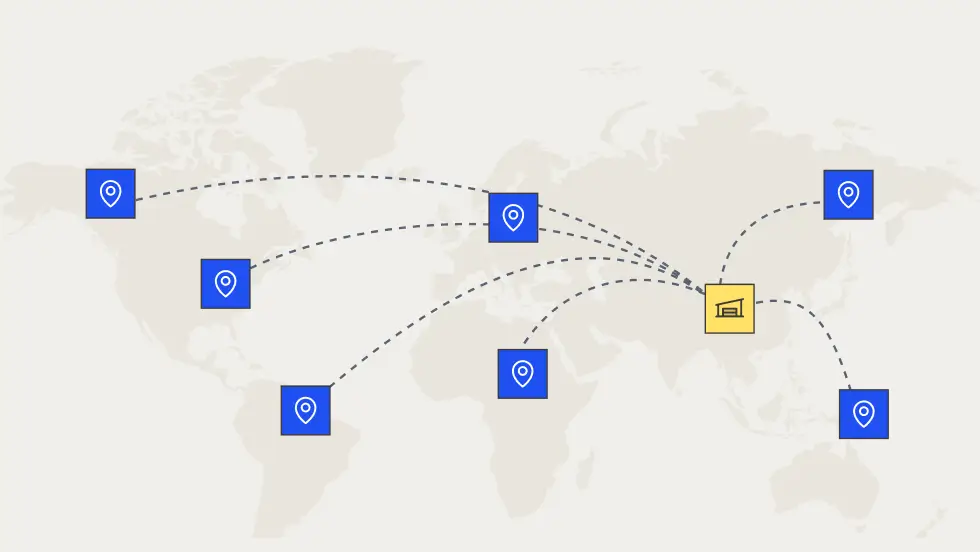
- Instead of shipping to a port, the goods go to a fulfillment center near the factory.
- Inventory becomes available for sale online immediately.
- When a customer places an order, the fulfillment center picks, packs, and ships directly to the US customer, often in five to eight days, with a domestic shipping experience for the end customer.
This model cuts out unnecessary steps, reducing the time from production to sale from months to just days. The best part? It uses tariff deferment, so brands only pay duties after goods ship and after they receive payment from their customers. That means better cash flow, lower risk, and faster scaling.
How tariff deferment works in each model
Legacy model = no tariff deferment
- Pay tariffs upfront on all inventory imported.
- Tariffs (depending on origin country) apply even if inventory doesn't sell.
- Cash can be locked up for 90+ days, hurting liquidity.
Direct fulfillment is tariff deferment by default
- Only pay tariffs when an item sells, after the customer has already paid.
- No tariffs on unsold or slow-moving inventory, preserving cash flow.
- Lower risk, healthier margins while competitors bleed working capital.
Tariff deferment in action
The table below models a brand doing 5,000 orders per month at $30 landed cost per unit, with an effective duty rate of 30% on goods from China. Assumes 90 days of inventory on hand under the legacy model and seven days of in-transit inventory under direct fulfillment.
::table
Metric;Legacy fulfillment;Direct fulfillment (Portless)
Inventory on hand;15,000 units;1,200 units
Cash locked in inventory;$450,000;$36,000
Duty paid upfront;$135,000;$0
Duty payment timing;At port arrival;Per parcel, after customer pays
Days cash is tied up;90+;0 to 5
Exposure on unsold inventory;High;None
:table
Two things this makes concrete:
The cash difference is not the duty rate — it is the timing. A brand paying $135K in duties up front and waiting 90 days to recoup it has a working capital hole the size of a quarter's marketing budget.
The duty obligation does not disappear under direct fulfillment. You still pay 30% per parcel under DDP. But you pay it the day the customer's order ships, not the day the container lands.
For brands doing $1M to $15M in annual revenue, the difference in cash position typically lands between $200K and $1.5M, capital that goes back into inventory reorders, ad spend, and product development.
Calculate your own scenario with the Portless direct fulfillment ROI calculator.
Who should use tariff deferment
Tariff deferment via direct fulfillment is a fit if most of the following are true for your brand:
- You do $1M to $15M in annual revenue and 1,000 to 15,000 orders per month
- You manufacture in Asia
- Your products are lightweight (under 3.5 lbs), apparel, beauty, electronics, home goods, toys
- You sell to markets outside China, primarily the US, UK, EU, or Australia
- Cash flow is currently the bottleneck on inventory reorders or paid acquisition
- You are paying duties on a 60 to 90 day inventory cycle
It is not a fit if:
- Your products are heavy or oversized (freight economics favor sea freight + domestic warehousing)
- You sell wholesale or B2B in pallet quantities
- You manufacture in the US or your country of sale
The simplest qualifying question: how much cash do you have parked in inventory and customs that has not yet sold? If the answer is meaningful, deferment matters.
For brands at the larger end of the range, deferment pairs well with other duty strategies. Defer tariffs for your Ecommerce brand using First Sale and What is tariff engineering and how can your brand leverage it cover two complementary approaches worth evaluating alongside direct fulfillment.
Turn tariffs from a cash drain into an advantage
Navigating tariffs is tough, but you don't have to do it alone. The right strategy turns duty timing from a working capital problem into a structural advantage. If duties on unsold inventory are eating your cash position, it's worth talking to our team about what direct fulfillment would change for your specific cost structure.
FAQ
Who pays the tariff on imports?
The US importer of record pays the tariff to US Customs and Border Protection (CBP) at the port of entry. Foreign exporters do not pay US tariffs. For DTC brands importing from Asia, you or your customs broker are on the hook — which is why timing of duty payment matters so much for cash flow.
When are tariffs paid on imported goods?
Tariffs are paid when goods enter the US, at the time of customs clearance. Under a legacy supply chain, that means paying duties on an entire container weeks or months before the inventory sells. Under a direct fulfillment model, duties are paid per parcel as orders ship, after the customer has already paid you.
Is tariff deferment the same as a duty drawback?
No. Tariff deferment delays when you pay duties (until goods ship to the customer). Duty drawback refunds duties already paid on goods that get re-exported. Direct fulfillment from Asia gives you deferment by default, you never prepay duties on inventory that may not sell.
What is a tariff vs. an import duty?
The terms are used interchangeably. Both refer to a tax a government charges on goods crossing its border, calculated on the declared customs value plus freight and insurance. The US importer of record pays it to CBP.
How much can tariff deferment save a DTC brand?
Savings depend on your duty rate, inventory turnover, and sell-through. A brand sitting on $400K of inventory at a 30% effective duty rate has $120K in duties tied up for the 90+ days it takes that inventory to sell. Deferment keeps that capital in your business until the cash from the sale lands.







.jpg)