Shipping zone
A shipping zone is a geographic area carriers use to price domestic parcel shipments based on the distance between the origin warehouse and the destination address. In the US, zones run from Zone 1 (local, same region) to Zone 8 (coast-to-coast), and your rate climbs with the zone number.
Shipping zones are the pricing layer most DTC brands underestimate until they scale. Carriers like USPS, UPS, and FedEx don't charge a flat rate to move a package — they charge based on how far that package travels from your fulfillment center. The farther the destination, the higher the zone, and the more you pay per order.
For a brand fulfilling out of a single domestic warehouse, every customer outside your immediate region becomes a far-zone shipment. That adds up fast. According to USPS domestic zone pricing, a two-pound Priority Mail package can cost 50% more to send to Zone 8 than to Zone 2. Multiply that across thousands of monthly orders and you're looking at a meaningful line item — one that rarely appears in your 3PL invoice as "zone premium," but absolutely shapes your unit economics.
How shipping zones are calculated
Carriers assign zones based on the distance between the origin ZIP code (your warehouse) and the destination ZIP code (your customer). The exact mileage breakpoints vary slightly by carrier, but the structure is consistent across USPS, UPS, and FedEx.
- Zone 1: same ZIP or local, roughly 0–50 miles
- Zone 2: 51–150 miles
- Zone 3: 151–300 miles
- Zone 4: 301–600 miles
- Zone 5: 601–1,000 miles
- Zone 6: 1,001–1,400 miles
- Zone 7: 1,401–1,800 miles
- Zone 8: 1,801+ miles, including coast-to-coast
Zones 9 through 11 cover Alaska, Hawaii, and US territories, with higher rates and longer transit times.
The key thing to understand: the zone is determined by your origin, not by some fixed national map. A package shipped from Los Angeles to New York is Zone 8. The same package shipped from Columbus, Ohio to New York might be Zone 4. Your warehouse location dictates your average zone cost across your order base.
Why shipping zones matter for DTC brands
Zone-based pricing creates a hidden tax on growth. As your customer base spreads geographically, your average zone climbs — and so does your cost per order.
Here's how it typically plays out:
- A brand launches with a single 3PL on the West Coast.
- Early customers cluster regionally, so most orders ship in Zones 1–3.
- The brand scales, runs national ads, and starts acquiring customers nationwide.
- Suddenly 40% of orders ship to Zones 6–8, and shipping cost per order rises 30–50%.
The traditional fix is to split inventory across multiple warehouses to keep more orders in low zones. But that creates new problems: forecasting across nodes, paying multiple storage fees, and tying up working capital in inventory stocked in the wrong region. We broke down the full math on this in our analysis of why your 3PL location is the wrong thing to optimize for in 2026.
How zones affect transit time
Zones don't just affect cost — they affect speed. A Zone 2 ground shipment typically delivers in 1–2 days. A Zone 8 ground shipment can take 5–6 days. For brands competing on delivery speed, that's the difference between a customer who buys again and a customer who churns.
This is why so many brands feel pressure to add warehouse nodes. Each new node reduces average zones and average transit times — but only for the orders in that node's catchment area. You're solving zone pricing with capital intensity, which is fine if you have the demand to justify it and painful if you don't.
Zone skipping and other workarounds
Some brands try to avoid full zone pricing by using zone skipping — consolidating outbound parcels onto a truck, driving them to a regional carrier injection point, and entering the carrier network closer to the customer. This bypasses several zones of carrier pricing in exchange for a flat trucking cost.
Zone skipping works at volume. If you're shipping 10,000+ orders per month with strong regional concentration, the math can pencil out. Below that, the operational overhead usually isn't worth the savings.
How direct fulfillment changes the zone equation
Zone-based pricing assumes a single domestic origin. Once you flip that assumption, the math changes.
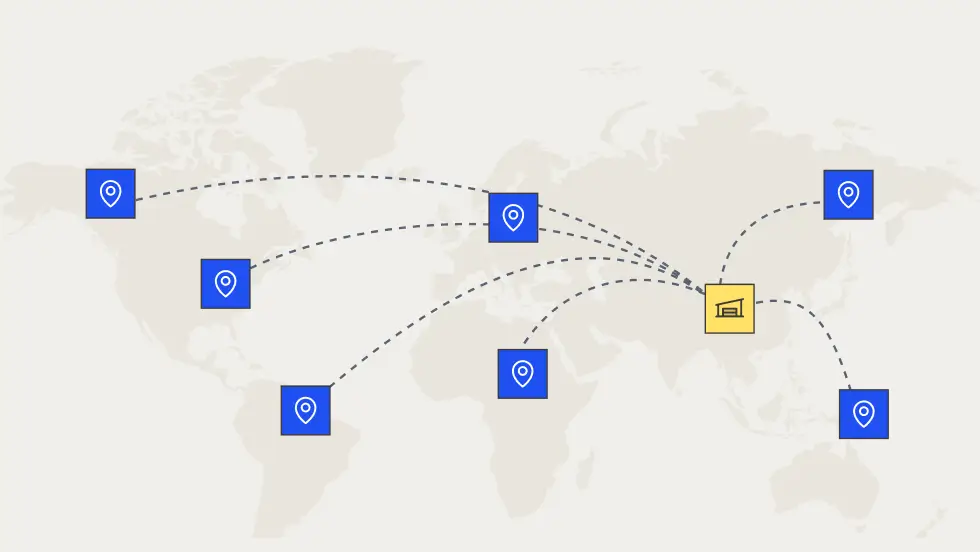
With direct fulfillment from manufacturing origin, packages enter the destination country's carrier network after customs clearance — not from a fixed warehouse address. That means a shipment to Miami and a shipment to Vancouver can use entirely different carriers and entirely different injection points, even when they leave the fulfillment center on the same day. You can read more about how this works inside our Shenzhen fulfillment operations.
Carrier choice becomes the optimization variable, not warehouse geography. You're no longer forced to pre-position inventory in five regional 3PLs to chase low zones. Inventory sits in one place, and the system routes each order through the most efficient last-mile carrier for its destination.
This also unlocks international markets that zone-based domestic models can't reach efficiently. Shipping to 85+ countries from a single origin removes the warehouse-per-region problem entirely. For brands expanding globally, this matters a lot — we covered the operational playbook in our guide to international Ecommerce expansion.
Stop optimizing for zones you don't need to pay
Shipping zones are a feature of the legacy domestic fulfillment model. If your business is built on a single 3PL shipping coast-to-coast, you're paying the zone tax on every far-zone order — and the only fixes are more warehouses or fewer customers.
Portless removes the constraint entirely. Inventory ships from manufacturing origin directly into the destination country's last-mile network, with dynamic carrier routing on every order. No zone premiums baked into your unit economics, no multi-node forecasting headaches, and a delivery window of five to eight days to 85+ countries.
If you want to see what your shipping costs look like without zone-based pricing, contact us and we'll walk through the numbers with you.
← Back to the Ecommerce supply chain glossary