Days sales outstanding (DSO)
Days sales outstanding (DSO) is the average number of days it takes a business to collect payment after a sale is made. A lower DSO means cash returns to your business faster, freeing working capital for inventory, marketing, and growth.
For most DTC brands, payment hits the account within minutes of checkout — so DSO feels like a B2B problem. It isn't. The moment you sell wholesale, ship through marketplaces with delayed payouts, offer net terms to retail partners, or operate across regions where payment processors hold funds for days, DSO becomes one of the most important numbers on your balance sheet. It's the second variable in the cash conversion cycle, sitting between how long your inventory sits unsold and how long you take to pay your suppliers. Get it wrong, and you're funding everyone else's growth with your own cash.
How to calculate days sales outstanding (DSO)
The standard DSO formula is:
DSO = (Accounts receivable ÷ Total credit sales) × Number of days in the period
A worked example: if you have $300,000 in accounts receivable, $1.2M in credit sales over a 90-day quarter, your DSO is:
($300,000 ÷ $1,200,000) × 90 = 22.5 days
That means, on average, it takes you 22.5 days to collect cash after a sale. According to Investopedia's breakdown of DSO, a DSO under 45 days is generally considered healthy, though the right benchmark depends heavily on your industry, customer mix, and payment terms.
Why DSO matters for Ecommerce brands
DSO is not just an accounting metric. It directly shapes how much cash you have available to reinvest in the business.
- It dictates working capital availability. Every day of DSO is a day your money is sitting in someone else's account instead of yours.
- It compounds with inventory cycles. If your inventory takes 90 days to sell and your DSO is 30 days, you've locked up cash for 120 days before seeing any of it back.
- It limits growth speed. High DSO means you can't reinvest revenue into the next production run, ad campaign, or market expansion as quickly.
- It exposes financing risk. Brands with high DSO often turn to credit lines or financing to bridge the gap — adding interest costs that eat into margin.
For a deeper look at how slow capital recovery damages DTC brands, read our breakdown on how to turn 2025 inventory into 2026 cash flow wins.
DSO vs. the cash conversion cycle
DSO is one of three components of the cash conversion cycle (CCC):
- Days inventory outstanding (DIO): how long inventory sits before it sells
- Days sales outstanding (DSO): how long it takes to collect cash after the sale
- Days payable outstanding (DPO): how long you take to pay your suppliers
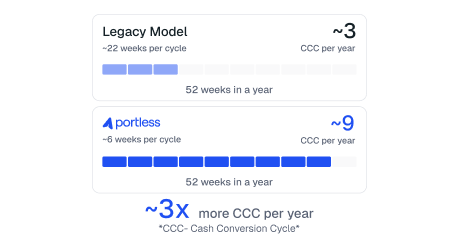
The formula: CCC = DIO + DSO – DPO
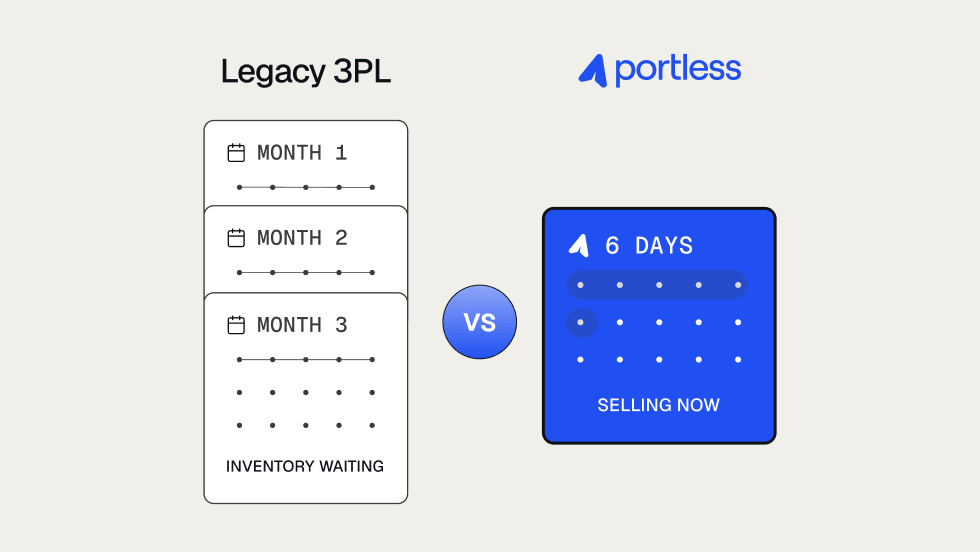
For most Ecommerce brands working under the legacy bulk-import model, DIO is the worst offender — inventory sits on water for 30 to 45 days, then in a 3PL for another 30 to 60. But DSO matters too, especially as brands diversify into wholesale, marketplaces with delayed payouts (Amazon, TikTok Shop), and international markets where payment processing windows stretch longer.
What drives high DSO in Ecommerce
A handful of structural factors push DSO up:
- Payment processor hold times. Stripe, PayPal, and Shopify Payments often hold funds for two to seven days, longer for international transactions or new accounts.
- Marketplace payout cycles. Amazon pays out every 14 days. TikTok Shop and other emerging channels can stretch to 30 days or more.
- Wholesale and retail accounts. Net 30, net 60, and net 90 terms are standard in retail — and a single large retailer can dominate your DSO calculation.
- International expansion. Cross-border payment flows add days to settlement, especially when currency conversion or local banking rails are involved.
- Disputes and chargebacks. Funds tied up in disputed transactions inflate accounts receivable until resolved.
How to lower your DSO
Reducing DSO is about shortening the gap between sale and cash:
- Tighten payment terms with wholesale accounts and enforce them
- Offer early-payment discounts to incentivize faster settlement
- Use payment processors with faster payout schedules where available
- Automate invoicing and collections so nothing slips through manual cracks
- Diversify across channels so a single slow-paying customer doesn't dominate AR
But here's the thing: lowering DSO from 30 to 20 days helps. Restructuring your supply chain so inventory itself converts to cash in days, not months, helps significantly more.
How Portless compresses the cash cycle that DSO is part of
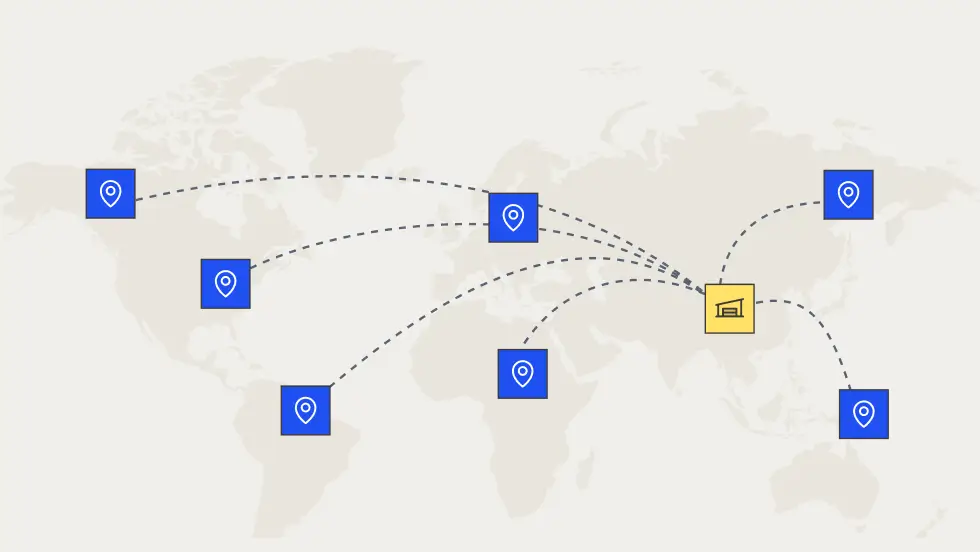
DSO is one piece of the cash conversion equation, but it's not the piece most DTC brands can move dramatically. The bigger lever is days inventory outstanding — and that's where the legacy model is broken. Bulk ocean freight and domestic 3PLs lock up your cash in inventory for 60 to 120 days before a single unit sells. With Portless's direct fulfillment from manufacturers in Asia, inventory becomes available to sell within days of production, and orders ship straight to customers in five to eight days. The result is a cash conversion cycle that compresses from 90+ days to under 30. Model your own cash cycle improvement with our direct fulfillment ROI calculator, or contact us to see how it works for your brand.
← Back to the Ecommerce supply chain glossary