Kitting and assembly
Kitting and assembly is the process of combining multiple individual items into a single, ready-to-ship unit — either by bundling separate SKUs into one package (kitting) or by physically constructing a finished product from components (assembly). Both happen before an order ships and turn loose inventory into something a customer can buy as one product.
Kitting and assembly sit between manufacturing and fulfillment. Kitting groups multiple finished items into a single SKU: a skincare set, a subscription box, a bundle of three colorways. Assembly is the physical work of building something from parts: snapping a base onto a device, threading a strap through a bag, packaging components that ship from different suppliers into one finished product.
For DTC brands, the difference matters because each model changes where the work happens, who pays for it, and how fast you can react to demand. Done at the factory, kitting and assembly is cheap and predictable but locks you into a fixed bundle months before the customer orders. Done at a domestic 3PL, it's flexible but slow and expensive. Done at the point of fulfillment in Asia — close to production — it's both flexible and fast.
Kitting vs. assembly: the operational difference
The two terms get used interchangeably, but they're distinct workflows with different cost structures and different failure modes.
Kitting is bundling. You take existing SKUs — already manufactured, already QC'd — and combine them into a new sellable unit. A four-pack of candles. A starter kit. A "build your own" set with three customer-selected items. The work is light: picking, grouping, repackaging, applying a new barcode. Most fulfillment centers can do basic kitting without specialized equipment.
Assembly is construction. Components arrive separately and become a finished product through physical work — fastening, gluing, programming, inserting batteries, applying labels. Assembly requires trained operators, tooling, and tighter quality control than kitting, because you're creating the product, not just repackaging it.
The practical test: if you broke the kit apart, would each item still be sellable? If yes, it's kitting. If no, it's assembly.
When brands use kitting and assembly
Kitting and assembly show up in five common scenarios for DTC brands:
- Bundling proven SKUs into a higher-AOV offer (skincare routines, gift sets, starter packs)
- Building subscription boxes with rotating contents that change monthly
- Combining a core product with promotional inserts, samples, or marketing collateral
- Assembling multi-component products where shipping parts separately would damage the unboxing experience
- Creating retail-ready packaging for wholesale channels that differs from the DTC SKU
Each use case has different timing requirements. A gift set sold year-round can be pre-kitted in bulk. A Mother's Day bundle that runs for three weeks shouldn't be — you'll be left with components configured for a promotion that's over.
Where kitting and assembly happens — and why it matters
The location of kitting and assembly is the lever most brands overlook. There are three options, each with real trade-offs.
At the factory
Cheapest per unit. Workers are already on-site, labor is integrated into the production line, and bundled units ship as a single SKU. The trade-off: you commit to the bundle months in advance. If the variant mix doesn't match demand, you're stuck with kits nobody wants and components you can't separate.
At a domestic 3PL
Most flexible for late-stage decisions, since kitting happens after inventory is already in-country. The trade-off: domestic kitting labor is expensive (often $1–$3 per kit in the US), 3PLs typically charge setup fees per SKU, and you've already paid duties, freight, and warehousing on every component sitting on the shelf. You're paying twice — once to import the parts, once to assemble them — and tying up cash on both ends.
At the point of fulfillment, near manufacturing
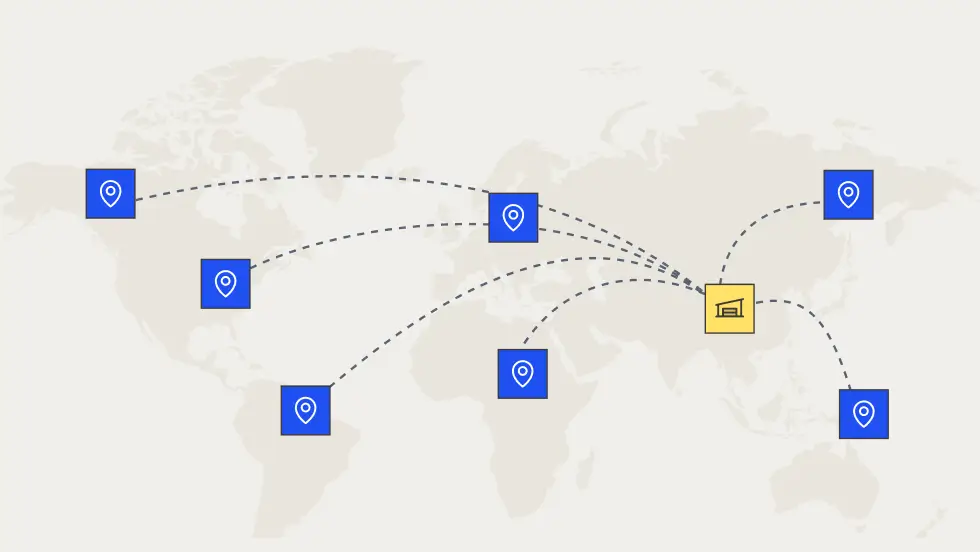
This is the model Portless uses. Kitting and assembly happen at our fulfillment center adjacent to the factory in Asia before the package enters the air freight network. You get the labor cost of overseas kitting with the flexibility of decisions made days before shipment, not months.
When a customer in one of 85+ countries Portless ships to places an order, the kit is built to spec and air-freighted directly. No domestic warehouse markup. No duties paid on unsold component inventory. No 30–45 days of dead stock sitting in a US 3PL.
The cash flow impact most brands miss
Kitting and assembly directly affect working capital — and the legacy model is brutal on cash flow.
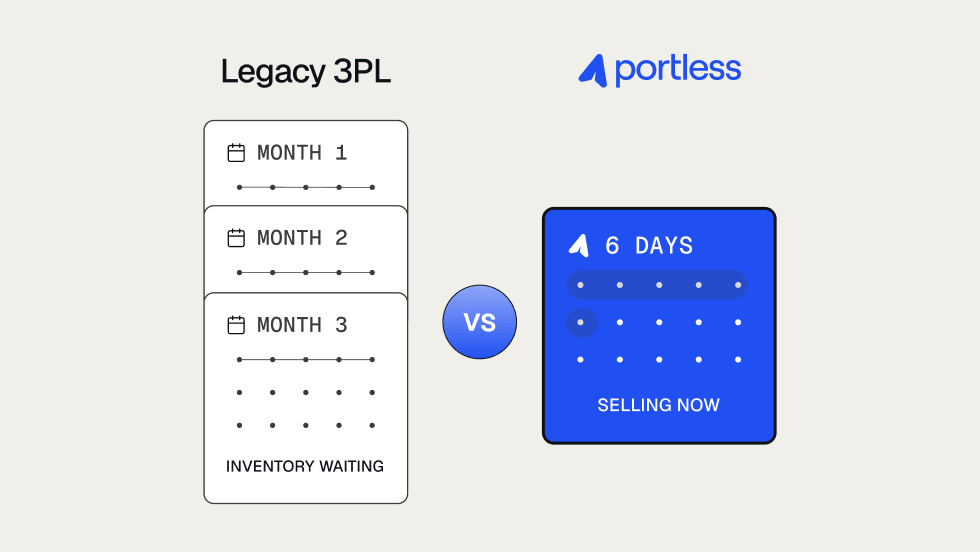
In the legacy 3PL setup, you pay your manufacturer for components, ship them by ocean (five to eight weeks), pay duties on every component as it lands, pay storage fees while they sit, then pay kitting fees again when an order comes in. By the time a customer pays for the bundle, you've held capital in those components for three to four months.
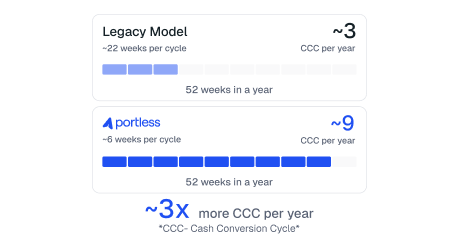
Direct fulfillment compresses this. Components are kitted at the point of production, sit in inventory for days instead of months, and ship directly to the customer. As Craft Club's founder Nikos Maniaty put it after switching to direct fulfillment: "Pretty much immediately, we saw a 3x in growth, corresponded to the 3x drop in our cash flow conversion cycle."
The math: every day a kitted unit sits in inventory before sale is a day of working capital you can't redeploy into ads, new SKUs, or international expansion.
Quality control in kitting and assembly
The closer kitting happens to manufacturing, the cheaper it is to fix mistakes. A wrong component caught at a factory-adjacent fulfillment center is a same-day swap. The same mistake caught at a US 3PL means shipping the defective inventory back — usually not economical — or eating the loss.
Effective kitting QC includes:
- Component verification at receiving, with every SKU scanned against the bill of materials
- Photo or video documentation of completed kits before sealing
- Random sampling on multi-component assemblies
- Weight checks at packing stations to flag missing components before the box leaves
Cameras at packing stations also matter for customer support. When a customer reports a missing item in a four-piece kit, you want footage of the actual pack, not a guess.
Cut the cost of kitting and assembly with direct fulfillment
Kitting and assembly are not back-office tasks — they directly shape your landed cost, your cash conversion cycle, and how quickly you can launch a new bundle. The legacy model of kitting at a domestic 3PL was built for a different era of Ecommerce, when speed-to-market wasn't the constraint and tariffs didn't change quarterly.
Portless handles kitting and assembly at the point of manufacture, so your bundles are built once, shipped directly, and never sit in expensive domestic storage. If you're running bundles, subscription boxes, or multi-component products and want to see what direct fulfillment does to your unit economics, contact us.
← Back to the Ecommerce supply chain glossary