VAT ecommerce
VAT ecommerce refers to the value-added tax obligations that apply to online sellers operating across international markets, including registration, collection, reporting, and remittance requirements that differ by country. For brands selling cross-border, VAT determines how much you charge at checkout, where you register, and how customs treats your shipments.
If you sell into the EU, UK, or other VAT jurisdictions, value-added tax is not optional and not a one-time setup. It's an ongoing compliance layer that touches your checkout, your customs documentation, your cash flow, and your customer experience. Get it wrong and you face held shipments, surprise fees on the customer's doorstep, retroactive tax bills, and lost conversion. Get it right and you ship faster, charge correctly, and keep margins intact.
This page covers what VAT ecommerce means in practice for DTC brands shipping internationally: the rules, the schemes (IOSS, OSS), the registration thresholds, and what's changing as governments close the loopholes that historically favored offshore sellers.
What is VAT in ecommerce
VAT (value-added tax) is a consumption tax charged at each stage of the supply chain, ultimately paid by the end consumer. Over 170 countries use some form of VAT, including all 27 EU member states, the UK, Norway, Australia, and Canada (as GST). Rates vary: the EU averages around 21%, with country rates ranging from 17% in Luxembourg to 27% in Hungary, according to the European Commission's VAT rules.
For ecommerce specifically, VAT applies to:
- Sales to consumers in a VAT jurisdiction, regardless of where the seller is based
- Imports of physical goods, charged at the border based on declared customs value
- Digital services and downloadable products sold to consumers abroad
The seller is generally responsible for collecting VAT at checkout and remitting it to the relevant tax authority. The buyer pays it as part of the purchase price.
How VAT works for cross-border ecommerce
When you ship a product from Asia, or the US to a customer in Germany, VAT enters the picture in one of two places: at the point of sale, or at the border.
At the point of sale (checkout): If you're registered under a scheme like the EU's Import One-Stop Shop (IOSS), you collect VAT from the customer at checkout and remit it through a single monthly return. The shipment clears customs without additional VAT charges, and the customer receives the package without surprise fees.
At the border: If you don't collect VAT upfront, the customer pays it on delivery, plus a handling fee from the carrier. This creates friction, refused deliveries, and chargebacks. It also makes your brand look unprofessional next to competitors who handle VAT cleanly.
Most EU countries calculate VAT on product value plus shipping plus duties, which means higher duty amounts indirectly increase the VAT owed. After the EU's de minimis exemption ends in 2026, this stacking effect will become more pronounced for brands shipping low-value parcels.
The EU VAT ecommerce package
The EU overhauled its VAT rules for ecommerce on July 1, 2021, eliminating the previous €22 import VAT exemption and introducing two key schemes designed to simplify compliance for cross-border sellers.
Import One-Stop Shop (IOSS)
IOSS applies to imports of goods valued at €150 or less sold to EU consumers. Sellers register in one EU member state, collect VAT at checkout based on the customer's country, and file a single monthly return covering all EU sales. The benefits:
- Customers pay VAT at checkout, not on delivery
- Shipments clear customs faster with an IOSS number on the declaration
- One registration covers all 27 EU member states
For brands shipping from Asia directly to EU consumers, IOSS is the standard mechanism for handling VAT cleanly.
One-Stop Shop (OSS)
OSS applies to intra-EU distance sales — for example, if you hold inventory in a German warehouse and ship to consumers across the EU. Like IOSS, it consolidates VAT reporting into a single return, but it covers goods already inside the EU rather than imports.
VAT registration thresholds
Whether you need to register for VAT depends on where you sell, how much you sell, and whether you hold inventory locally.
- EU: A single €10,000 EU-wide threshold for distance sellers. Above this, you must register for OSS or in each country individually
- UK: A £85,000 domestic threshold for UK-based businesses; non-UK sellers must register from the first sale
- Norway (VOEC): Non-Norwegian sellers must register and collect VAT on goods under NOK 3,000
- Australia (GST): Non-resident sellers must register if annual turnover to Australian consumers exceeds AUD 75,000
Thresholds change frequently. Always check the current rules with the relevant tax authority or a VAT specialist before launching in a new market.
VAT and the end of de minimis
For years, brands shipping low-value parcels into the EU benefited from a system where VAT was technically owed but rarely enforced on small packages. That ended in 2021 with IOSS. The next shoe to drop is the EU's de minimis exemption for duties, which the European Council voted to eliminate on November 13, 2025. The change begins rolling out in early 2026.
What this means for VAT:
- VAT obligations through IOSS or alternative schemes remain in place
- Every package will now also incur customs duties on top of VAT
- VAT is calculated on the duty-inclusive value, increasing the effective tax burden
- Documentation requirements tighten across the board
For a full breakdown of how these rules stack, read the EU de minimis changes and what your brand needs to know.
How VAT affects cash flow
VAT creates a structural cash flow gap that most operators underestimate. You collect VAT from customers at checkout, but you remit it to tax authorities on a fixed schedule — monthly or quarterly — regardless of whether you've actually been paid by your payment processor or whether the customer has returned the item.
The result: you're effectively financing the government with your own working capital between collection and remittance. According to the UK Chamber of Commerce, 35% of small businesses cite VAT timing as a major strain on cash flow.
Three mechanisms can ease the pressure:
- Cash accounting schemes: In the UK, businesses under £1.35 million turnover can pay VAT only when customers pay them
- Postponed VAT Accounting (PVA): Available in the UK, Netherlands, and others — pay and reclaim import VAT on the same return, eliminating the cash flow gap
- Monthly returns instead of quarterly: If you're consistently in a refund position (common for exporters), faster returns mean faster refunds
For a deeper dive, read leveraging your VAT number for improved cash flow.
Common VAT mistakes that cost brands money
- Declaring retail price instead of transaction value on customs paperwork, inflating the VAT base
- Failing to register for IOSS and pushing VAT collection to delivery, where customers refuse parcels
- Misclassifying products under the wrong HS code, leading to incorrect VAT rates
- Treating VAT as a one-time setup instead of an ongoing monthly compliance cycle
- Ignoring the interaction between duties and VAT — higher duties mean higher VAT
How Portless handles VAT for direct fulfillment
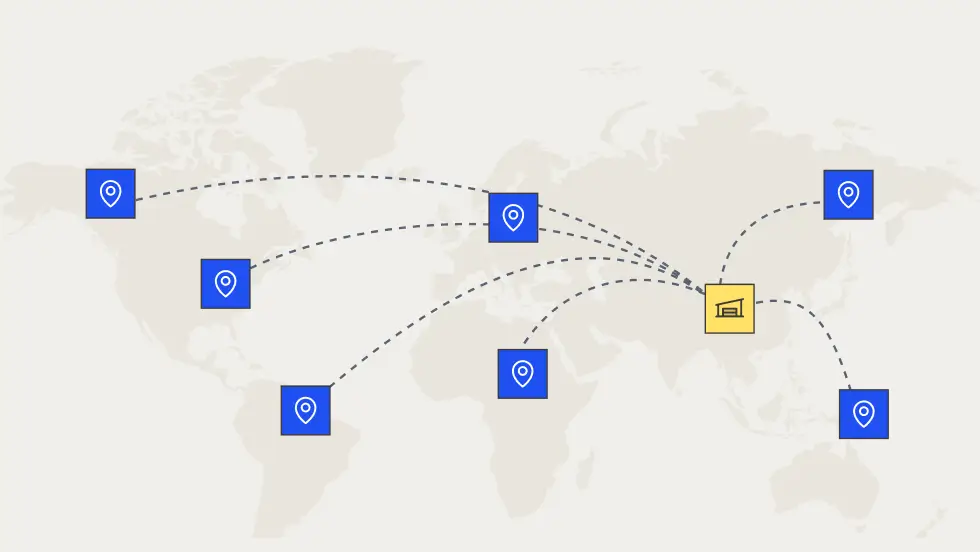
Portless ships directly from manufacturers in Asia to customers in 85+ countries, including every EU member state and the UK. We support IOSS-registered brands by handling the documentation, declarations, and DDP routing that keep shipments moving without customer-side surprises. VAT and duties are calculated and paid upfront, so the customer experience is domestic-level — no held parcels, no doorstep fees, no refused deliveries.
If you're navigating VAT, IOSS registration, or the EU de minimis changes and want to talk through how a direct fulfillment model fits, contact our team.
← Back to the Ecommerce supply chain glossary