Reorder point (ROP)
Reorder point (ROP) is the inventory level at which you place a new purchase order to replenish stock before you run out. It's calculated from your supplier lead time, average daily sales velocity, and safety stock buffer.
Reorder point (ROP) is the trigger that tells you when to reorder, not how much. It answers a specific question: at what unit count on the shelf should you fire off a new PO so that new inventory arrives before the current stock hits zero? The answer depends almost entirely on one variable most DTC brands underestimate — lead time. Long lead times push your reorder point higher, force you to carry more safety stock, and tie up working capital in inventory that's sitting on a boat. Short lead times do the opposite. That's why ROP isn't just an inventory formula. It's a reflection of how your supply chain is structured.
How to calculate reorder point (ROP)
The standard reorder point formula is:
ROP = (average daily sales × lead time in days) + safety stock
Three inputs, each one a lever:
- Average daily sales: units sold per day for the SKU, typically averaged over 30 to 90 days
- Lead time: total days from placing a PO to receiving usable inventory in your fulfillment node
- Safety stock: buffer units held to cover demand spikes or supplier delays
Example: you sell 50 units per day, your lead time is 60 days from a China factory through ocean freight to a US 3PL, and you hold 500 units of safety stock. Your ROP is (50 × 60) + 500 = 3,500 units. The moment you hit 3,500 units on hand, you place the next order.
Now compress that lead time. If the same product ships factory-direct in eight days instead of 60, your ROP drops to (50 × 8) + 500 = 900 units. That's 2,600 fewer units of working capital tied up in inventory at any given time — for the exact same sales velocity.
Why lead time is the variable that breaks legacy ROP math
Most reorder point calculators assume a static lead time. The legacy model — bulk ocean freight, container consolidation, port dwell, drayage, domestic warehouse intake — produces lead times of 45 to 90 days, and those numbers swing based on port congestion, supplier reliability, and seasonal freight rates.
When lead time is long and variable, you're forced to do two things:
- Raise your ROP to cover the longest plausible lead time
- Carry more safety stock to absorb demand variability over that longer window
Both decisions trap cash. According to IHL Group research, inventory distortion (overstocks plus stockouts) costs retailers roughly $1.7 trillion globally each year. A meaningful share of that comes from brands setting reorder points around supply chains that are slow by design.
Safety stock: the part of ROP most brands get wrong
Safety stock exists to protect against two kinds of variability — demand variability (a SKU goes viral) and supply variability (your factory misses a deadline or freight is delayed). The longer and less predictable your lead time, the more safety stock you need.
A common shortcut for safety stock:
Safety stock = (max daily sales × max lead time) − (average daily sales × average lead time)
If your average lead time is 60 days but your worst-case is 80 days, and your peak daily sales hit 80 units versus an average of 50, your safety stock calculation balloons. Compress lead time variability — by moving to direct fulfillment from the factory — and the safety stock number drops with it.
How ROP connects to cash flow
Every unit sitting above your reorder point is cash you've already spent. For a brand doing 1,000 to 15,000 orders per month, the difference between a 60-day ROP and an eight-day ROP is the difference between running on inventory financing and running on customer revenue.
This is where reorder point stops being a procurement tactic and becomes a financial strategy. A shorter ROP means:
- Less capital trapped in pre-shipped inventory
- Faster cash conversion cycles
- More frequent, smaller production runs tied to real demand
- Lower risk of deadstock from forecasting errors
A 2025 McKinsey analysis on working capital makes the broader point: most mid-market companies have substantial liquidity locked inside their inventory and supply chain timing. Reorder point math is one of the cleanest places to find it.
ROP in a direct fulfillment model
The legacy reorder point assumes inventory has to be pre-positioned in a domestic 3PL — which means committing capital to a forecast months before demand shows up. That assumption breaks down when you ship directly from the point of manufacture.
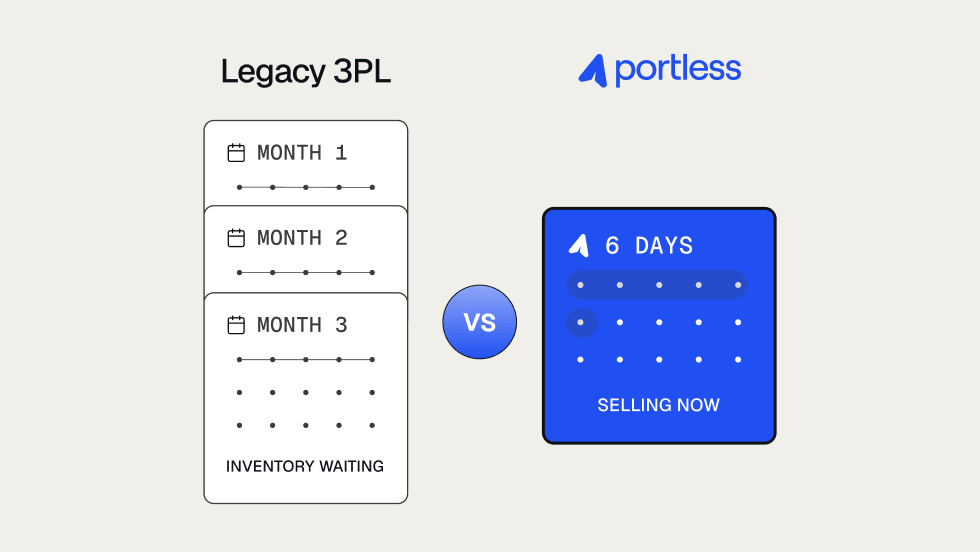
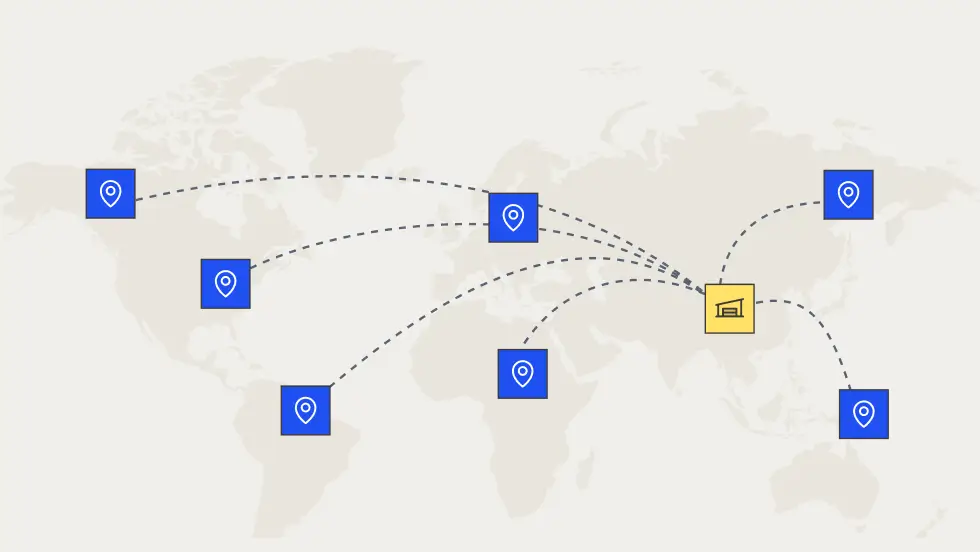
With Portless, your inventory stages near factories in Asia. Orders ship to customers in five to eight days. Your effective lead time on replenishment drops from 60-plus days to under 10 for many SKUs. That changes the ROP equation at every input:
- Lead time shrinks by up to 90%
- Safety stock requirements fall because lead time variability narrows
- Reorder cycles become weekly instead of quarterly
- You commit cash to inventory only after demand is real, not before
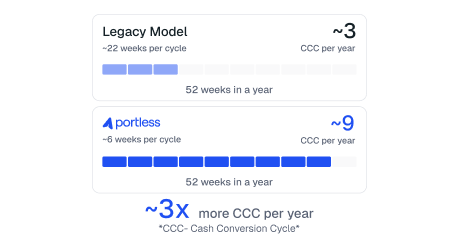
Craft Club, one of our customers, cut their cash conversion cycle by 3x after moving to this model — largely because their reorder point math no longer required them to pre-fund three months of inventory.
Reset your reorder point around a shorter supply chain
Reorder point is only as smart as the supply chain it's calculated against. If your lead time is structurally long, no formula will save you from carrying too much inventory. The fix is upstream — compress the lead time, and the ROP corrects itself.
If you want to see what your reorder point looks like with direct fulfillment, contact us and we'll walk through your numbers.
← Back to the Ecommerce supply chain glossary