Order management system (OMS)
An OMS sits between your storefront and your fulfillment operation. It captures every order placed across your channels, routes it to the right inventory location, hands it off to the right carrier, and keeps the customer updated through delivery and any returns. Without one, you're stitching together spreadsheets, Shopify exports, 3PL portals, and email threads — which works at 100 orders a month and breaks at 10,000.
For DTC brands manufacturing in Asia and selling globally, the OMS is the nervous system that connects sales demand to the supply chain. It decides which warehouse, fulfillment center, or direct fulfillment node ships which order, based on inventory, customer location, and shipping cost. Get this wrong and you ship from the wrong place, miss promised delivery windows, or oversell SKUs that aren't actually in stock.
What an order management system actually does
An OMS handles four core jobs across the order lifecycle:
- Order capture and consolidation. Pulls orders from Shopify, Amazon, WooCommerce, wholesale EDI, marketplaces, and any other sales channel into one queue.
- Inventory visibility. Tracks stock levels across every fulfillment node in real time, so you stop overselling.
- Order routing. Decides where each order ships from based on rules you set — closest warehouse, lowest shipping cost, available stock, or specific SKU location.
- Status and tracking. Pushes updates to the customer, your support team, and your finance system as the order moves from picked to packed to delivered.
The more channels and fulfillment locations you operate, the more an OMS earns its keep. A single-channel brand shipping from one 3PL can usually live inside Shopify alone. A brand selling on three marketplaces, running a DTC site, and fulfilling from two countries cannot.
Why an OMS matters more as you scale internationally
Selling into 10+ countries from a single domestic warehouse is one thing. Selling into 85+ countries with inventory positioned at the point of manufacture is another. The OMS is what makes that complexity legible.
When you expand internationally, the variables multiply: duty rules per country, carrier handoffs, currency, tax registration (like IOSS for EU shipments or UK VAT for British orders), and customer expectations on delivery speed. An OMS configured for cross-border commerce knows which routing rule to apply, which carrier to use, and which compliance data to attach to each shipment automatically.
This is also where the OMS connects to your landed cost calculation. If your routing logic doesn't account for duties, taxes, and freight per destination, you'll route orders to the wrong node and erode margin on every shipment.
OMS vs. ERP vs. WMS: what's the difference
These three systems get confused constantly. They overlap, but they solve different problems:
- OMS (Order Management System): orchestrates the order from purchase to delivery across channels.
- WMS (Warehouse Management System): runs the physical operation inside a warehouse — receiving, putaway, pick, pack, ship.
- ERP (Enterprise Resource Planning): the financial and operational system of record — accounting, procurement, HR, sometimes inventory.
A growing brand often starts with Shopify handling order capture, a 3PL's WMS handling fulfillment, and QuickBooks or NetSuite acting as the ERP. The OMS layer becomes necessary when those systems stop talking to each other cleanly — usually around the time you add a second sales channel, a second fulfillment node, or international shipping.
Key features to look for in an OMS
Not every OMS is built for DTC Ecommerce. Some are enterprise retail tools that assume you're running stores and a 3PL contract that doesn't change for five years. Others are lightweight tools that crack under wholesale EDI volume. For a brand doing 1,000–15,000 orders a month, the features that actually matter:
- Multi-channel order ingestion from Shopify, Amazon, WooCommerce, TikTok Shop, and major marketplaces
- Real-time inventory sync across every fulfillment node, including overseas
- Rules-based order routing with overrides for SKU, region, and shipping method
- Carrier integration with the actual carriers you use, not just FedEx and UPS
- Returns management that connects to your reverse logistics workflow
- Reporting on fulfillment SLA, stockout rate, and shipping cost per order
- API access so you can connect custom tools without paying for a six-month integration project
How an OMS supports direct fulfillment from manufacturers
The legacy model assumes inventory lives in a domestic warehouse, gets picked by a 3PL, and ships from there. That's the model most OMS platforms were built around.
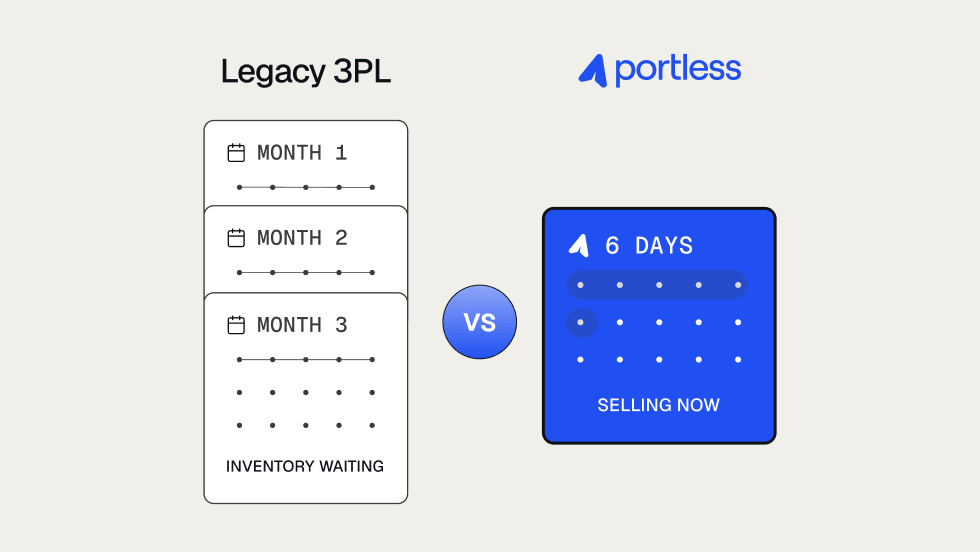
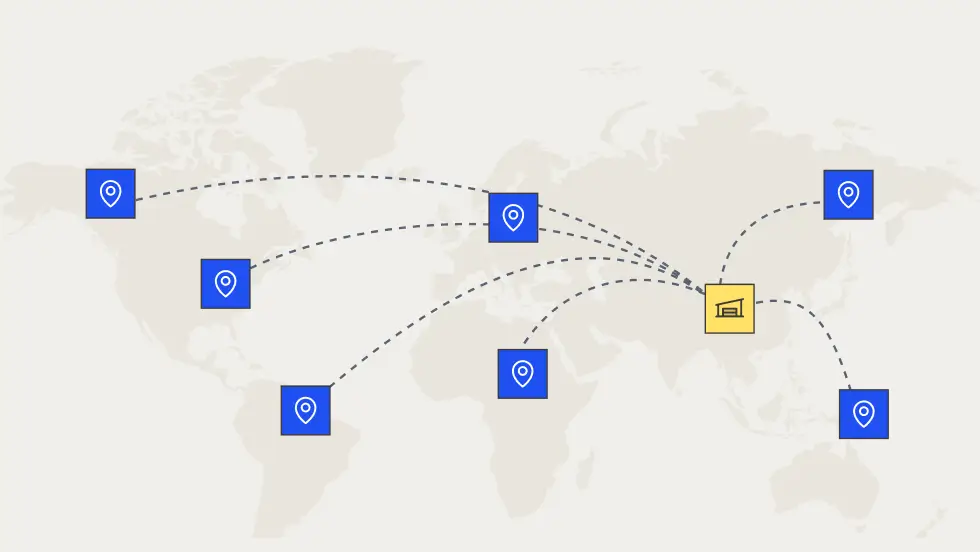
Direct fulfillment from the point of manufacture inverts that assumption. Inventory becomes available for sale days after production, not weeks after it clears a U.S. port. Orders route to a fulfillment node in Asia, ship via air injection into the destination country's carrier network, and land at the customer's door in five to eight days with duties handled via DDP shipping.
An OMS that supports this model needs to treat the manufacturing-adjacent fulfillment center as a first-class node — not as a workaround. That means accurate inventory counts the moment goods come off the line, routing rules that account for international transit and duties, and tracking integration that gives the customer a domestic-level experience even though the package originates overseas.
How Portless plugs into your existing OMS
Portless integrates with Shopify, WooCommerce, and the major Ecommerce platforms most brands already use as their order management layer. Orders flow from your storefront to our fulfillment centers in Asia, ship directly to customers in 85+ countries, and clear customs via DDP — without you swapping out your existing systems. If your OMS can route an order, we can fulfill it. Contact us to see how it works with your stack.
← Back to the Ecommerce supply chain glossary