Merchant of record (MOR)
A merchant of record (MOR) is the legal entity that sells a product to the end customer and takes on the financial, tax, and compliance liability for that transaction. The MOR processes the payment, collects and remits sales tax or VAT, manages chargebacks, and is the name the customer sees on their bank statement.
If you're selling cross-border, the question of who is legally on the hook for each transaction matters more than most operators realize. The merchant of record is the entity that the credit card networks, tax authorities, and consumer protection regulators hold accountable for a sale. That means tax remittance, fraud liability, chargeback disputes, and PCI compliance all flow through the MOR — not necessarily the brand whose logo is on the box.
For DTC brands shipping internationally, the MOR decision shapes how much regulatory complexity sits on your team versus a third party. It also affects how clean your expansion into new markets actually is.
What a merchant of record is responsible for
The MOR sits between you and the customer as the legal seller of record. That role carries a specific set of obligations:
- Processing payments and maintaining relationships with card networks like Visa, Mastercard, and Amex
- Collecting and remitting sales tax, VAT, GST, and other consumption taxes in each jurisdiction where sales occur
- Handling chargebacks, refunds, and fraud disputes with issuing banks
- Maintaining PCI DSS compliance for cardholder data
- Appearing as the seller on the customer's bank statement and receipt
- Complying with consumer protection laws in the buyer's country
When a brand acts as its own MOR, all of this lives in-house. When a third party serves as the MOR, that party assumes the liability in exchange for a fee — typically a percentage of each transaction.
MOR vs. payment processor vs. importer of record
These three roles get conflated, but they're distinct.
A payment processor (Stripe, Adyen, Braintree) moves money from the customer's card to your bank account. They don't take on tax liability. You're still the seller.
A merchant of record is the legal seller. They handle the payment relationship and the tax compliance that comes with each sale.
An importer of record (IOR) is the entity legally responsible for goods entering a country — paying duties, filing customs entries, and ensuring the shipment complies with import regulations. The IOR is a customs concept. The MOR is a commerce and tax concept.
You can be your own MOR while using a third-party IOR, or vice versa. They're separate decisions with separate implications. For a deeper read on how customs valuation interacts with the importer relationship, see the U.S. Customs and Border Protection guidance on importer responsibilities.
When brands use a third-party MOR
A third-party MOR makes sense when the cost of compliance outweighs the cost of the fee. Common triggers:
- Selling into multiple countries with different VAT or GST registration thresholds
- Lacking in-house tax and legal capacity to register and file in each jurisdiction
- Wanting to launch in a new market in days rather than months
- Selling digital goods or subscriptions, where MOR services first became standard
For physical goods DTC brands, most operators selling primarily into the US act as their own MOR because the tax landscape is manageable with software like Avalara or TaxJar. The calculus changes when you start adding the EU, UK, Australia, and other regions with their own VAT regimes and registration rules.
The cost trade-off
Third-party MOR fees typically run 4–8% of transaction value, often inclusive of payment processing. That's a meaningful chunk of margin for a physical goods brand running on 60–70% gross margin.
The trade-off is real:
- As your own MOR: lower per-transaction cost, but you absorb registration costs, filing burden, audit risk, and chargeback exposure in every market you enter
- Using a third-party MOR: higher per-transaction cost, but compliance, tax remittance, and fraud liability move off your team
Most DTC physical goods brands at $1–15M find the math works against a third-party MOR for their primary market and may opt into one only for harder-to-enter regions.
How MOR fits into a cross-border DTC supply chain
The MOR question often gets confused with logistics questions, but they sit in separate parts of the stack. Your MOR governs the commercial transaction. Your fulfillment model governs how the product physically reaches the customer.
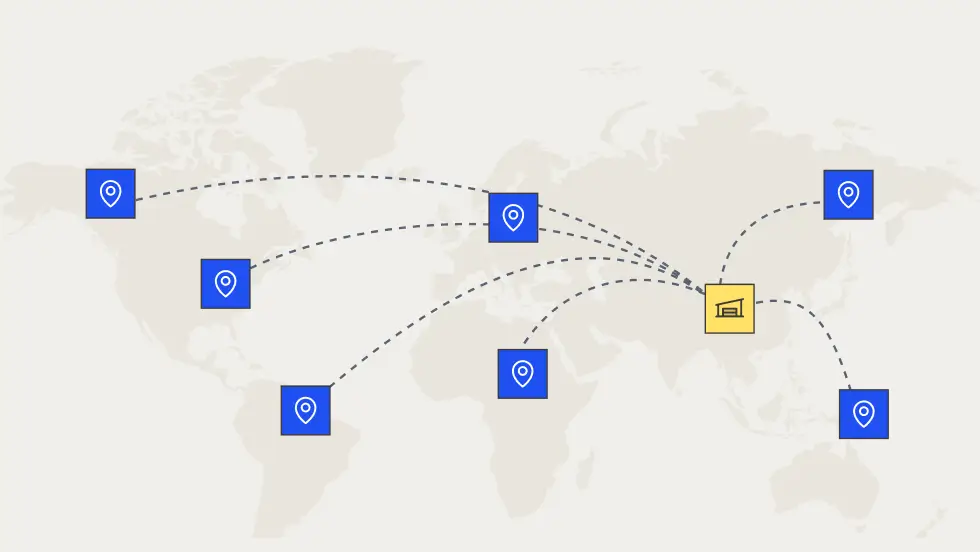
A brand using direct fulfillment from Asia still needs to decide who acts as MOR. Portless handles the physical movement and customs side — including delivered duty paid (DDP) and importer of record responsibilities for inbound shipments — while the brand or a third party handles the MOR role on the commercial side.
This separation matters when you expand internationally. You can ship to 85+ countries through a direct fulfillment model while choosing market-by-market whether to act as your own MOR or layer in a third-party service for tax-heavy regions.
Why this matters for international expansion
Brands that try to expand into the EU or UK without understanding the MOR question often hit one of two walls: surprise tax bills from missed VAT registration, or surprise margin compression from defaulting to a third-party MOR they didn't need.
The cleaner approach is to map MOR strategy market by market:
- For the US, most DTC brands act as their own MOR and handle sales tax with software
- For the EU, you can register for IOSS and act as your own MOR, or use a third party that handles IOSS registration and VAT remittance
- For the UK, the UK VAT £135 threshold requires registration regardless, which many brands handle directly
- For smaller markets, a third-party MOR can be the fastest path to launch without standing up local compliance
The right answer depends on volume per market and how much regulatory work your team can absorb.
How Portless fits into your merchant of record strategy
Portless doesn't act as your MOR — that's a commercial and tax decision that stays with you or a tax-focused partner. What Portless does is remove the logistics complexity that makes cross-border MOR decisions harder than they need to be. By shipping direct from manufacturers in Asia with DDP handling baked in, you get a clean logistics layer underneath whatever MOR structure you choose. Contact us to see how direct fulfillment fits into your international expansion plan.
← Back to the Ecommerce supply chain glossary