Monthly order volume (MOV)
Monthly order volume (MOV) is the total number of customer orders an Ecommerce brand fulfills in a calendar month. It's a core operational metric that drives 3PL pricing tiers, warehouse staffing, carrier rate negotiations, and inventory planning decisions.
Monthly order volume (MOV) sounds straightforward, but it shapes almost every fulfillment decision you make. The number of orders you ship each month determines which 3PLs will work with you, what carrier rates you can negotiate, how much safety stock you need, and how much working capital sits trapped in inventory at any given moment. For DTC brands in the 1,000 to 15,000 orders per month range, MOV is the single number that defines your operational tier — and the one that legacy 3PLs use to price you into a corner.
This page breaks down how MOV is calculated, why it matters for cash flow and margin, and how the metric behaves differently under direct fulfillment versus legacy 3PL models.
How to calculate monthly order volume
The calculation is simple: count the total number of customer orders fulfilled in a given calendar month. That includes split shipments as one order, returns as separate transactions, and excludes canceled orders that never shipped.
Most brands pull MOV directly from Shopify, WooCommerce, or their order management system. The number itself is easy. What's harder is understanding what it tells you about the business.
A brand doing 5,000 orders a month with a $40 average order value is operating at a different scale than one doing 5,000 orders at $120 AOV — even though MOV is identical. That's why MOV is most useful paired with average order value (AOV) and contribution margin, not viewed in isolation.
Why MOV matters to 3PLs and carriers
3PLs price in tiers. Below 1,000 orders a month, you're typically paying retail rates with minimum monthly fees that crush unit economics. Between 1,000 and 5,000 orders, you start unlocking better pick-and-pack pricing. Above 10,000, you have real leverage on storage rates, carrier discounts, and SLA terms.
Carriers operate on similar logic. USPS, UPS, and FedEx rate cards are volume-tiered. The more packages you hand them per month, the lower your effective per-package cost — which is why brands obsess over MOV growth as a margin lever, not just a revenue signal.
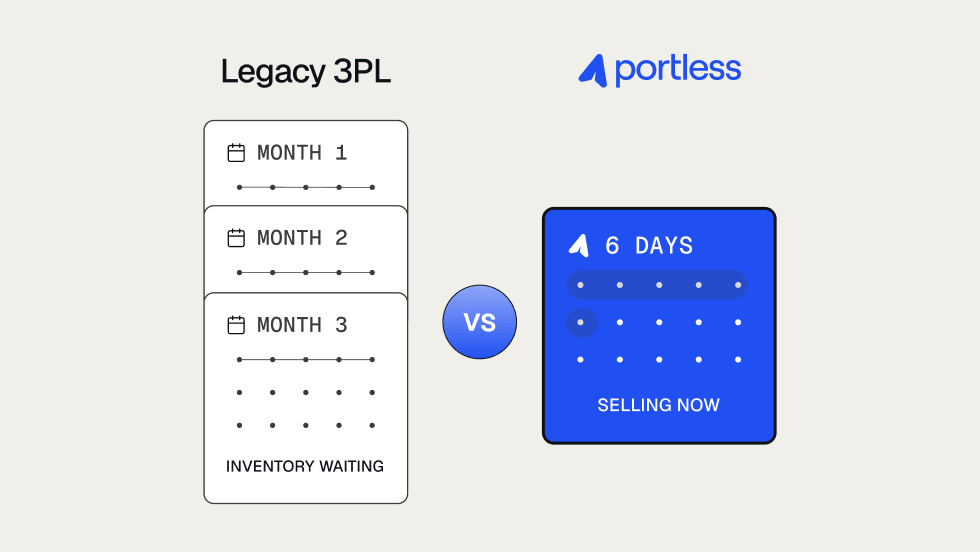
The problem: hitting those volume tiers usually requires committing to bulk inventory cycles that lock up cash for 60 to 90 days before you see a single order ship. Most brands trade cash flow for unit economics without realizing it.
How MOV connects to cash flow
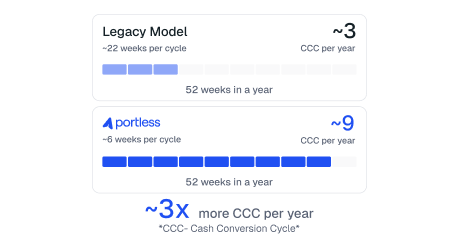
MOV is the denominator for almost every unit economic calculation that matters: cost per order, contribution margin per order, cash conversion cycle, and CAC payback period.
Here's where the legacy model breaks. A brand doing 8,000 orders a month under a traditional 3PL setup has to forecast that volume months in advance, order container-scale inventory, pay duties upfront, wait 30 to 60 days for ocean freight, and then sit on stock until orders trickle in. Capital is locked up against projected MOV, not actual MOV.
If demand misses by 20%, you're stuck with dead stock. If demand exceeds forecast, you stock out and lose the orders that would have grown MOV in the first place. The model punishes you in both directions.
How direct fulfillment changes the MOV equation
Direct fulfillment from the point of manufacture changes how MOV interacts with your balance sheet. Instead of forecasting three months ahead and pre-positioning inventory in a domestic warehouse, you produce and ship in smaller cycles tied to actual demand.
Brands using Portless typically see their cash conversion cycle compress from 79 days to around 26 days. That means $200,000 in working capital that turned four times a year under a legacy model can turn 14 times a year — supporting $2.8M in throughput instead of $800,000. MOV growth stops requiring proportional cash commitment.
Craft Club is a clear example. By moving inventory upstream and replenishing in smaller, more frequent cycles, they tripled growth while cutting their cash conversion cycle by 3x. Their MOV scaled without the typical capital lock-up.
MOV thresholds that change how you operate
Different MOV bands trigger different operational realities:
- Under 1,000 orders/month: You're paying retail carrier rates and likely getting squeezed by 3PL minimums. Focus on product-market fit, not warehouse optimization.
- 1,000–5,000 orders/month: Carrier negotiation starts to matter. You have enough volume to unlock 3PL pricing tiers but not enough to absorb a bad inventory bet.
- 5,000–15,000 orders/month: International expansion becomes viable. Cash flow management is the constraint, not demand. This is where direct fulfillment delivers the largest margin and working capital impact.
- 15,000+ orders/month:Multi-node fulfillment, advanced demand forecasting, and carrier diversification become required, not optional.
The brands that scale efficiently through these tiers are the ones that decouple MOV growth from capital lock-up. The legacy model forces you to fund growth out of cash reserves. Direct fulfillment lets growth fund itself.
How Portless makes MOV growth less expensive
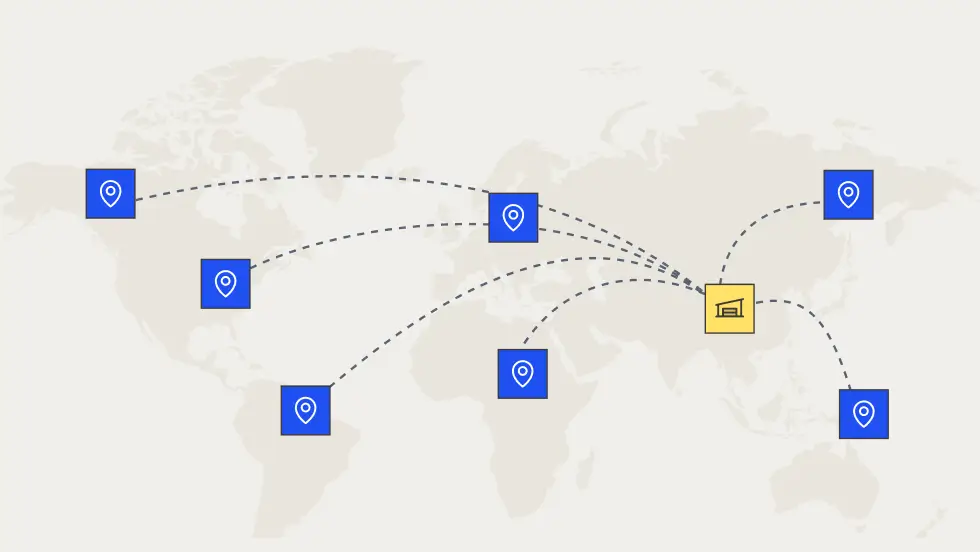
MOV is the number every Ecommerce operator watches, but it's also the number the legacy 3PL model uses against you. Higher MOV under a bulk inventory cycle means more cash trapped in warehouses, more forecasting risk, and more dead stock exposure. Portless flips that equation by shipping directly from your manufacturer in Asia to customers in 85+ countries — inventory becomes available for sale within days of production, not months. Contact us to see how your current MOV would perform under direct fulfillment.
← Back to the Ecommerce supply chain glossary