CAC payback period
CAC payback period is the number of months it takes a DTC brand to recover the cost of acquiring a customer through the gross profit that customer generates. The shorter the period, the faster you can reinvest in growth.
CAC payback period is one of the most honest numbers on a DTC P&L. It tells you exactly how long your cash is tied up between paying to acquire a customer and earning that money back. If your CAC payback is 14 months but your supply chain locks up cash for 90 days before a single order ships, you're not running a growth business — you're running a working capital problem with a storefront attached.
For Ecommerce brands manufacturing in Asia, CAC payback isn't just a marketing metric. It's downstream of every supply chain decision you make: how much inventory you pre-buy, how long it sits on the water, how much duty you pay upfront, and how quickly orders convert into cash.
How to calculate CAC payback period
The standard formula is:
CAC ÷ (average gross profit per customer per month) = CAC payback period in months
For a subscription or repeat-purchase brand, you'd divide CAC by monthly gross profit per customer. For a one-time purchase DTC brand, the calculation is simpler: CAC ÷ gross profit per order. If your CAC is $40 and your gross profit per order is $20, your payback is two orders — and if customers buy once, payback equals one purchase cycle.
A worked example: a beauty brand spends $50 to acquire a customer. The customer's first order generates $80 in revenue at a 50% gross margin, or $40 in gross profit. CAC payback is $50 ÷ $40 = 1.25 orders. If that customer reorders every two months, payback lands at roughly 2.5 months.
The number you use for gross profit matters. Use contribution margin — revenue minus COGS, shipping, pick-and-pack, and payment processing — not just gross margin. That's the dollar amount actually available to repay acquisition spend.
Why CAC payback period matters for DTC brands
CAC payback determines how fast you can recycle cash into the next acquisition cycle. A 12-month payback means every dollar you spend on ads is locked up for a year before it funds the next dollar. A three-month payback means you can compound four times faster on the same working capital base.
For DTC brands doing $1–15M in revenue, this is often the difference between growth and stagnation. According to OpenView's SaaS benchmarks, top-performing companies aim for CAC payback under 12 months. For Ecommerce, the benchmark is tighter — most healthy DTC brands target payback within the first or second order.
The brands that fail between $10M and $50M usually aren't losing on CAC. They're losing on the gap between when they pay (suppliers, freight, duties, ad platforms) and when they collect. We covered this dynamic in detail in the cost of waiting and how decision latency drains DTC margins.
What a healthy CAC payback period looks like
Benchmarks vary by category, but useful reference points for DTC:
- Under one order: best-in-class, typical for high-margin beauty and supplements
- One to two orders: healthy for most apparel and home goods brands
- Three or more orders: dependent on strong repeat purchase behavior
- 12+ months: structurally fragile unless backed by predictable subscription revenue
The right target depends on gross margin, repeat rate, and how much cash your supply chain ties up before the first sale. A brand with 70% gross margin and a 26-day cash conversion cycle can absorb a higher CAC than a brand with 40% margin and a 90-day cycle, even if their payback periods look identical on paper.
How supply chain decisions affect CAC payback
This is where most CAC payback analyses go wrong. They treat acquisition as a marketing problem and ignore the operational drag that makes payback worse than it needs to be.
Inventory carrying cost extends your real payback. When you pre-buy six months of inventory and ship it by ocean freight, the cash you spent to acquire that customer is competing with cash locked in unsold stock. The longer inventory sits, the longer your effective payback.
Tied-up duties inflate landed cost. Brands paying duties upfront on bulk shipments are funding the government before they fund their next ad spend. A DDP shipping model that pays duties per order — only on what actually sells — frees that capital.
Slow fulfillment delays revenue recognition. If a customer orders today and the product takes 14 days to deliver, you've waited 14 days to bank revenue against the ad spend. Compress that to five to eight days and you compress payback proportionally.
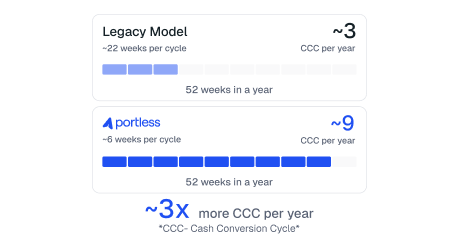
Portless customers see inventory turn 14 times per year versus four times in the legacy ocean-and-3PL model. That's a 3.5x improvement in cash velocity, which directly shortens the time it takes to recover acquisition spend.
How to shorten CAC payback period
Three levers, in order of impact for most DTC brands:
- Increase contribution margin per order. Higher AOV, better landed cost, lower fulfillment cost per unit. Cutting landed cost by 15% on a $40 order moves $6 directly into payback math.
- Improve repeat purchase rate. Doubling repeat rate within 90 days cuts payback in half for brands above a single-order threshold.
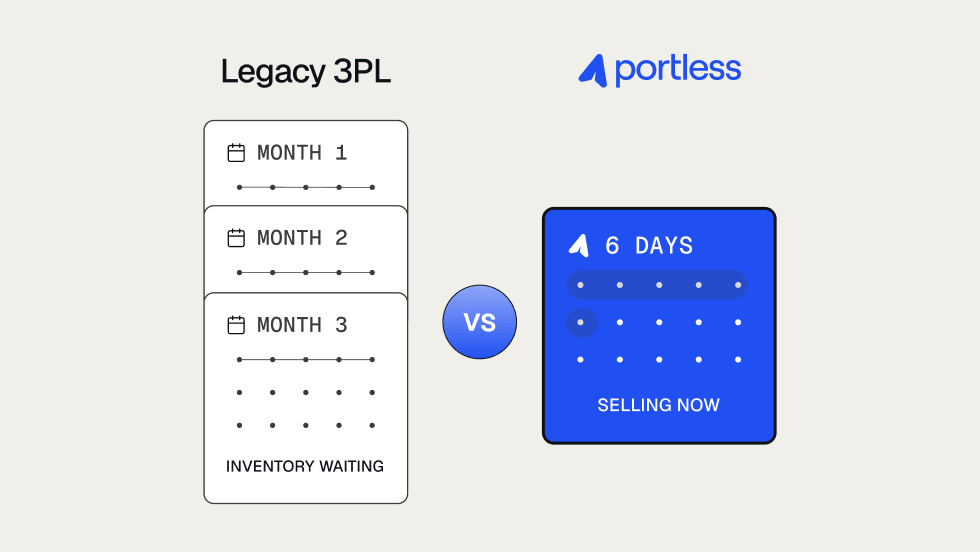
- Compress your cash conversion cycle. Faster supply chain means faster reinvestment. Direct fulfillment compresses the production-to-cash cycle from 79 days to 26 days, which structurally reduces working capital required to fund the same level of acquisition.
The third lever is the one most brands ignore because it sits outside the marketing org. But it's also the one with the biggest compounding effect.
Shorten your CAC payback by fixing what's upstream of it
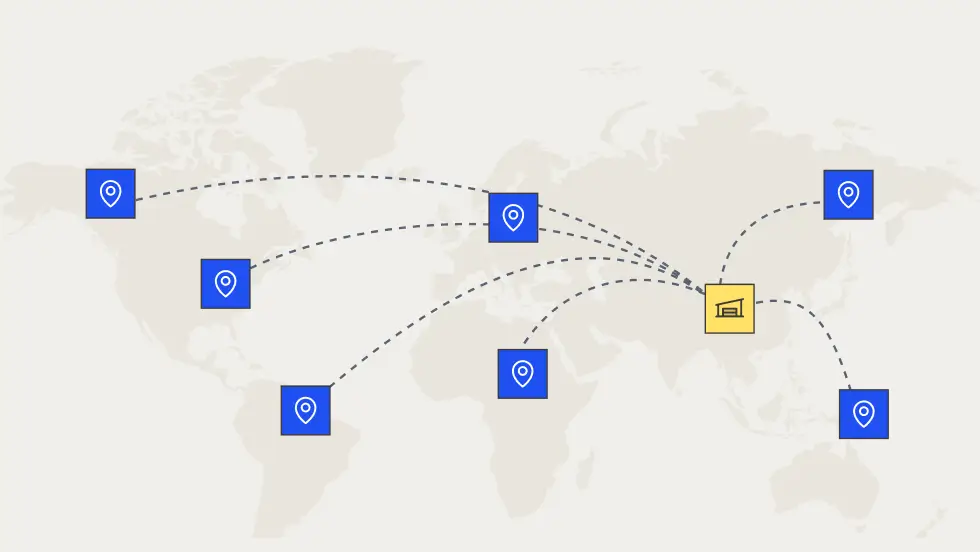
CAC payback is a marketing metric with supply chain inputs. You can squeeze CPMs and optimize creative all day, but if your cash is locked up in ocean containers and bulk duty payments, your payback period will always be longer than your competitors who've moved to direct fulfillment. Portless ships orders directly from manufacturers in Asia to customers in 85+ countries in five to eight days, which means revenue lands faster, inventory turns more frequently, and the cash you spent on acquisition comes back sooner.
Contact us to see how direct fulfillment shortens your cash cycle — and your CAC payback with it.
← Back to the Ecommerce supply chain glossary