Non-bonded warehouse
A non-bonded warehouse is a standard storage facility where goods are held after all applicable customs duties, taxes, and VAT have already been paid. Unlike bonded warehouses, non-bonded facilities don't operate under customs supervision, so inventory can move freely into domestic commerce without deferred-duty restrictions.
For Ecommerce brands shipping cross-border, the non-bonded vs bonded warehouse decision shows up in two places: your cost of goods, and your operational flexibility. A non-bonded warehouse is the default model — a regular facility where goods sit after they've cleared customs and any owed duties or VAT have been settled. There's no government oversight on inventory movements, no time limits tied to customs status, and no special documentation required to ship orders out.
That simplicity is the trade-off. You lose the duty-deferral benefits of bonded storage, but you gain cheaper operations, more shipping flexibility, and faster fulfillment cycles. For most DTC brands shipping from China, the math favors non-bonded — and understanding why starts with how the model works.
How a non-bonded warehouse works
Goods enter a non-bonded warehouse after duties, taxes, and VAT have already been paid (or, in the case of goods sourced in China, after they've been classified as part of the local market rather than as exports). Once inside, inventory is treated like any other commercial product:
- Stored without customs supervision or filing requirements
- Moved, repackaged, or kitted without triggering customs events
- Shipped domestically or internationally without restrictions tied to bonded status
- Subject only to standard commercial regulations, not duty-suspension rules
This is what makes non-bonded the simpler operational model. There's no clock running on how long inventory can stay. There's no paperwork required every time a unit ships out. And there's no requirement to route shipments through specific customs-approved channels.
Non-bonded vs bonded warehouse: the key differences
The two warehouse types solve different problems. Bonded facilities defer duty and VAT payments until goods leave the facility, which helps with cash flow on high-value or slow-moving inventory. Non-bonded facilities skip that mechanism entirely — duties are already paid, so there's no deferral, but also no complexity.
::table
Feature;Non-bonded warehouse;Bonded warehouse
Duty/VAT status;Already paid;Deferred until goods leave
Customs supervision;None;Required
Storage duration;No customs-related limits;Time limits vary by jurisdiction
Operational complexity;Lower;Higher
Shipping flexibility;Any route, any carrier;Often restricted (e.g., Hong Kong routing for bonded goods in China)
Storage costs;Standard rates;Typically 40–60% higher
Best for;Low-to-mid COG products, fast-moving inventory;High-COG products, long-hold inventory
:table
For brands manufacturing in China specifically, the bonded vs non-bonded warehouse decision comes down to whether the 13% VAT savings from bonded storage outweigh the higher logistics costs. For most DTC brands shipping low-to-mid COG products, it doesn't.
When non-bonded warehousing makes sense
Non-bonded is the right choice when speed, flexibility, and lower operating costs matter more than duty deferral. Specific scenarios where non-bonded wins:
- Your products have a cost of goods below ~$40–50, where logistics savings outweigh VAT benefits
- You ship internationally from multiple airports and don't want to be locked into customs-restricted routing
- Your inventory turns quickly, so duty deferral wouldn't save you much working capital anyway
- You run time-sensitive campaigns, flash sales, or new product launches that need rapid fulfillment
- Your factory doesn't require export documentation to release goods
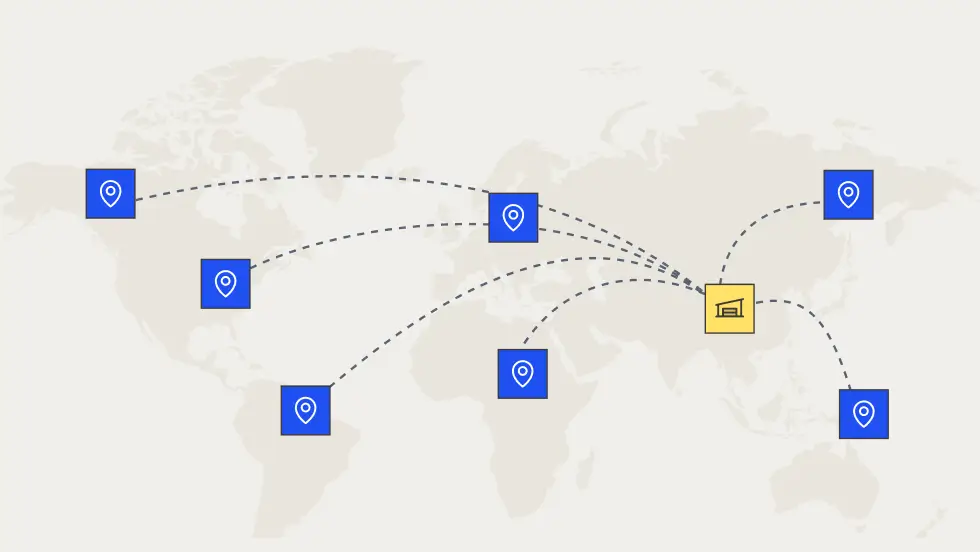
For DTC brands using direct fulfillment from China, non-bonded facilities can ship from any mainland China airport rather than routing exclusively through Hong Kong. According to China's standard VAT framework documented by PwC, the 13% VAT applies to most manufactured goods — but the logistics premium on bonded storage typically exceeds that saving for lightweight, fast-moving Ecommerce products.
When non-bonded is the wrong choice
There are cases where bonded makes more sense:
- High-COG products where the 13% VAT savings exceed the bonded logistics premium
- Seasonal inventory you need to hold for months before selling
- Factories that strictly require export documentation to release goods
- Products with regulatory requirements that mandate bonded storage in destination markets
If you're holding inventory for six months while waiting on seasonal demand, the duty-deferral benefit of bonded storage can outweigh the higher operating costs. But for brands running just-in-time fulfillment models with short inventory cycles, non-bonded almost always nets out cheaper.
How non-bonded warehouses affect cash flow
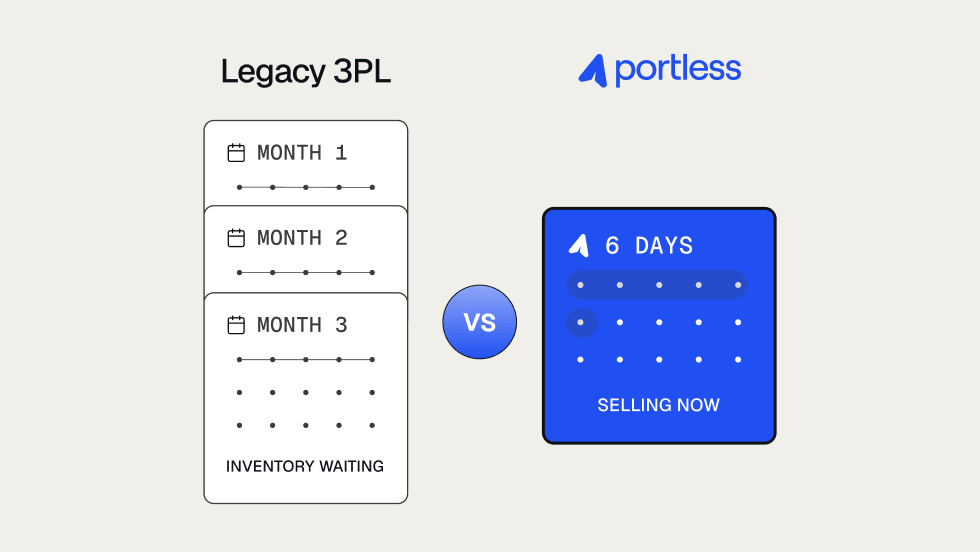
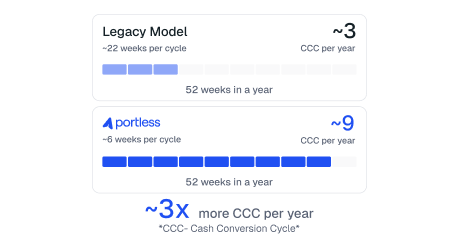
The cash flow argument for non-bonded isn't about duty deferral — it's about inventory velocity. When goods move through non-bonded facilities, they ship faster, from more airports, with less paperwork. That speed compresses the time between production and live, sellable inventory.
For brands using direct fulfillment, this means:
- Smaller initial production runs because reorder cycles are faster
- Less capital locked up in slow-moving inventory
- Faster feedback loops on new SKU performance
- Working capital freed up for marketing, product development, or expansion
The traditional model — bulk freight into a bonded or domestic warehouse, with duties paid upfront on unsold inventory — locks up capital for months. Non-bonded direct fulfillment keeps the cash conversion cycle as tight as possible.
Why Portless uses non-bonded fulfillment for most brands
Roughly 90% of brands fulfilling through Portless operate on the non-bonded model. The reason is simple: for most DTC categories — apparel, beauty, electronics, home goods — the combined savings on shipping, storage, and pick-and-pack outweigh the 13% VAT cost. We also operate bonded facilities for the 10% of brands where the math runs the other way. If you want to know which model fits your product mix, contact us and we'll run the numbers on your specific COG, order volume, and destination markets.
← Back to the Ecommerce supply chain glossary