Incoterms
Incoterms (International Commercial Terms) are a set of 11 standardized trade rules published by the International Chamber of Commerce that define which party — buyer or seller — handles shipping, insurance, customs clearance, duties, and risk at each stage of an international transaction.If you're sourcing from Asia, every purchase order you sign with a factory has an Incoterm on it. That three-letter code (FOB, EXW, DDP, CIF) decides who pays for what, when ownership transfers, and who eats the cost when something goes wrong in transit. Most DTC operators treat Incoterms as a procurement detail. They're not. They're a cash flow lever, a risk allocation tool, and the foundation of how your landed cost actually gets calculated.
If you've ever signed a supplier contract that says "FOB Shenzhen" or seen "DDP" on a freight quote and nodded along without asking what it actually obligates you to, you're not alone. Incoterms are the three-letter codes that quietly decide whether your factory or you pays for ocean freight, who's on the hook if a container gets damaged at sea, and which party clears customs on arrival. Get them wrong and you'll find out the expensive way — usually when an invoice shows up for something you assumed was covered.
Incoterms are maintained by the International Chamber of Commerce and updated roughly every decade. The current version is Incoterms 2020, which replaced Incoterms 2010. They apply to the sale of physical goods and govern three things: who arranges and pays for transport, who handles customs, and at what point risk transfers from seller to buyer.
Why Incoterms matter for DTC brands sourcing from Asia
For DTC brands manufacturing in Asia, Incoterms are the line between a clean unit economics model and a surprise cost that wrecks your landed cost calculation. Your supplier in Shenzhen or Ho Chi Minh City will quote you a price under a specific Incoterm — and that quote means very different things depending on which three letters follow it.
Under EXW (Ex Works), you're responsible for everything from the factory loading dock onward. Under FOB (Free on Board), the factory delivers to the port and handles export clearance, but you take over from there. Under DDP (Delivered Duty Paid), the seller delivers all the way to the buyer's door with duties paid — though in practice, very few overseas factories agree to act as DDP seller into the US because of the compliance and tax exposure involved.
The Incoterm you negotiate determines:
- Who pays for inland trucking from factory to port
- Who pays for ocean or air freight
- Who pays for insurance during transit
- Who handles export clearance in the origin country
- Who handles import clearance and pays duties in the destination country
- When risk of loss or damage transfers from seller to buyer
The 11 Incoterms in 2020, grouped by use case
The US International Trade Administration groups Incoterms into two categories: rules for any mode of transport, and rules specifically for sea and inland waterway transport.
Any mode of transport (7 terms)
- EXW (Ex Works): Seller makes goods available at their premises. Buyer takes on every cost and risk from that point.
- FCA (Free Carrier): Seller delivers goods to a carrier chosen by the buyer at a named location and handles export clearance.
- CPT (Carriage Paid To): Seller pays freight to a named destination. Risk transfers when goods are handed to the first carrier.
- CIP (Carriage and Insurance Paid To): Same as CPT, but the seller also pays for insurance.
- DAP (Delivered at Place): Seller delivers to a named place in the destination country. Buyer handles import clearance and duties.
- DPU (Delivered at Place Unloaded): Same as DAP, but the seller also unloads the goods at the destination.
- DDP (Delivered Duty Paid): Seller delivers to the buyer's location with all duties and taxes paid.
Sea and inland waterway only (4 terms)
- FAS (Free Alongside Ship): Seller delivers goods alongside the vessel at the named port of shipment.
- FOB (Free on Board): Seller delivers goods on board the vessel. Risk transfers once goods cross the ship's rail.
- CFR (Cost and Freight): Seller pays freight to the destination port. Risk transfers when goods are loaded.
- CIF (Cost, Insurance, and Freight): Same as CFR, but the seller also pays for insurance.
The Incoterms most DTC brands actually encounter
In practice, you'll see three Incoterms come up over and over in conversations with factories, freight forwarders, and 3PLs:
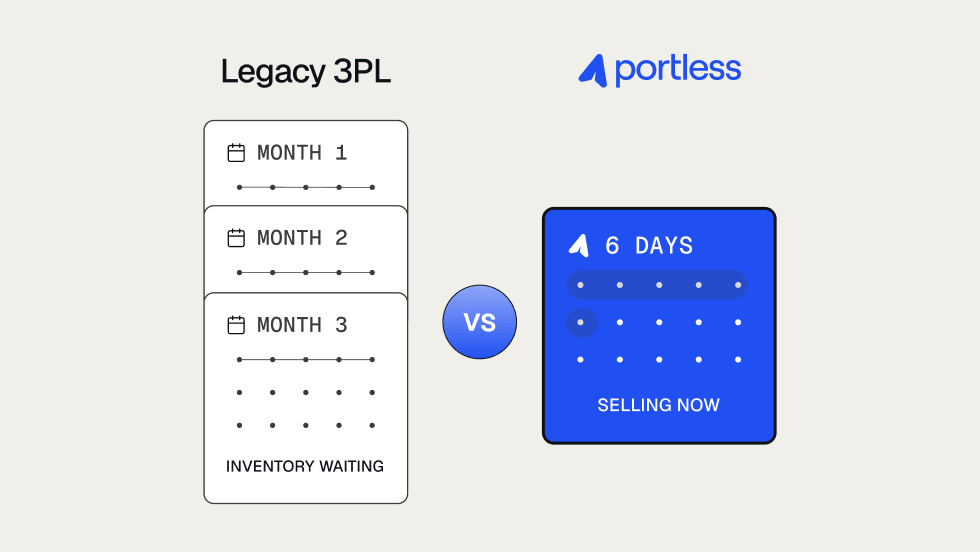
FOB is the most common for brands using legacy bulk ocean freight. Your supplier delivers to the port of origin (FOB Shenzhen, FOB Ningbo, FOB Haiphong) and handles export paperwork. You pay for ocean freight, insurance, US customs clearance, duties, and inland trucking to your warehouse. This is the foundation of the legacy supply chain model — and it's also why duties are paid in bulk before a single unit sells.
EXW shifts even more responsibility to you. The factory just makes goods available at their door. You arrange everything else, including export clearance from China. Cheaper on paper, but operationally heavier.
DDP is the cleanest model for the buyer because everything is bundled — but as noted, most overseas factories don't offer it because they aren't set up to act as US importer of record or remit duties to CBP. This is where direct fulfillment models differ. With Portless, duties are paid per parcel at the point of fulfillment using a DDP shipping experience to the end customer, matched against the order revenue, not paid upfront on a bulk container.
How Incoterms affect your landed cost and cash flow
Your landed cost — the full cost of getting a product from factory to customer — is shaped by which Incoterm you agreed to. Under FOB, your landed cost includes the FOB price plus freight, insurance, brokerage, duties, and last-mile delivery. Under DDP, those costs are bundled into one number from the seller.
The bigger issue isn't just what the costs are. It's when you pay them. Under the legacy FOB-plus-ocean-freight model, you pay duties at the port of entry before a single unit sells. That's capital deployed against unsold inventory, with no revenue offsetting it for weeks or months. When tariff rates shift between when you place the PO and when the container lands — which happened repeatedly throughout 2025 — your pricing assumptions are wrong before you can act on them.
This is the structural problem the legacy model creates and why the Incoterm you negotiate is more than a contract detail. It's a cash flow decision.
Common mistakes brands make with Incoterms
- Assuming FOB covers insurance. It doesn't. FOB only covers cost and freight to the port. Insurance is on you unless you specifically arranged it.
- Confusing DDU and DAP. DDU was retired under Incoterms 2010 and replaced by DAP. Many contracts still reference DDU, but DAP is the current term.
- Not specifying the named place precisely. "FOB China" is meaningless. It needs to be "FOB Shenzhen Yantian Port" or another named port. Vague terms create vague obligations.
- Treating Incoterms as a payment term. They're not. Incoterms govern delivery, cost allocation, and risk — not when or how the buyer pays the seller.
- Forgetting that Incoterms don't transfer title. They allocate risk and cost. Ownership transfer is a separate legal question handled in the sales contract.
How direct fulfillment changes the Incoterms conversation
The whole reason Incoterms get complicated for DTC brands is that the legacy model has so many handoffs: factory to port, port to ocean carrier, carrier to destination port, port to customs broker, broker to 3PL, 3PL to last-mile carrier. Every handoff is a place where an Incoterm has to define who's responsible.
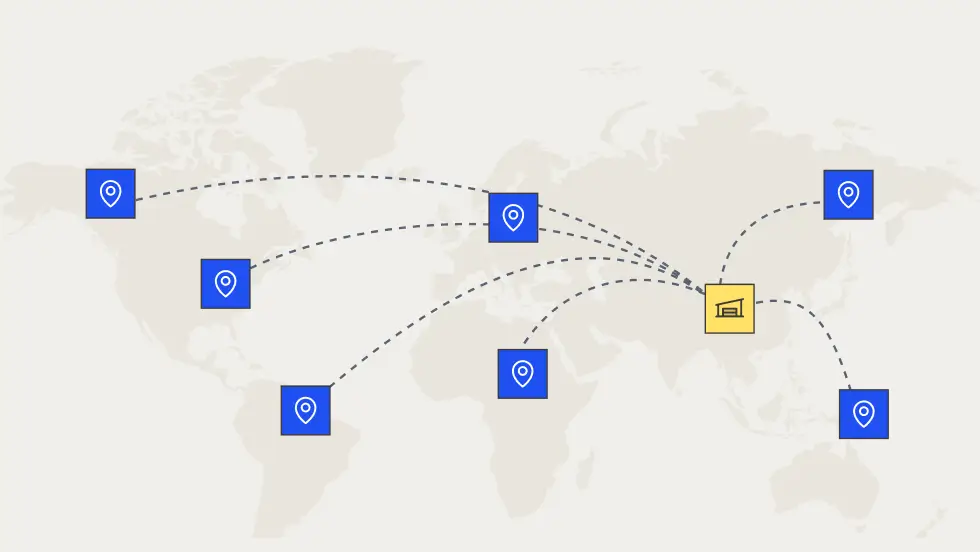
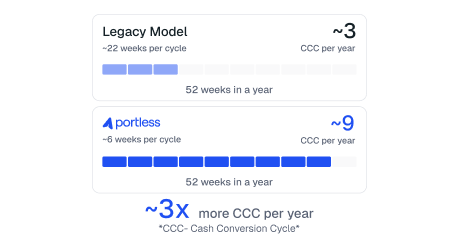
Direct fulfillment compresses that chain. With Portless, goods move from your manufacturer to a fulfillment center near the factory, then ship as individual orders directly to your customers in 85+ countries — with duties handled per parcel through a DDP model. The result is a simpler cost structure, a shorter cash conversion cycle, and far fewer of the Incoterms-related surprises that come with bulk ocean freight.
Get clarity on your true landed cost before you negotiate your next Incoterm
Incoterms decide who pays for what and when risk transfers — but they don't fix the underlying problem of paying duties on inventory that hasn't sold yet. If you want to see what your supply chain looks like when duties are paid per order instead of per container, talk to our team.
← Back to the Ecommerce supply chain glossary