Transit time
Transit time sounds simple — pickup to delivery, count the days. But in cross-border Ecommerce, it's where the legacy supply chain quietly bleeds margin. A 30-day ocean voyage looks like one line on a freight quote. In reality, it's 30 days of capital sitting in a container, 30 days where you can't respond to demand signals, and 30 days before a single unit is available to sell.
The brands that win in 2026 aren't the ones with the cheapest freight rate. They're the ones who've compressed transit time to the point where production and sales operate on the same clock.
What transit time actually measures
Transit time is the duration between a shipment leaving its origin and arriving at its destination. Depending on the leg of the supply chain you're measuring, that can mean very different things:
- Factory to port: the time it takes goods to leave production and reach the port of departure
- Port to port (or airport to airport): the international leg, by ocean or air
- Customs clearance: time spent at the port of entry before goods are released
- Last mile delivery: the final handoff from a local hub to the customer's door
A 3PL might quote you "transit time" and mean only the international leg. A carrier might mean only the last mile. The number that actually matters to your business is the full door-to-door time from factory to customer.
Ocean vs. air vs. direct fulfillment: real transit time numbers
Ocean freight is the cheapest per unit but locks capital for the longest. It also forces you to forecast demand months in advance — which means betting big on what customers will want before they've told you.
Air freight cuts the transport leg dramatically but still routes through a domestic 3PL, adding receiving, putaway, and order picking time on the back end.
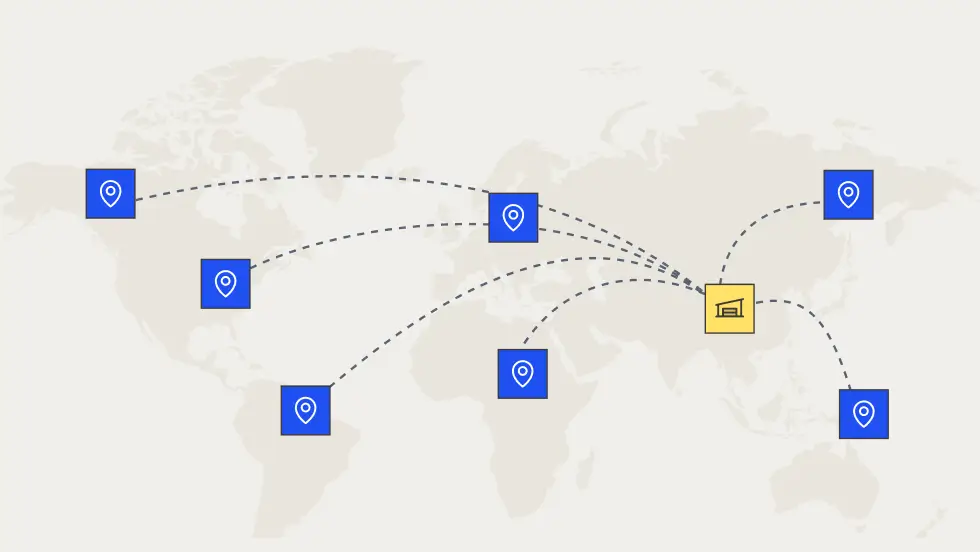
Direct fulfillment eliminates the warehousing layer entirely. Orders ship from factory-adjacent fulfillment centers in Asia directly to customers in 85+ countries. The transit clock starts when the customer places the order, not when goods land in a domestic warehouse.
Why transit time is a cash flow problem, not just a delivery problem
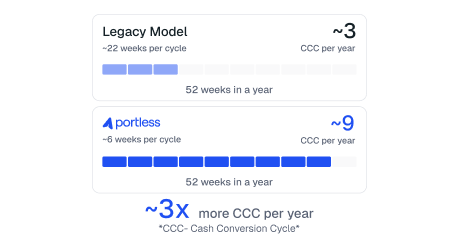
Every day of transit time is a day your capital is tied up in inventory that isn't generating revenue. This is the cash conversion cycle at work.
Consider a $50,000 inventory order:
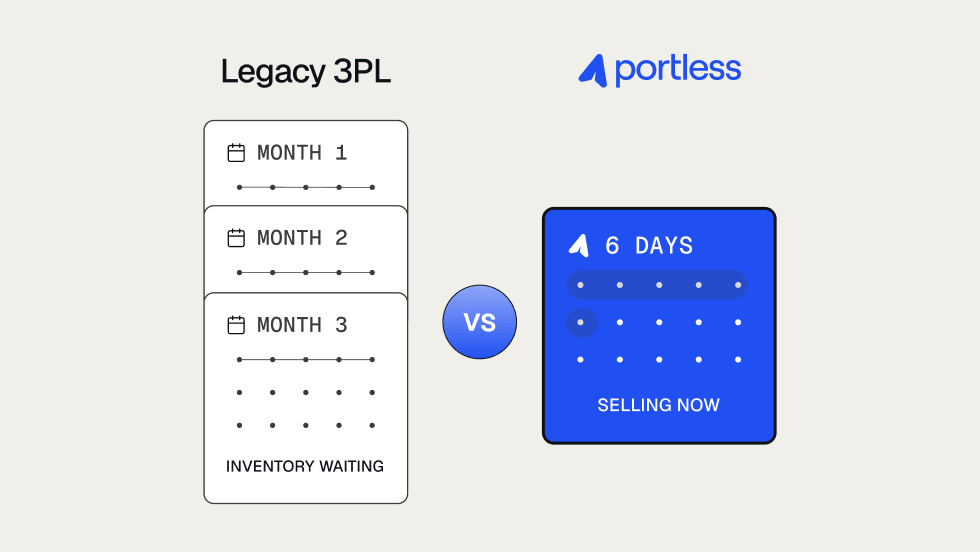
- Legacy ocean model: Day 1 you pay your supplier. Day 60-65 inventory arrives at the 3PL. Day 70 you make your first sale. Day 79 cash hits your account. Total: 79 days of locked capital.
- Direct fulfillment model: Day 1 you pay your supplier. Day 3 inventory is sale-ready at the fulfillment center. Day 5 first sales. Day 26 cash received. Total: 26 days.
On $200,000 in working capital, that's the difference between four inventory turns per year and 14. Same cash, 3.5x the throughput.
What affects transit time in practice
Transit time is rarely just a function of distance. The variables that move the number most:
- Mode of transport. Ocean, air, and rail have fundamentally different baseline speeds.
- Customs clearance. Incorrect HS codes, missing documentation, or random inspections can add days.
- Carrier handoffs. Each transfer between carriers adds processing time. Direct injection models minimize this.
- Origin and destination. Major ports clear faster than secondary ones. Urban delivery zones beat rural.
- Peak season congestion. BFCM, Chinese New Year, and pre-holiday windows compress capacity across every mode.
- Trade policy disruptions.Tariff changes, Section 321 shifts, and de minimis restrictions can stall shipments at customs.
According to CBP data, the average customs clearance time in the US is under 24 hours when documentation is complete and HS codes are accurate. When they're not, it can stretch into days.
Customer-facing transit time vs. internal transit time
There are two clocks running, and brands often confuse them:
- Internal transit time: factory to fulfillment center. This affects your inventory planning, cash flow, and forecasting risk.
- Customer-facing transit time: order placed to package delivered. This affects conversion, returns, and customer satisfaction.
Legacy 3PL models try to solve customer-facing transit time by pre-positioning massive inventory near the customer — at the cost of multi-month internal transit and locked working capital. Direct fulfillment collapses both clocks at once: factory-adjacent fulfillment means internal transit is hours, not weeks, and air injection means customer-facing transit lands in five to eight days.
How transit time interacts with returns
Faster isn't always better. Research from the Journal of Retailing found that for each day a product arrives earlier than expected, return rates rise — particularly among first-time customers, who haven't had time to mentally rationalize their purchase.
The implication: optimizing for the absolute shortest transit time can backfire. The goal is consistent, predictable delivery windows that match customer expectations — not racing to the bottom on speed.
How direct fulfillment compresses transit time without compromising cost
Portless ships from factory-adjacent fulfillment centers in Asia directly to customers in over 85 countries, with a typical five to eight day delivery window. The mechanics:
- Inventory arrives at the fulfillment center within hours of production, not weeks
- Orders are picked, packed, and routed dynamically across 20+ last-mile carriers based on real-time performance
- Same-day air freight cutoffs mean orders placed before the deadline move within hours
- Duties are handled upfront under a Delivered Duty Paid (DDP) model, removing customs delays
- Customers see domestic last-mile tracking — the experience reads as local, not international
This isn't faster shipping bolted onto the legacy model. It's a different operating system: one where transit time and inventory strategy are designed together.
Cut your transit time and free your working capital
Transit time isn't a logistics metric. It's a cash flow metric, a forecasting metric, and a customer experience metric — all measured in days you can't get back. The brands moving fastest in 2026 are the ones who've stopped treating transit time as a fixed cost of doing business and started treating it as something to engineer down.
If you manufacture in Asia and sell globally, contact us to see how direct fulfillment cuts transit time from months to days.
← Back to the Ecommerce supply chain glossary