Wholesale fulfillment
Wholesale fulfillment is the logistics process of receiving, storing, picking, packing, and shipping bulk orders from a brand or manufacturer to retailers, distributors, or other business buyers — typically palletized, routed to distribution centers, and governed by retailer compliance rules.
Wholesale fulfillment operates on a completely different rhythm than DTC. Instead of shipping one unit to one customer, you're moving cases, pallets, or full truckloads into a retailer's distribution center. The unit economics look different. The compliance burden is heavier. And the cost of getting it wrong — a missed routing window, a mislabeled pallet, a chargeback — lands directly on your margin.
For Ecommerce brands expanding from DTC into wholesale, this is often where supply chain assumptions break. The 3PL that handles your Shopify orders may not be set up for EDI-driven retailer compliance. The packaging that looks great in a customer's hands isn't built for case-pack labeling. Wholesale fulfillment is its own discipline, and understanding what it actually requires is the difference between profitable retail expansion and a quarter of chargebacks.
What wholesale fulfillment actually involves
At its core, wholesale fulfillment covers the full lifecycle of a bulk order: receiving inventory, storing it, picking and packing at case or pallet level, generating retailer-compliant shipping documents, and routing to the buyer's distribution center or store.
The operational steps include:
- Receiving large purchase orders from retailers, distributors, or marketplaces, typically via EDI (electronic data interchange) rather than a Shopify checkout
- Picking inventory in case packs or full pallets, not individual units
- Applying retailer-specific labeling, including UCC-128 shipping labels and SKU barcodes
- Generating advance ship notices (ASNs) so the retailer's DC knows what's arriving and when
- Booking freight — typically LTL (less than truckload) for partial loads or FTL (full truckload) for full ones — within the retailer's assigned routing window
- Generating a bill of lading (BOL) to document the shipment legally
Miss any of these steps, and the retailer charges you back. Major retailers like Walmart, Target, and Costco publish compliance manuals running hundreds of pages, and chargebacks for non-compliance can wipe out the margin on the order entirely.
Why wholesale fulfillment matters for DTC brands
If you're a DTC brand doing $1–15M in revenue, wholesale fulfillment usually enters the conversation in one of three scenarios:
- Retail expansion. You land a wholesale account with a specialty retailer, a regional chain, or a major like Target or Costco. Suddenly you need to ship pallets, not parcels.
- Marketplace 3P/1P transitions. Moving from Amazon FBM to vendor-direct (1P) means shipping cases to Amazon's fulfillment network on their terms, not yours.
- International distributor models. When you expand into new countries through a local distributor instead of selling DTC directly, you're shipping in bulk to their warehouse rather than to individual customers.
Each one introduces compliance risk and capital tie-up. You're now buying inventory in larger quantities, holding it longer, and exposed to retailer payment terms that can stretch 60 to 90 days — a real strain on working capital.
The compliance layer: what makes wholesale hard
The reason wholesale fulfillment is operationally heavier than DTC isn't the picking or the packing — it's the compliance. Every major retailer has its own routing guide, label specifications, ASN format, and chargeback schedule.
Common chargeback triggers include:
- Late or early delivery outside the assigned routing window
- Incorrect or missing UCC-128 labels on cases and pallets
- ASN inaccuracies — quantity mismatches, missing PO numbers, wrong ship dates
- Improper pallet configuration (stack height, overhang, shrink wrap)
- Missing or incorrect packing slips
- Wrong carton dimensions or weights vs. what's on the ASN
According to SPS Commerce data on retail compliance, chargebacks can consume 1–3% of wholesale revenue for non-compliant suppliers. On a thin-margin product, that's the difference between a profitable account and a loss-making one.
How wholesale fulfillment connects to your broader supply chain
Wholesale fulfillment doesn't exist in isolation. It interacts with every other part of your supply chain — sourcing, inventory planning, and DTC fulfillment all have to coexist.
The biggest tension: wholesale typically requires holding more inventory, in case-pack configurations, for longer periods. That conflicts with DTC's need for individual-unit flexibility and lean inventory cycles. If you're forecasting demand for both channels off the same pool of inventory, you need to think carefully about allocation, replenishment timing, and where production capital is sitting at any given moment.
This is where Ecommerce fulfillment risk compounds. A heavy wholesale commitment ties up capital in a way that's hard to reverse, especially if the retail account underperforms. Brands that scale wholesale on top of DTC without rethinking their inventory strategy often end up overstocked on case-pack configurations and understocked on the variants their direct customers actually want.
How Portless changes the math for hybrid DTC and wholesale brands
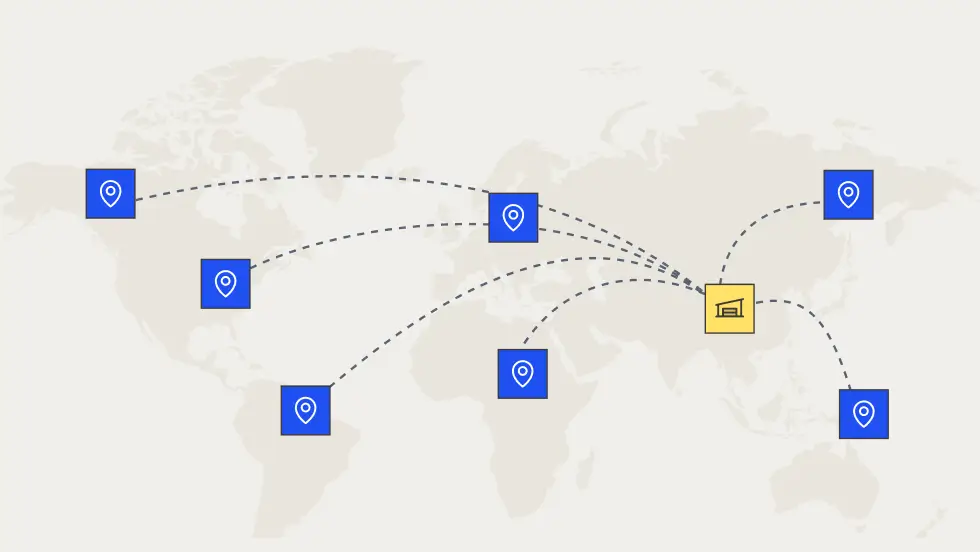
Portless is built for direct fulfillment — orders ship one-by-one from our facility near your manufacturer in Asia to customers in 85+ countries within five to eight days. That's a DTC-native model, not a wholesale one. But the way Portless changes your inventory strategy has direct implications for how you handle wholesale.
By keeping inventory upstream near production instead of pre-committing it to a domestic 3PL, you free up working capital and SKU-level flexibility. When a wholesale order comes in, you can pull from the same pool, route it to a domestic wholesale fulfillment partner, and still keep your DTC business running on lean, just-in-time replenishment. You're not forced to choose between feeding wholesale demand and feeding your DTC channel — both draw from one upstream inventory pool.
Ready to rethink how inventory flows across your channels? Contact us to see how direct fulfillment fits alongside your wholesale operations.
← Back to the Ecommerce supply chain glossary